
ASEAN needs 15 years to become a borderless economic community
SINGAPORE — A borderless economic community among the Association of Southeast Asian Nations (ASEAN) member states will not emerge for at least another 15 years, ANZ Bank said in a report yesterday, despite the good progress made in areas such as trade integration and the reduction of tariffs.
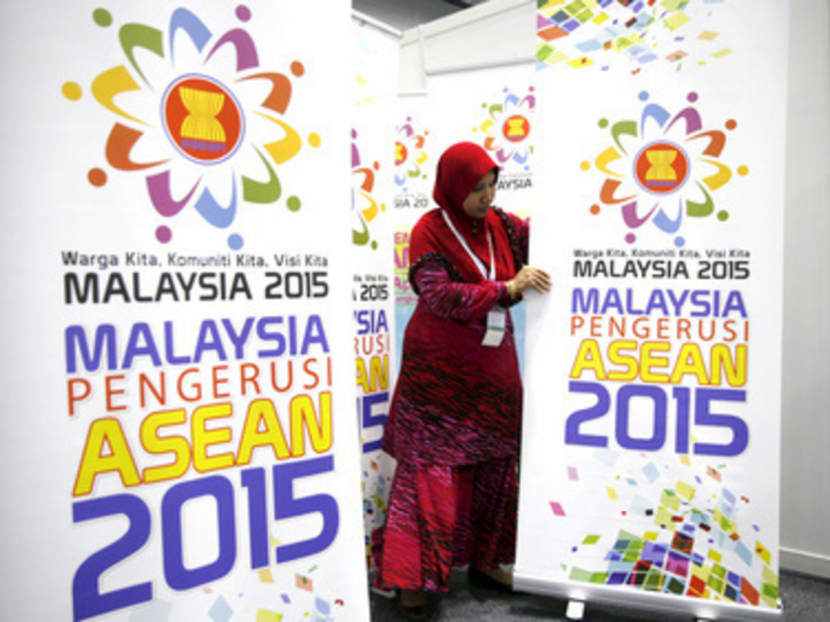
A woman setting up banners yesterday for the 26th ASEAN Summit at the Kuala Lumpur Convention Centre. ASEAN could replace China as the world’s leading manufacturing centre in the next 10 to 15 years. Photo: REUTERS
SINGAPORE — A borderless economic community among the Association of Southeast Asian Nations (ASEAN) member states will not emerge for at least another 15 years, ANZ Bank said in a report yesterday, despite the good progress made in areas such as trade integration and the reduction of tariffs.
Even then, the regional bloc is on track to become Asia’s third engine of growth alongside China and India, as well as the fifth-largest economy in the world by 2020. It could also replace China as the world’s leading manufacturing centre in the next 10 to 15 years, the report said.
“ASEAN’s potential is enormous, driven by demographics, low labour costs and its strategic position at the intersection of global trade and shipping routes. The way that the world manufacturers is changing but critically where it consumes is shifting to ASEAN,” said Mr Andrew Geczy, ANZ’s chief executive for International and Institutional Banking at the launch of the report.
“ASEAN’s leaders have recognised, however, that greater integration through the creation of a single market and production base is essential to realising the economic potential.”
But challenges such as inadequate infrastructure linkages and comparatively low levels of financial integration in the region will hinder progress. While steps have been taken to address the misalignments, progress is slow and will be gradual.
“The surge in intra-regional ASEAN trade requires banking realignment ... The ASEAN Banking Integration Framework is intended to liberalise the banking market by 2020, helping pave the way for further integration and the entry of ASEAN banks into other regional banking markets,” the report said.
The release of the ANZ report came just a day after rating agency Moody’s said that several targets for the formation of ASEAN Economic Community (AEC), such as the elimination of non-tariff barriers, enhanced labour mobility and financial integration, would not be met by the December deadline. However, Moody’s said member states could lay claim to establishing a near-complete free trade area with regard to trade in goods.
ANZ said the AEC is unlikely to develop into a fully integrated bloc, bureaucratically administered like the European Union. Instead, three sub-regions will form before the region becomes more tightly integrated.
The bank said Myanmar, Cambodia and Laos will be the main source of labour that will benefit the second group of Thailand, Vietnam, Indonesia and the Philippines, which will seek to be the most cost-effective mid-value manufacturers. The third group of Singapore, Brunei and Malaysia will be where the higher value-added activities are carried out.
“I don’t think that is necessarily a bad thing when you have these large discrepancies in development and wages ... So 10 to 15 years is where we think it will look a little more like the EU in terms of flows, but certainly not like the EU in terms of the centrally bureaucratically managed region,” said Mr Glenn Maguire, ANZ’s chief economist for South Asia, ASEAN and Pacific.
Singapore, already a full-fledged global financial hub with a robust regulatory environment, is expected to emerge as the financial capital of ASEAN. And with the absence of clear political leadership in the region, Singapore can potentially also be the de facto leader of the bloc.
“If we look at the EU, even though it had a more bureaucratic centre located in Brussels, Germany as the largest capital market became the de facto leader ... I think Singapore’s leadership of the ASEAN is likely to be two-pronged: One, it is the most successful development model; two, as the financial capital, I think it will be the de facto capital in the absence of a political capital,” said Mr Maguire.
Stay in the know. Anytime. Anywhere.

Subscribe to our newsletter for the top features, insights and must reads delivered straight to your inbox.
By clicking subscribe, I agree for my personal data to be used to send me TODAY newsletters, promotional offers and for research and analysis.






