
China inflation falls to slowest rate in 18 months
BEIJING — Consumer price inflation in China decelerated to an 18-month low last month, while the decline in factory-gate prices persisted, giving the government more scope to loosen policies if a growth slowdown in Asia’s largest economy deepens.
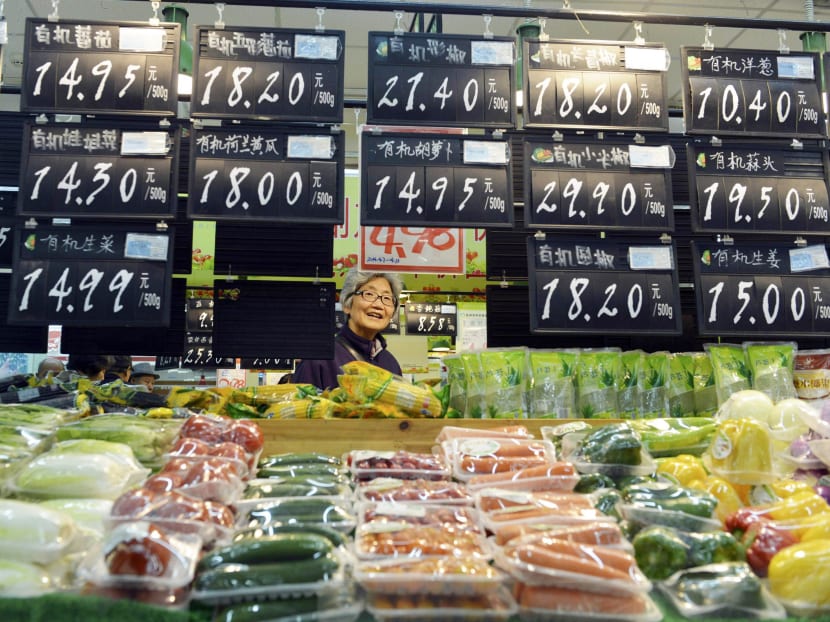
Food prices last month rose 2.3 per cent from a year earlier, the NBS said, after a 4.1 per cent gain in March. REUTERS
BEIJING — Consumer price inflation in China decelerated to an 18-month low last month, while the decline in factory-gate prices persisted, giving the government more scope to loosen policies if a growth slowdown in Asia’s largest economy deepens.
The consumer price index rose 1.8 per cent in April from the same month last year, the National Bureau of Statistics (NBS) said yesterday, below the median economists’ estimate of 2.1 per cent and the 2.4 per cent gain in March. Declining prices of vegetables and pork were the main reasons for last month’s soft reading, which is probably the lowest in the first half of the year, the NBS added.
The producer price index fell 2 per cent, the 26th straight decline, following a 2.3 per cent drop in the previous month, the NBS said. That compared with the median estimate of economists for a 1.9 per cent fall and extends the longest stretch of declines since a 31-month slide that started in 1997.
The inflation data adds to signs that domestic demand remains muted, with falling commodity prices exacerbating overcapacity in industries including steel and cement. The lack of inflationary pressure will allow the People’s Bank of China (PBOC) to relax monetary policy to support the economy if Premier Li Keqiang’s full-year growth target of about 7.5 per cent is threatened.
Mr Li, in a speech on Thursday in Nigeria, reiterated that China has the confidence and capability to achieve this year’s growth goal. Analysts surveyed by Bloomberg forecast expansion of 7.3 per cent, which would be the slowest in 24 years.
Mr Chang Jian, chief China economist with Barclays in Hong Kong, said there is downward pressure on property prices and overall inflation. If real estate prices keep falling in the second half, there will be more room for easing, including a cut in banks’ reserve-requirement ratios, he said.
Inflation has remained at least one percentage point below the government’s full-year target of 3.5 per cent every month this year. Food prices last month rose 2.3 per cent from a year earlier, the NBS said, after a 4.1 per cent gain in March. Non-food inflation was 1.6 per cent, compared with a 1.5 per cent pace the previous month.
Mr Liu Li Gang, chief Greater China economist at Australia and New Zealand Banking Group in Hong Kong, said: “We believe it is time for the PBOC to contemplate easing monetary policy further.” The risk of deflation has risen, and cutting banks’ reserve requirement ratio can help to lower the lending rates facing Chinese enterprises, he added.
The NBS will publish last month’s industrial production and retail sales and January-April fixed-asset investment data next week. A customs administration report on Thursday showed China’s exports unexpectedly rose 0.9 per cent last month from a year earlier, recovering from a 6.6 per cent fall in March, while imports increased 0.8 per cent after an 11.3 per cent drop. BLOOMBERG
Stay in the know. Anytime. Anywhere.

Subscribe to our newsletter for the top features, insights and must reads delivered straight to your inbox.
By clicking subscribe, I agree for my personal data to be used to send me TODAY newsletters, promotional offers and for research and analysis.






