
China’s PMI slips, sparking calls for policy easing
BEIJING — Growth in China’s vast factory sector cooled last month as foreign and domestic demand slowed, two surveys showed yesterday, spurring new calls for more policy easing to prevent the economy from stumbling once more.
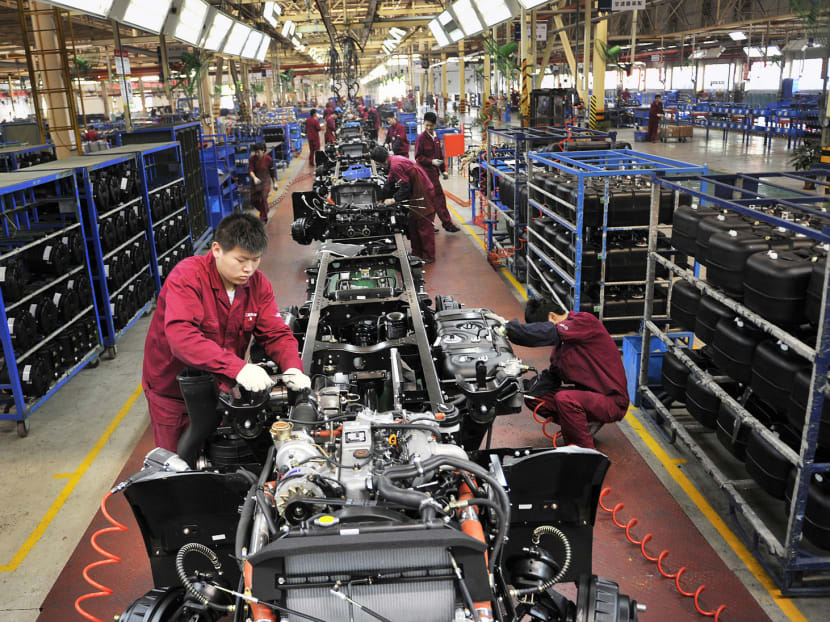
Employees working on a chassis at a truck factory in Hefei, Anhui province, in May. A pullback in manufacturing adds pressure on the Chinese government to step up efforts to meet its expansion target of 7.5 per cent this year. PHOTO: REUTERS
BEIJING — Growth in China’s vast factory sector cooled last month as foreign and domestic demand slowed, two surveys showed yesterday, spurring new calls for more policy easing to prevent the economy from stumbling once more.
HSBC’s purchasing managers index fell to 50.2 from July’s 18-month high of 51.7. An official industry group, the China Federation of Logistics and Purchasing, said its separate PMI declined to 51.1 from 51.7.
Both readings remain above the 50-point mark separating expansion from contraction.
A pullback in manufacturing, coming as the property market slumps, adds pressure on the government to step up efforts to meet its expansion target of 7.5 per cent this year.
More stimulus measures will be announced in the next few weeks, said Mr Lu Ting, Bank of America’s Hong Kong-based head of Greater China economics.
“The two PMIs show that the current recovery is relatively weak and choppy,” Mr Lu said. Stimulus may include a greater re-lending quota from the central bank and the government has “pretty firm confidence” that it will keep the economy stable, he said.
China’s economy has had a rocky spell this year. Growth sank to an 18-month low of 7.4 per cent in the first quarter before edging up to 7.5 per cent between April and June.
Hopes that the mild rebound would gain traction were dashed last month when growth in retail sales and fixed asset investment slowed, while money injected into the economy unexpectedly tumbled to a near six-year low.
Yesterday’s PMIs showed the outlook remains cloudy. A breakdown of the official PMI — which is biased towards larger, state-owned factories — showed output, employment, new orders, delivery time and raw material inventory falling across the board, with the labour market showing the most weakness.
It was the first time in six months that the official PMI had witnessed a decline. The employment sub-index, which has stayed under 50 for at least two years, slipped to a three-month low of 48.2 last month. New orders, a proxy for domestic demand, also fell to 52.5 from July’s 53.6.
The HSBC PMI also pointed to slackening demand. Firms had reported “subdued client demand” for new orders, especially for those selling investment goods, it said, adding that a number of companies had also cut spending on steel in particular.
New orders and new export orders fell to their lowest in two to three months for the HSBC PMI, with the new orders sub-index being the worse performer of the two, shedding two full points to 51.3 from July.
“The economy still faces considerable downside risks to growth in the second-half of the year, which warrants further policy easing,” said Mr Qu Hongbin, an economist at HSBC. Agencies
Stay in the know. Anytime. Anywhere.

Subscribe to our newsletter for the top features, insights and must reads delivered straight to your inbox.
By clicking subscribe, I agree for my personal data to be used to send me TODAY newsletters, promotional offers and for research and analysis.






