
NTU spin-off in S$4.3m deal to treat wastewater in China
SINGAPORE — From a university lab to a lucrative business deal: A two-year-old local start-up has clinched a S$4.3 million joint venture with a Chinese state-owned enterprise to treat industrial wastewater in the city of Qingdao, in what could be a springboard to the billion-dollar water treatment industry in Asia’s largest economy.
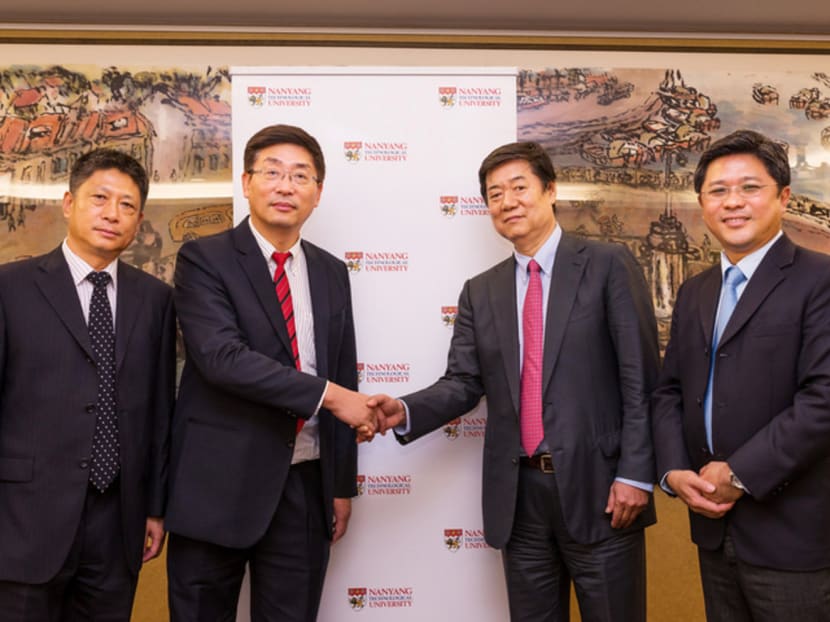
SINGAPORE — From a university lab to a lucrative business deal: A two-year-old local start-up has clinched a S$4.3 million joint venture with a Chinese state-owned enterprise to treat industrial wastewater in the city of Qingdao, in what could be a springboard to the billion-dollar water treatment industry in Asia’s largest economy.
Under the deal with the China Commerce Group for International Economic Coorperation (CCIEC), the start-up NanoSun will deploy its advanced membrane technology to treat industrial wastewater in the Qingdao National High-Tech Industrial Development Zone, a 20 sq km zone in the northern coastal province of Shandong.
NanoSun was founded in May 2013 by company chairman Darren Sun, 55, an associate professor from the Nanyang Technological University (NTU) School of Civil and Environmental Engineering, and managing director Wong Ann Chai, 47, an adjunct professor from NTU’s Nanyang Business School.
In some ways, the deal is a serendipitous turn of events for NanoSun. The company previously only conducted laboratory research and had not considered the extent of the value of the technology until meeting with CCIEC officials a year ago. CCIEC quickly saw the vast potential of NanoSun’s self-cleaning, 3D-printed membrane water filter technology in China, where rapid industrialisation is driving demand for extensive wastewater treatment.
However, the road to success has been long and arduous: Mr Sun dedicated 17 years of research into the technology before perfecting it to what it is today. The professor also created other processes during the course of his research, such as reducing the size of sludge waste in certain industries by 95 per cent through chemical engineering, thereby saving on space for disposal.
“What we will demonstrate in Qingdao will be an affordable, but effective technology that can turn polluted and industrial wastewater into a source of clean water, without the generation of secondary waste … We see great potential for our innovative made-in-NTU technology to succeed in China and beyond,” said Mr Sun, who is also the chairman of the Chemical Industries Specialty Group of the International Water Association.
CCIEC president Chen Yu said: “This is a unique weapon to maintain competitiveness … A new innovative product that I envision can create a new market and a new industry.”
“There is a huge demand from the industries to find unique technology to treat wastewater. China’s textile industry produces two billion metric tonnes of wastewater per year. This collaboration is in relation to our central government’s policies for a green economy,” he added.
Mr Chen said he chose NanoSun because of the ties he has with NTU. Mr Chen, previously the chief representative of the Qingdao city government in Singapore, had resided here for a number of years and has a close relationship with the university.
CCIEC will hold a 51 per cent stake in the joint venture and NanoSun will take up the other 49 per cent. NanoSun will supply the 3D-printed membrane technology as well as future value-added activities in QingDao, while CCIEC and its board of directors will direct strategic decisions and provide capital fund raising.
The joint venture is expected to treat about 100 million litres of wastewater in the next three to four years, with plans to expand to the rest of China and beyond.
Besides the Qingdao agreement, NanoSun has also signed other deals — with an Indonesian firm and an industrial paper mill firm in Guangzhou to provide wastewater treatment.
Stay in the know. Anytime. Anywhere.

Subscribe to our newsletter for the top features, insights and must reads delivered straight to your inbox.
By clicking subscribe, I agree for my personal data to be used to send me TODAY newsletters, promotional offers and for research and analysis.






