
China cracks down on those feting ex-president Jiang
BEIJING — Chinese authorities fretting about potentially “subversive” civil society groups — such as rights lawyers and labour activists — have a new red flag: The birthday of former president Jiang Zemin today.
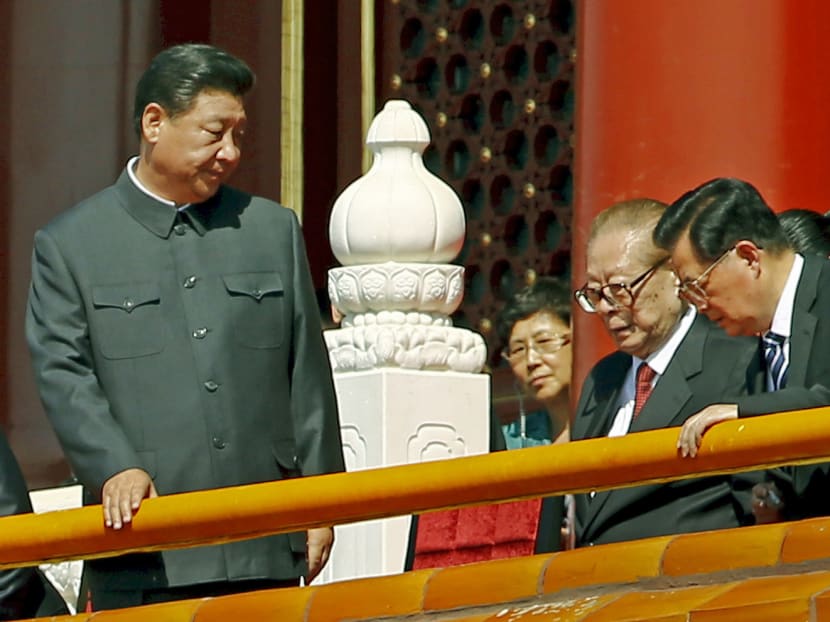
Chinese President Xi Jinping (left) with former presidents Jiang Zemin (second from right) and Hu Jintao. Mr Xi is seeking to prevent Mr Jiang and members of his clique from interfering with appointments, said an analyst. Photo: Reuters
BEIJING — Chinese authorities fretting about potentially “subversive” civil society groups — such as rights lawyers and labour activists — have a new red flag: The birthday of former president Jiang Zemin today.
“We all wanted to do something like a birthday party,” says Mr Wu Qiang, a former lecturer in politics at Beijing’s Tsinghua University.
But he and other self-styled supporters of Mr Jiang decided celebrations could be dangerous after visits from police who also warned against alluding to him online.
Although frail as he turns 90 today, the former president is regarded as a political threat by incumbent leader Xi Jinping who, ahead of a second term in office, is preparing for a large turnover of senior officials late next year.
That, together with a desire to quash nostalgia for the more liberal 1990s, has prompted the crackdown. “Xi wants to promote his own people,” says Mr Willy Lam at Hong Kong’s Chinese University. “He has pulled out all the stops to prevent Jiang and members of his clique from interfering.”
Humorous references to Mr Jiang have until now avoided many of Mr Xi’s recent curbs on intellectual life and online discourse.
Although some supporters of Mr Jiang are too young to remember his 14 years in office beginning in 1989, when Mr Jiang emerged as the compromise choice of tough leader after the Tiananmen Square massacre, attention has focused on his unscripted outbursts.
One clip shows him confronting some Hong Kong journalists whose questions had annoyed him. In a mish-mash of Mandarin, Cantonese and English, he chastised them as “too young, too simple (and) sometimes naive”.
“I became a supporter when I saw (that clip),” said Mr Wang Chuchu, a student at Fudan university in Shanghai. “I loved it.”
“A lot of people miss Jiang’s time,” says Mr Hong Zhenkuai, an older intellectual who remembers the period well. “Judging from China’s recent history, there were a lot of positives when he was in power.”
With his acerbic but popular premier, Mr Zhu Rongji, Mr Jiang oversaw reforms paving the way for China’s entry into the World Trade Organisation and emergence as a global economic power. Liberals also recall relative freedom for bolder state newspapers.
“We clearly can’t criticise the present, so we celebrate the past,” admits Kris Liu, a pop culture blogger. “Everyone naturally expects our newer leaders to be better than the past leaders, but we haven’t seen much of an improvement.” FINANCIAL TIMES
Stay in the know. Anytime. Anywhere.

Subscribe to our newsletter for the top features, insights and must reads delivered straight to your inbox.
By clicking subscribe, I agree for my personal data to be used to send me TODAY newsletters, promotional offers and for research and analysis.






