
Inside China’s 23-day detention of an NGO chief
CHIANG MAI — Mr Peter Dahlin, a Swedish citizen, was detained and interrogated for 23 days this year by China’s Ministry of State Security, a powerful spy and counterespionage agency. The authorities showed him on national television apologising for unspecified crimes. Then they deported him.
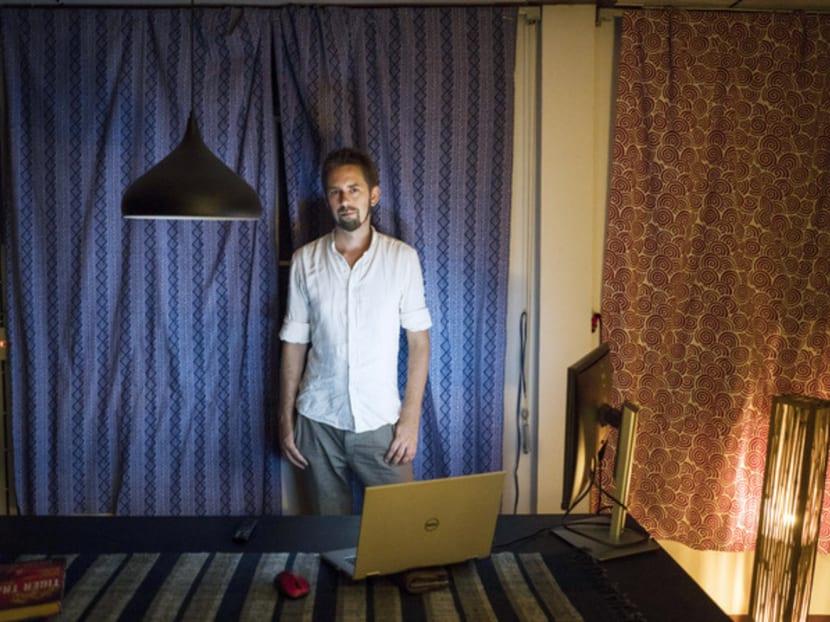
Peter Dahlin, a Swedish citizen who was detained, interrogated for 23 days by China’s powerful Ministry of State Security, and then deported, at his new home in Chiang Mai, Thailand, May 13, 2016. Photo: The New York Times
CHIANG MAI — Mr Peter Dahlin, a Swedish citizen, was detained and interrogated for 23 days this year by China’s Ministry of State Security, a powerful spy and counterespionage agency. The authorities showed him on national television apologising for unspecified crimes. Then they deported him.
His ordeal, which he described for the first time in an interview with The New York Times, offers an unusually clear view into the suspicion directed toward foreign non-governmental organisations (NGOs) by Chinese security, and the lengths to which it goes to police such groups.
President Xi Jinping has warned that Western non-governmental organisations dedicated to building civil society — through training for lawyers and journalists and programmes to address income inequality, for example — are working to undermine Communist Party rule. He has overseen a broad effort to both restrict Western influence as well as to clamp down on grassroots Chinese activism.
In April, the government passed a law requiring all foreign non-governmental groups in China — about 7,000 by one estimate — to find an official Chinese sponsor and register with the police, who will have new supervisory authority over them.
Mr Dahlin’s relatively obscure Chinese Urgent Action Working Group, which he helped found in 2009 to promote the development of an independent judiciary in China, is exactly the type of organisation that Mr Xi is trying to stifle.
After Mr Dahlin’s expulsion, The New York Times tracked him down in northern Thailand, where he was trying to make a fresh start. The authorities have used televised confessions with growing frequency to intimidate foreigners and their Chinese colleagues, and few have dared speak publicly about the experience afterward.
But Mr Dahlin, 36, who had studied political science and worked in government in Sweden, agreed to an interview after concluding that his Chinese friends would not face retaliation.
Mr Dahlin said he and a Chinese lawyer, Wang Quanzheng, had established their organisation in Hong Kong as a private business, because there were no regulations for registering foreign non-governmental organisations in mainland China before the new law was adopted. They employed about 15 to 20 people, most of them part-time and all of them local Chinese except for Mr Dahlin and an American.
The group quietly held seminars for lawyers and others interested in suing officials and agencies, and it offered crisis legal aid. It specialised in China’s freedom-of-information statutes and ran a training programme for investigative journalists.
Mr Dahlin knew the security apparatus was watching the organisation, he said. But he said the scrutiny intensified in 2013, soon after Mr Xi took office. Then came a broad crackdown on activist lawyers last year. Several who had worked with Mr Dahlin’s group were arrested, including Mr Wang, who had already left the organisation. Security officers had surveillance photographs of Chinese citizens arriving for a training session the group held last year in southern Thailand, said Mr Dahlin.
Mr Dahlin was detained on Jan 3, just hours before he planned to leave the country to renew his visa. More than a dozen officers showed up at his home in an alleyway in Beijing with warrants for him and his girlfriend, Ms Pan Jinling, a Chinese citizen.
They seized computers, phones, hard drives, bank cards, receipts, a safe with about 175,000 yuan (S$35,200) in cash, and medicine that Mr Dahlin takes daily for a rare adrenal disease. They rushed him to an unmarked detention centre near an airport. All the rooms were padded.
Mr Dahlin said he was questioned daily, usually in a single session lasting for hours at night, when he was tired. The interrogations took place in a separate room with a desk and glaring lights.
The officers did not beat him, he said, but tried different tactics to pressure him. Early on, they tried to deprive him of sleep, keeping the fluorescent lights on in his cell at night. Mr Dahlin told a woman running the centre that this amounted to torture under the Geneva Conventions, and the practice soon stopped.
The officers also mentioned or showed Mr Dahlin the names of almost every lawyer in China who had worked with his group, as well as recent emails exchanged by the group’s employees.
Despite such access, the officers appeared to have a “limited understanding of how NGOs operate, how international funding operates, how you transfer funds, what’s the project plan”, said Mr Dahlin. “They’re basically trying to understand this field so they can counter it.”
After two weeks in custody, said Mr Dahlin, he was told to sit in front of a camera and face a reporter for China Central Television, the state broadcaster. Both were ordered to read from a script.
“When I saw the questions and answers, it became even more clear that, OK, this is part of a PR campaign. This is going to be on CCTV,” he said. “I’m going to be a star.”
Mr Dahlin said he had agreed to cooperate because the authorities already signalled they would deport him, and he wanted to expedite that process and get Ms Pan released.
In less than an hour, Mr Dahlin said that his group had acted illegally and that he had stolen money. He also said he had “hurt the feelings of the Chinese people”. But he refused to label three associates as “criminals” as the officers had demanded.
CCTV broadcast the confession the night of Jan. 19. Two days later, Mr Dahlin was told that he was being granted a medical parole and would be sent home. The day of his deportation, the Foreign Ministry said that Mr Dahlin was suspected of “funding criminal activities harmful to China’s national security”. Ms Pan was released the same day.
“I think the era for effecting change in China seems to be over for now for NGOs,” he said. “It seems for now that the scope of civil society to try to influence is getting smaller and smaller.” THE NEW YORK TIMES
Stay in the know. Anytime. Anywhere.

Subscribe to our newsletter for the top features, insights and must reads delivered straight to your inbox.
By clicking subscribe, I agree for my personal data to be used to send me TODAY newsletters, promotional offers and for research and analysis.






