
People’s Daily blasts Li Ka-shing for Chinese divestment
BEIJING — The People’s Daily, the official newspaper of the Chinese Communist Party, has slammed Asia’s richest man for divesting some of his assets in China, describing his actions as immoral, ungrateful and ultimately self-defeating.
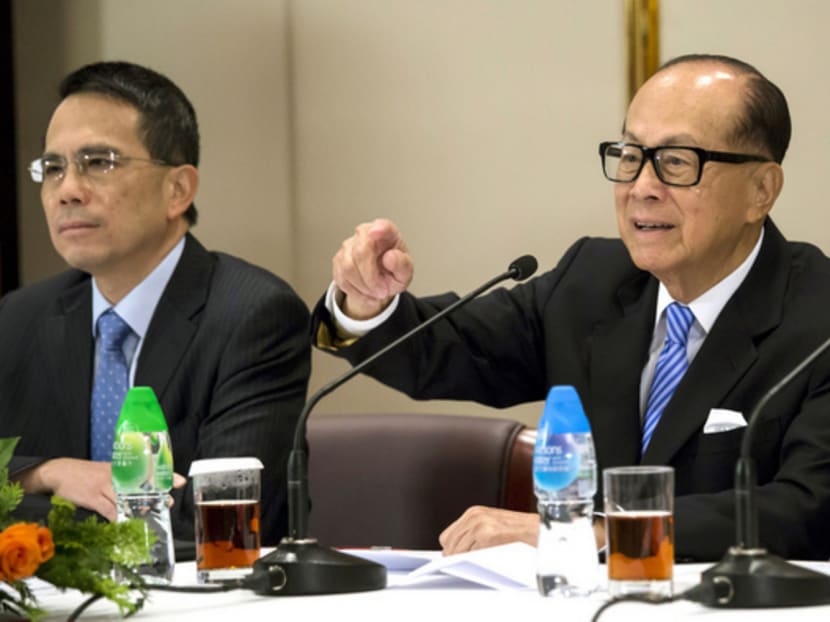
Mr Li Ka-shing’s business moves suggest he is pessimistic about China’s economic growth, which has slowed to its weakest pace in 25 years. Photo: Reuters
BEIJING — The People’s Daily, the official newspaper of the Chinese Communist Party, has slammed Asia’s richest man for divesting some of his assets in China, describing his actions as immoral, ungrateful and ultimately self-defeating.
Mr Li Ka-shing, the 87-year-old Hong Kong property, telecoms and port tycoon, who is worth nearly US$33 billion (S$45 billion), has been alternately lambasted and defended in Chinese media and the Internet in recent weeks for a series of deals that reoriented his business empire away from greater China and towards Europe.
“Concerning the controversy over (Mr Li’s) divestments from the mainland, the war of words continues: Is it a normal business operation or an act of immoral misconduct? A legal adjustment or a helpless evacuation?” the newspaper asked in an editorial posted on Chinese social media.
“Li Ka-shing’s choices do appear particularly brazen. In the eyes of ordinary people we shared comfort and prosperity together in the good times but when the hard times come he abandons us — this has really left some people speechless.”
The article questioned Mr Li’s patriotism and said he would ultimately be the biggest loser as China’s economy continues to grow in the future.
It is a sharp turn of events for a man known in Hong Kong as “superman” because of his investing prowess and whose rise from an impoverished 15-year-old plastics salesman to Asia’s richest man has long been a source of pride and inspiration in China.
But the newspaper, which is often used to present the party’s official line, also rejected calls for the government to block Mr Li’s sales of prime real estate and other assets in China.
“Li Ka-shing has earned money in the mainland and even if it is morally legitimate to stop him from moving his capital out now because of special privileges he received in the past, it is not logical and not in accordance with the spirit of rule by law,” the paper said.
The editorial appeared to be partly intended as a defensive move by the party in response to the wave of vitriolic debate that has spread across the internet after a government-affiliated think-tank published an even more incendiary article attacking Mr Li a week ago.
Many of his critics have accused the pro-Beijing tycoon of earning his fortune through connections to top officials, who they say gave him access to prime land in central locations, often at hugely discounted prices.
Mr Li has long been a defender of Communist Party rule in the mainland and in Hong Kong, where he spends most of his time, and he is known to have been particularly close to former president Jiang Zemin.
Mr Li could not be reached for comment through a spokesperson on Monday.
Many on the Chinese Internet have interpreted his business moves as a sign of pessimism as the country’s economic growth has slowed to its weakest pace in 25 years and is struggling under a mountain of debt.
For several years, Mr Li has been selling assets in greater China and shifting his business empire towards Europe, where he owns ports, retail operations, real estate, rail and telecoms assets.
This year he bought British telecom giant O2 from Spain’s Telefonica, having earlier acquired the United Kingdom’s Eversholt Rail Group.
At the same time, Chinese media estimate his companies have divested about 100 billion yuan (S$22 billion) of assets in mainland China and Hong Kong in just the past three years.
At the start of this year, Mr Li announced plans to restructure his companies in a series of complicated transactions that left virtually all of his empire domiciled in the Caribbean instead of Hong Kong. FINANCIAL TIMES
Stay in the know. Anytime. Anywhere.

Subscribe to our newsletter for the top features, insights and must reads delivered straight to your inbox.
By clicking subscribe, I agree for my personal data to be used to send me TODAY newsletters, promotional offers and for research and analysis.






