
India launches first mission to Mars
NEW DELHI — India’s first Mars orbiter yesterday successfully began a 400-million-km-long journey to Mars, making it the first Asian country and the fourth in the world to undertake a mission to the red planet.
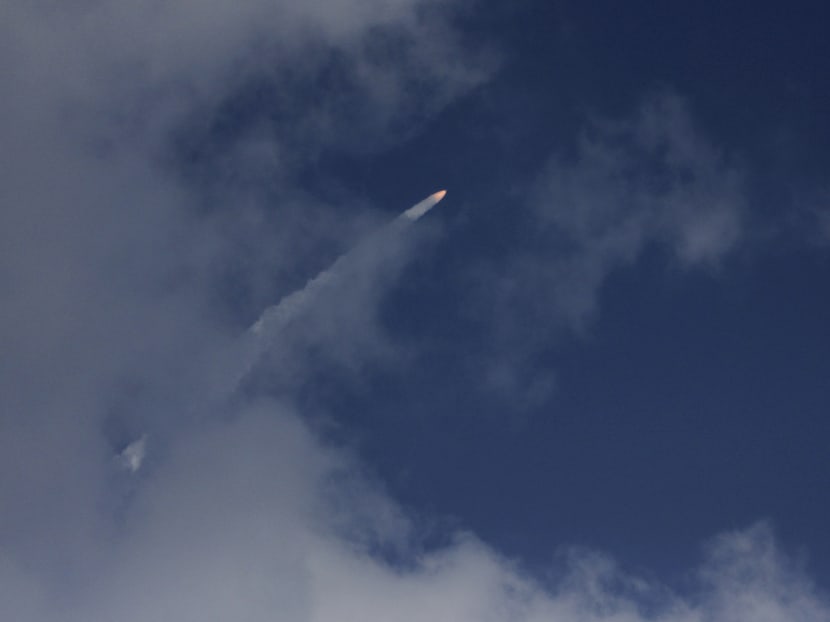
A rocket carrying the Mars orbiter streaks across the sky after taking off from the east-coast island of Sriharikota, India, Tuesday, Nov 5, 2013. Photo: AP
NEW DELHI — India’s first Mars orbiter yesterday successfully began a 400-million-km-long journey to Mars, making it the first Asian country and the fourth in the world to undertake a mission to the red planet.
Hundreds of people watched the rocket carrying the spacecraft take off from the east-coast island of Sriharikota and streak across the sky. Many more across the country watched live television broadcasts provided by the Indian Space Research Organisation.
The 1,350kg Mangalyaan orbiter was headed first into an elliptical orbit around Earth, after which a series of technical manoeuvres and short burns will raise its orbit before it slingshots towards Mars.
Mangalyaan, which means Mars craft in Hindi, must travel 780 million kilometres over 300 days to reach an orbit around the red planet next September. “The biggest challenge will be precisely navigating the spacecraft to Mars,” said Mr K Radhakrishnan, Chairman of the Indian space agency. “We will know if we pass our examination on Sept 24, 2014.”
Setting off to Mars is a demonstration of India’s technological capabilities and an attempt to join the United States, Russia and the European Union in successful interplanetary exploration before space rivals China and Japan.
In recent years, Japan, China and India — in cooperation with the US National Aeronautics and Space Administration (NASA) — have put satellites into lunar orbit. China has also taken the lead, putting its first woman astronaut into space as it strives towards goals such as establishing a manned space station.
But efforts by Asian nations to reach Mars have failed after successful launches. China’s 2011 attempt with Russia to send the Yinghuo-1 satellite to Mars failed after the Russian rocket carrying it was unable to leave Earth’s orbit. A Japanese 2003 mission to Mars was unable to place a satellite into Martian orbit.
While few officials will admit it, there is a race for “space-related power and prestige” in Asia and India is concerned about China’s rise, according to Professor James Moltz from the Naval Postgraduate School in California.
The Indian mission will cost US$73 million (S$90.7 million), far less than comparable voyages including NASA’s US$671 million Maven satellite that is expected to set off for Mars later this month.
Dr Ram Jakhu, a professor from the Institute of Air and Space Law at McGill University in Canada, said the space contest between India, China and Japan was different from the US-Soviet race, because “to some extent it’s about a rush for natural resources”.
If India were to locate a major deposit of titanium, for instance, during future missions, it would be a boost to the economy, he said. “India and China want to be major world players and feed their huge populations so they need natural resources.”
India’s launch came on the same day that China offered a rare glimpse into its secretive space programme for an upcoming mission. Shanghai Aerospace Systems Engineering Research Institute displayed a model of a lunar rover, which will explore the moon’s surface early next month, at the International Industry Fair in Shanghai.
Stay in the know. Anytime. Anywhere.

Subscribe to our newsletter for the top features, insights and must reads delivered straight to your inbox.
By clicking subscribe, I agree for my personal data to be used to send me TODAY newsletters, promotional offers and for research and analysis.






