
India should play bigger role in South China Sea: Ng Eng Hen
SINGAPORE — Singapore says it wants India to play a bigger role in the South China Sea as China hastens land reclamation in the disputed waters that carry some of the world’s busiest shipping lanes.
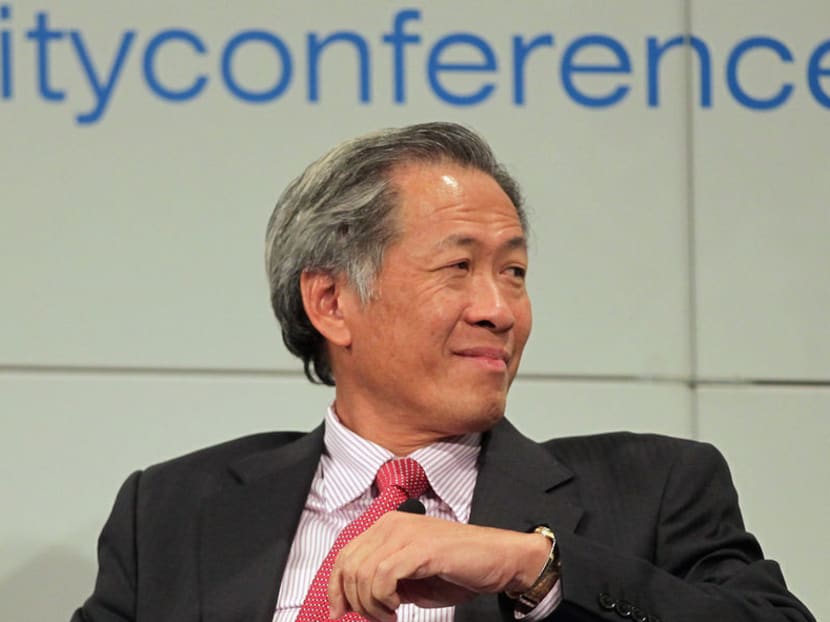
Singapore Minister for Defence Ng Eng Hen. Photo: Bloomberg

SINGAPORE — Singapore says it wants India to play a bigger role in the South China Sea as China hastens land reclamation in the disputed waters that carry some of the world’s busiest shipping lanes.
Singapore has been a strong supporter of India’s increased engagement in the region through security forums, Defence Minister Ng Eng Hen said in an interview yesterday (March 16) after a meeting with South-east Asian counterparts in Langkawi, an island in Malaysia. The group declared its commitment to the principle of no first use of force, he said.
“We hope that their presence and participation will increase – that really adds up to engagement and confidence building and mutual understanding” Dr Ng said, referring to Asia’s third-biggest economy. “India is a big country and it’s an influential country.”
India’s involvement in the region could give South-east Asian nations a further buffer against China as that country seeks to enforce its claims to the majority of the South China Sea and push back against decades of US military dominance in the Pacific. China is also looking to build a maritime trade route linking a network of ports through the Indian Ocean with Europe via the Suez Canal, a prospect that has unnerved India.
Dr Ng’s comments follow calls for Japan to separately play an enhanced role in the South China Sea. Vice-Admiral Robert Thomas, commander of the Navy’s Seventh Fleet, said in January the US would welcome an extension of Japan’s air surveillance into the area, while Defence Minister Gen Nakatani said last month that Japan would consider conducting air and sea patrols. Japan and China are separately embroiled in a territorial dispute in the East China Sea.
NINE-DASH LINE
China says it’s entitled to about four-fifths of the South China Sea, based on a nine-dash line drawn on a 1940s map that loops down like a cow’s tongue to a point about 1,800km south from China’s Hainan island. The area overlaps claims from Vietnam, Malaysia, the Philippines, Brunei and Taiwan.
South-east Asian nations are worried about China building multi-storey mall-like structures on the Cuarteron and Gaven reefs, Philippine Defence spokesman Peter Paul Galvez told reporters in Manila last week. The Philippines is relying on diplomatic protests and arbitration to address China’s “blatant disregard” of a 2002 non-binding declaration of conduct in the waters, he said.
China has reclaimed land around Fiery Cross Reef to create an island large enough to enable its first airstrip in the Spratly Islands, IHS Jane’s reported Nov 20, citing satellite pictures. The Spratlys are a collection of more than 100 islands or reefs that dot the southern South China Sea.
EXPLAIN ACTIONS
China will have to explain its actions and how they comply with the 2002 agreement, Dr Ng said. The declaration between China and the Association of South-east Asian Nations calls on parties to refrain from “inhabiting on the presently uninhabited islands, reefs, shoals, cays and other features”.
China has every right to carry out construction on its territory and won’t accept criticism from others about its “legal and reasonable” work, Foreign Minister Wang Yi said on March 8. “We are not comparable to some countries that like to build illegal houses on others’ territory.”
The US has urged China to stop reclaiming land, while the Philippines and China have frequently traded accusations over their territorial claims and encounters between fishing and military vessels.
PROJECTING POWER
“The reclaimed features will enable China to station warships, coast guard vessels and aircraft on a permanent basis in the Spratlys, thus enabling it to project and sustain its military and paramilitary assets far further south than it had previously been able to do so,” said Dr Ian Storey, senior fellow at the Institute of South-east Asian Studies in Singapore.
Greater Indian involvement in the South China Sea would risk raising tensions with China and complicate its efforts to assert control of the Indian Ocean, waters that carry most of the world’s oil trade. Prime Minister Narendra Modi is starting to bulk up his naval forces to assert control in the waters and prevent China from establishing a military foothold.
India last month increased its defence budget by 11 per cent to US$40 billion (S$56 billion) and approved the building of six nuclear-powered submarines, triple what it currently has in service, as well as seven new frigates. Mr Modi is concerned that China wants to expand its military presence in the region by establishing naval bases in Indian Ocean ports, a theory first expounded by US consultant Booz Allen Hamilton in a 2005 report for Defence Secretary Donald Rumsfeld.
OIL IMPORTS
China argues that its interests are purely economic, and that it wants to protect vital sea lines of communications that bring it energy supplies from the Middle East. 40 per cent of its oil imports pass through the Straits of Hormuz, and that figure doubles to more than 80 per cent in the Malacca Strait on the other side of the Indian Ocean.
“We’ve said so to our Indian counterparts, we feel that we benefit from their presence, from their voice, and we’ll continue to take that line,” said Dr Ng. “How they respond to their own interpretation of events in the Indian Ocean is up to them.”
During the meeting, the defence ministers noted the threat posed by the Islamic State group and its growing influence across the globe, Malaysian Defence Minister Hussein Hishammuddin said in a statement yesterday. The ministers agreed that collaboration to tackle the threat should include the sharing of intelligence, he said. BLOOMBERG
CLARIFICATION FROM MINDEF:
The article was based on an interview conducted after the ASEAN Defence Ministers Meeting (ADMM) where Minister Ng had expressed hope for greater Indian participation in this region, in the context of ADMM-plus with eight other countries. He said “We have always taken the view that India is an important partner and that’s why it was included in the Plus-8 partners. We, Singapore, have been a very strong proponent for India’s inclusion into the Plus-8 as well as its push for their greater engagement ...”
Minister Ng’s responses are consistent with the framework of ADMM-plus as an inclusive regional security architecture, of which India is a member. Minister did not make any comments on disputes in the South China Sea. Singapore is not a claimant state and takes no sides in this issue. The comments about India as a counter-weight to China and its role in the context of South China Sea disputes were added by the reporter.
Stay in the know. Anytime. Anywhere.

Subscribe to our newsletter for the top features, insights and must reads delivered straight to your inbox.
By clicking subscribe, I agree for my personal data to be used to send me TODAY newsletters, promotional offers and for research and analysis.






