
Myths about the Indian elections
The convincing victory of Bharatiya Janata Party (BJP) in the recent Indian general election came as a surprise to many. Most opinion polls, which had predicted a victory for BJP and the National Democratic Alliance (NDA) that it leads, had not anticipated the scale of the party’s victory. BJP won 282 seats and the NDA 336 out of 543 seats in the Lok Sabha (Lower House).
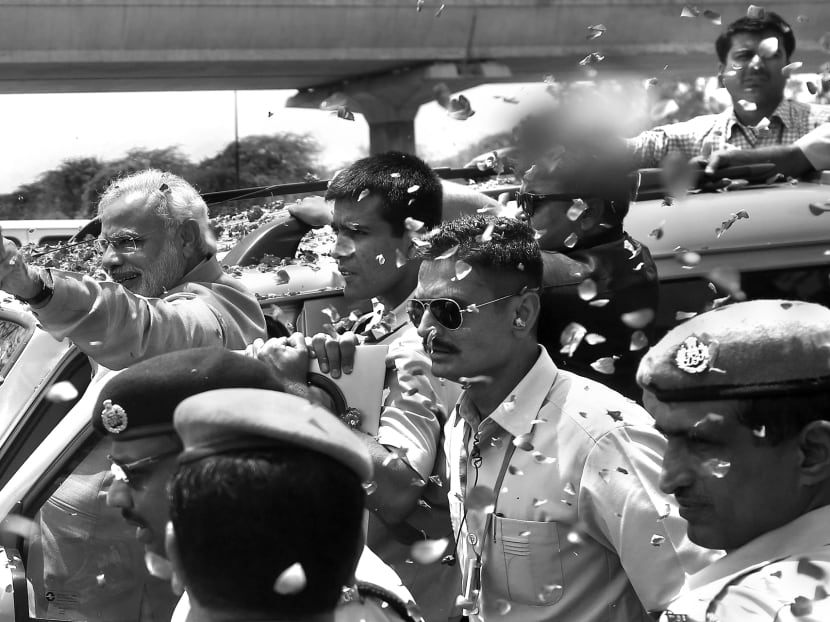
Prime-Minister-designate Narendra Modi from the Bharatiya Janata Party (BJP), acknowledging his supporters during a road show in Delhi a day after the results of the elections were announced. BJP and its allies won 336 seats out of 543 in the Lower House of Parliament. Photo: REUTERS

The convincing victory of Bharatiya Janata Party (BJP) in the recent Indian general election came as a surprise to many. Most opinion polls, which had predicted a victory for BJP and the National Democratic Alliance (NDA) that it leads, had not anticipated the scale of the party’s victory. BJP won 282 seats and the NDA 336 out of 543 seats in the Lok Sabha (Lower House).
This is the first time in 30 years that a party has won a majority on its own. This is also the worst showing by India’s grand old party, the Indian National Congress, which won a mere 44 seats, 70 less than its previous all-time low in 1999. But some of the grand narratives about the uniqueness of the result do not stand up to scrutiny.
BJP DID NOT DO AS WELL AS TOUTED
The election numbers argue against sweeping generalisations. It is now fairly well known that in this election, BJP on its own won only 31 per cent of the vote. This is the lowest vote share for a single-party majority in the Lok Sabha, much lower than the 41 per cent polled by Congress in 1967, when it won 283 seats. But the first-past-the-post system, coupled with the fragmentation of the anti-BJP vote in many constituencies, resulted in an extraordinarily high vote-to-seat conversion for BJP in 2014.
Political scientist Louise Tillin has calculated that BJP won 1.67 seats for every 1 per cent of the vote share. Congress won about 19 per cent of the votes, a little more than what BJP had won in 2009. However, Congress ended up with far fewer seats than BJP’s seat tally of 116 in 2009.
The reason for this was Congress’ ratio of only 0.42 seats for every 1 per cent of the vote share. This means that BJP and Prime-Minister-designate Narendra Modi did not sweep the elections in the way it is being made out to be. It also means that, although Congress performed extremely poorly, it has not been wiped out.
There are several other generalisations doing the rounds. One is that this election could spell the end of the coalition era that has been in place in India since the 1990s. While BJP has a clear majority on its own this time, the regional parties have held their own. The combined vote share of the regional parties this year is just under 50 per cent. This includes parties that tied up either with Congress or BJP to fight the elections.
Even if one leaves aside the coalition partners of the two national parties, the rest of the parties, including the All India Anna Dravida Munnetra Kazhagam and the All India Trinamool Congress that swept Tamil Nadu and West Bengal, respectively, still won a considerable 39 per cent of the votes.
RELIGION AND CASTE MATTER
Another point being made is that the election has made identity politics, particularly caste and religion, redundant. Although there are no numbers yet to back this, two facts are being put forward to support this thesis.
First, caste-based parties such as the Bahujan Samaj Party (BSP) and the Samajwadi Party (SP) in Uttar Pradesh, as well as the Rashtriya Janata Dal (RJD) and the Janata Dal (United) (JD(U)) in Bihar, did very badly.
Second, BJP’s excellent performance in India’s largest state, Uttar Pradesh, where Muslims make up 18 per cent of the population, means that Muslims are not averse to BJP.
Both propositions do not hold up. Surveys have shown that while identity might rank low on the voters’ list of priorities, people still show a positive bias in favour of one’s own caste when it comes to voting.
The low number of seats won by BSP and SP do not reflect their vote share in Uttar Pradesh. This is particularly stark for BSP, which won nearly 20 per cent of the vote but no seats. SP won 22 per cent of the vote share and secured only five seats.
Interestingly, in 2009 SP won only 1 per cent more of the vote share, but ended up with 23 seats. Similarly, RJD and JD(U) in Bihar won a combined vote share of 36 per cent, much higher than BJP’s 29 per cent in the state.
What hurt these parties is the ability of BJP to attract lower-caste voters who have in recent times been voting for the regional parties. Indeed, in the most recent elections, BJP successfully played the caste card by playing up Mr Modi’s lower-caste origins.
On religion, there is little evidence to suggest that Muslims voted for BJP. In fact, the Muslim vote seems to have been split between the anti-BJP parties in constituencies where it could have made a difference. Conversely, there was a Hindu consolidation behind BJP in some areas, which meant that religious identity trumped caste.
Finally, there are some who argued that the 2014 election decisively swung mass opinion in favour of free markets over socialist policies. Again, there is no clear evidence on that count. While it is true that Mr Modi emphasised development and governance, there is no support for the contention that Indian voters want the state to play a smaller role. On the contrary, given the hype around Mr Modi, voters have sky-high expectations of the newly-elected government.
BJP’s victory was remarkable. But it seems many commentators are reading too much into it.
ABOUT THE AUTHOR:
Ronojoy Sen is senior research fellow at the Institute of South Asian Studies and Asia Research Institute, National University of Singapore.
Stay in the know. Anytime. Anywhere.

Subscribe to our newsletter for the top features, insights and must reads delivered straight to your inbox.
By clicking subscribe, I agree for my personal data to be used to send me TODAY newsletters, promotional offers and for research and analysis.






