
Ahok’s sentence gives Islamic hardliners a boost
The North Jakarta District Court’s decision to sentence outgoing ethnic Chinese-Christian Jakarta Governor Basuki Tjahaja Purnama (also known as Ahok) to two years in jail for blasphemy against Islam has heightened concerns about the growing influence of hardline Islamist groups in Indonesia.
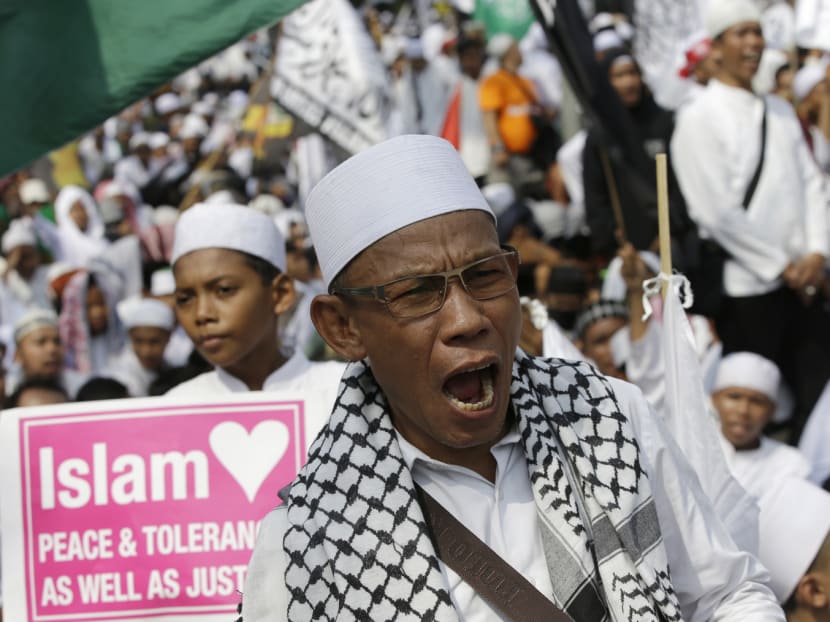
Protesters shouting slogans against Jakarta’s Christian Governor Basuki ‘Ahok’ Tjahaja Purnama in Jakarta on May 5. The two-year sentence handed down to Ahok for blasphemy against Islam has heightened concerns about the growing influence of hardline Islamist groups in Indonesia. Photo: AP

The North Jakarta District Court’s decision to sentence outgoing ethnic Chinese-Christian Jakarta Governor Basuki Tjahaja Purnama (also known as Ahok) to two years in jail for blasphemy against Islam has heightened concerns about the growing influence of hardline Islamist groups in Indonesia.
The sentence marks a stunning turn in what has been a highly controversial blasphemy trial that began in October last year, after a video emerged of Purnama commenting on those who use the Al-Maidah 51 verse of the Quran as basis for not voting for a non-Muslim leader.
What was particularly shocking was the fact that the panel of five judges had imposed a sentence that far exceeded the one-year probation prosecutors had recommended, and that the judges had cited a firebrand Islamist as a Quranic authority.
During sentencing, as the judges dissected the Al-Maidah verse, they endorsed the interpretation of Mr Rizieq Shihab , the controversial leader of the Islamic Defenders’ Front (FPI), who argued that the verse forbids Muslims from voting for non-Muslims.
The court also dismissed suggestions that the case has been politicised, although most observers think otherwise.
For one, the massive street protests led by hardline Muslim groups such as FPI demanding a heavy punishment — and even death — for Purnama had put intense pressure on the court proceedings.
Conservative politicians and hardline Muslim leaders further polarised the landscape with the potent line that a vote for Purnama in the Jakarta gubernatorial election in April was a vote against Islam.
The entire blasphemy allegation, investigation, prosecution and trial against Purnama had been marred with irregularities from the beginning.
There were important procedures such as the issuing of official notices that were bypassed for the sake of expediting the case.
The trial continued during the Jakarta gubernatorial campaign despite appeals for it to be postponed until after the election for the sake of maintaining a fair election and civic peace.
It is possible that the verdict was intended to appease conservative Muslim factions. However, any hope of ever appeasing Islamic hardliners is unrealistic, with anti-Ahok protesters already complaining that the sentence was not harsh enough.
If anything, the outcome of Purnama’s trial has lent even more legitimacy to the demands and narratives of Islamic hardliners.
The Jakarta Governor is under police custody pending his appeal against the sentence. The appeal will be heard behind closed doors. This could mean less public scrutiny and pressure on the judges.
More optimistic observers have suggested that perhaps somewhere along the long appeal process, Purnama might be handed a lighter sentence, although it is very unlikely that his conviction will be overturned.
The legal implications of Purnama’s incarceration before the appeal process starts is unclear.
The most likely scenario is that he will soon be officially dismissed from his post as Governor, thus disabling him from serving the rest of his term, which expires in October.
The sentence also guarantees that Purnama could not be appointed to other governmental posts or run for other public office anytime soon.
Having said that, anyone who thinks that this is the end of his political career would be mistaken.
The guilty verdict only served to increase his martyr status in the eyes of his supporters, and Purnama is now an even bigger symbol of struggle for Indonesia’s liberals and progressives.
Immediately after sentencing, thousands of his supporters turned up at Jakarta city hall and at Cipinang prison where he is jailed to hold a candlelight vigil and show their support.
This is not to mention the outpouring of support expressed on social media.
Many hail him as “Indonesia’s Nelson Mandela” in the face of perceived injustice amid a worrying trend of rising Islamic conservatism.
Purnama’s blasphemy case sets a dangerous precedent for the future of religious tolerance, freedom of speech and the rights of minorities in Indonesia.
Ultimately, the problem lies in the existence of Indonesia’s blasphemy law itself. His trial shows that Indonesia’s blasphemy law could easily be manipulated for political means and be used as a tool of intimidation, particularly for religious minorities.
Since 2005, there have been at least 106 cases of blasphemy prosecution in Indonesia, almost all of them in prosecution of members of a religious minority, and all of them resulting in a guilty verdict.
On the eve of Purnama’s sentencing, the Indonesian government moved to ban Hizbut Tahrir Indonesia, one of the hardline Islamic groups behind the massive anti-Ahok protests.
The move can be seen as an attempt by President Joko “Jokowi” Widodo’s government to curb the increasing power and influence of radical Islamist groups, especially in the wake of their recent efforts to provoke trouble in the capital.
While many in Indonesia support the ban, others label it as undemocratic, and there are also worries that such a move would provoke Islamic hardliners and strengthen their resolve.
However, if President Widodo is serious about combating religious extremism and defending the rights of minorities, then his government must, first of all, repeal legal mechanisms like the blasphemy law that have so far enabled the prosecution of those from religious minorities like Purnama.
ABOUT THE AUTHOR:
Charlotte Setijadi is visiting fellow in the Indonesia Studies Programme, Iseas-Yusof Ishak Institute.
Stay in the know. Anytime. Anywhere.

Subscribe to our newsletter for the top features, insights and must reads delivered straight to your inbox.
By clicking subscribe, I agree for my personal data to be used to send me TODAY newsletters, promotional offers and for research and analysis.






