
How to pitch unpopular policies
During the recent General Election campaign, Manpower Minister Lim Swee Say said it is not good enough to know how to solve problems.
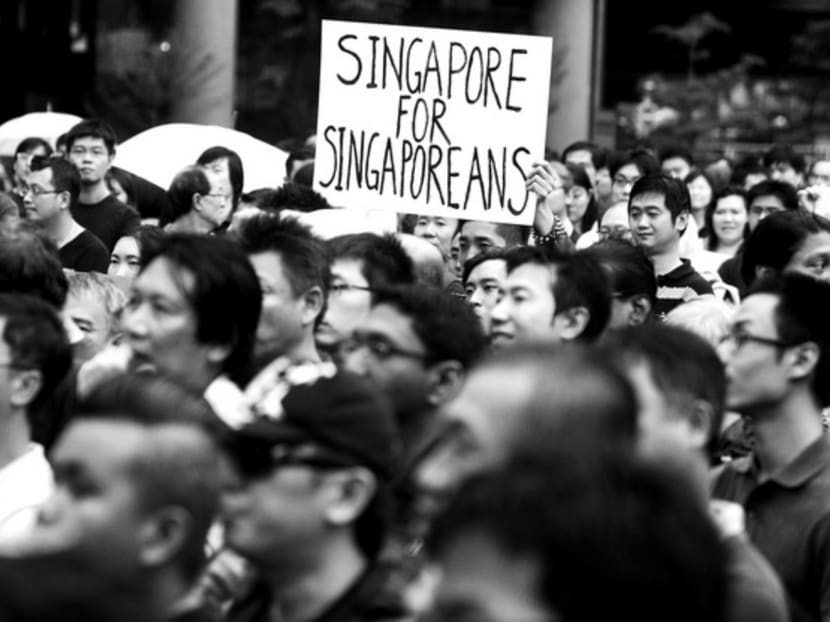
The ‘Say NO to 6.9 million population’ protest at Speakers’ Corner in 2013. Government policies on foreign talent and population projections, the CPF, the move to bring in casinos, the F1 race and even the call for Singaporeans to have more babies continue to attract public criticisms. TODAY File Photo

During the recent General Election campaign, Manpower Minister Lim Swee Say said it is not good enough to know how to solve problems.
“More importantly, we must make sure that people understand,” said Mr Lim during the People’s Action Party’s (PAP) introduction of candidates for East Coast Group Representation Constituency and Fengshan Single Member Constituency.
Newly-minted Finance Minister Heng Swee Keat, too, had earlier pointed out that the Government needed to do more in “communication of policy and in connecting with our people”.
Clearly, communications is a focus of the Government, as it is important to pitch policies that will be understood and in turn, well-received, by citizens. Otherwise, no matter how good a policy is, it remains lost in translation.
One might trace this emphasis on communication to the previous General Election in 2011. Then, the ruling PAP government, which scored its poorest showing because of unhappiness over issues such as immigration and housing, had pledged to relook its policies and improve its communications with the populace.
It subsequently appointed a former senior editor with The Straits Times, Mr Janadas Devan, in the new position of Chief of Government Communications in 2012, and appears to have widened the scope of outreach mechanisms.
Videos in dialect, for instance, have been created to explain policies such as the Pioneer Generation Package (PGP) and MediShield Life, while ambassadors have been going door-to-door to explain the PGP to elderly residents.
But despite such efforts to communicate, many other government policies — while well-meaning — continue to attract criticisms.
Take, for instance, policies on foreign talent and population projections, the Central Provident Fund (CPF), the move to bring in casinos, the Formula One (F1) race, and even the call for Singaporeans to have more babies.
Oft-heard gripes, rightly or wrongly, include allegations of foreigners taking away jobs from citizens and adding to the squeeze in Singapore; casinos eroding values; the F1 race causing traffic congestion and lost revenue for businesses near the race track; money being locked in the CPF; and the lack of finances and other resources to have more children. The list goes on.
Government policies affect livelihoods and citizens are understandably more focused on the short-term pain rather than the longer-term gains that affect Singapore’s survival.
But this also means negative perceptions of certain initiatives are difficult to change.
MAKING BENEFITS TANGIBLE
As the Government seeks to communicate better and clearer, some factors need to be addressed as it is often challenging for the average citizen to see things from the perspective of policymakers.
The reasons usually boil down to either a lack of easily digestible information, a lack of motivation because of self-interest, distrust towards the Government — or the benefits are too indirect or intangible.
Take the F1 race, for example, where the Government has taken the effort to highlight hefty gains in tourism receipts and worldwide television audiences.
Despite this, the race has continued to attract the same complaints, such as of traffic snarls, when those big headline numbers were lost on individuals.
Similarly, even though the Government has sought to convince Singaporeans of the need for foreign talent, concerns over immigration policies persist despite the recent tightening of the flow of foreigners into Singapore.
The idea of benefits cascading to citizens in the longer term can be hard to grasp, and it may be time to further examine how to explain the intent of policies in tangible terms, to help the layman understand the bigger picture.
On matters related to revenue and taxes, for instance, clearer explanations of how the initiatives are hypothecated — in other words, how specific revenue is linked to an expenditure or policy — could help.
When an individual knows how exactly his “pain”, or revenue from unpopular policies, has been channelled to other initiatives such as the Enhanced Baby Bonus and PGP, or even how such funds have staved off a hike in Goods and Services Tax and built infrastructure, connecting the dots between short-term inconveniences and the bigger picture will become much easier.
That said, the long-term benefits of certain government initiatives are indeed more challenging to express in tangible terms, such as the immigration policy, which is aimed at boosting the population because of low birth rates and an ageing workforce.
Using this as an example, a closer analysis of data could be required, so as to provide concrete numbers that show, perhaps, that more Singaporeans are being employed as a result of business expansion arising from the hiring of foreign talent. It would also help to highlight more real life instances that illustrate such contributions.
No doubt, it will take effort to summarise such information in a format that the layman understands, but big data analytics and graphs could be useful in making the associations.
Similarly, there is room to profile companies that have hired top foreign talent who in turn trained locals to fill senior positions. Microsoft Singapore has many Singaporeans in its senior management, while IBM Singapore is helmed by an NUS Business School graduate, Ms Janet Ang.
Again, hard numbers on such companies and the average length of such transitions will demonstrate the benefits of such inflow of top foreign talent and allay fears of local displacement.
It is impossible to please everyone and there will always be detractors, and good communication needs to be backed by sound policies. But there is room to make explanations more tangible, so that more people appreciate the motivations behind the policies.
ABOUT THE AUTHORS:
The writers are from the National University of Singapore Business School. Christopher Chong is senior communications manager, while Lee Yih Hwai and Leonard Lee are Associate Professors of Marketing.
Stay in the know. Anytime. Anywhere.

Subscribe to our newsletter for the top features, insights and must reads delivered straight to your inbox.
By clicking subscribe, I agree for my personal data to be used to send me TODAY newsletters, promotional offers and for research and analysis.