
Reading the tea leaves of Taiwan’s political Mona Lisa
For centuries, Leonardo da Vinci’s Mona Lisa has puzzled countless observers from French emperors to Sigmund Freud with her enigmatic smile. Each year, some six million visitors are attracted to the Louvre museum in Paris by her arresting smile and identity.
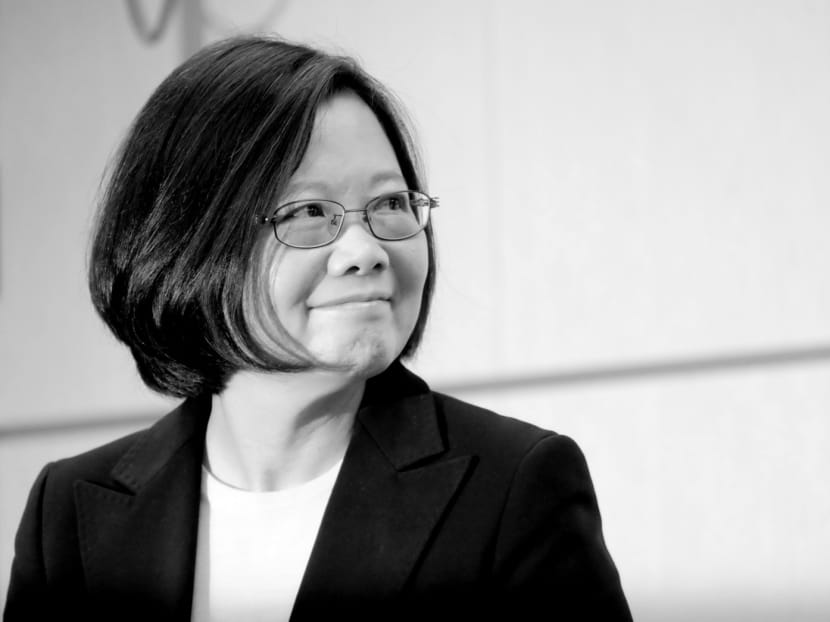
Beijing is suspicious of Taiwan’s incoming President, Ms Tsai Ing-wen, for good reason. The scholar-turned-politician masterminded the caricature of cross-strait ties as ‘a special state-to-state relations’, which enraged Beijing because of its assumption of Taiwan as an independent state with peer status. Photo: AFP

For centuries, Leonardo da Vinci’s Mona Lisa has puzzled countless observers from French emperors to Sigmund Freud with her enigmatic smile. Each year, some six million visitors are attracted to the Louvre museum in Paris by her arresting smile and identity.
When Taiwan’s former Vice-President Annette Lu branded incoming president Tsai Ing-wen “a political Mona Lisa” for the latter’s perplexing China policy, the term stuck.
Ms Tsai often carries a half-smile and her pledge of maintaining the delicate and often confusing “status quo” with China is as enigmatic as Mona Lisa’s smile.
As Ms Tsai’s inauguration date of May 20 approaches, the world is trying to decipher how the leader of the Democratic Progressive Party (DPP) will frame cross-strait relations. After all, countries adjust their own policies towards Taiwan based on perceived national interests. How her administration handles the 1992 Consensus, a term of creative ambiguity that facilitated cross-strait peace for the past eight years, could be the first piece of puzzle.
In 1992, both Taipei and Beijing had “unofficial” representatives meet in Hong Kong and agreed to disagree on the meaning of China. In Beijing’s understanding, the soul of the 1992 Consensus is “one China”; in Taipei’s comprehension, it means “One China with respective interpretation”.
Beijing, whose “China Dream” has included an eventual reunification with the self-ruled island, is suspicious of Ms Tsai, for good reason.
The scholar-turned-politician masterminded ex-President Lee Teng-hui’s caricature of cross-strait ties as “a special state-to-state relations” when she served as a law professor and legal advisor for Mr Lee’s Cabinet. The new rendition enraged Beijing because of its assumption of Taiwan as an independent state with peer status.
Heading the ministerial-level Mainland Affairs Council (MAC) under the Chen Shui-bian administration at the turn of the millennium, Ms Tsai was behind Mr Chen’s provocative political initiatives, including the “one state on each side of the Strait” declaration. She was also described by some in Taiwan and Washington as a true believer in the Taiwan independence movement.
Since her failed bid at the 2012 presidential election, she has moderated her stance, favouring a pragmatic “status quo as defined by Washington” on her campaign trail. In Taiwan’s deeply divided society, it was an ambiguous but safe statement for all sides.
For the past eight years, cross-strait ties under President Ma Ying-jeou have seen great improvement. Mr Ma adopted the “qinmei, hezhong, youri” (literally, cosy to the United States, peaceful with Mainland China and friendly with Japan), a sensible approach designed to maximise Taiwan’s geopolitical and geo-economic interests.
The tenuous cross-strait balance has been kept with the 1992 Consensus, which Beijing sees as a bedrock of cross-strait peace and cooperation. Yet Ms Tsai has refused to commit to either the spirit (one China) or the wording. Last month, Beijing fired a warning shot across the bow by re-establishing diplomatic ties with The Gambia after a two-year stasis.
To reward Mr Ma’s recognition of one China (with respective interpretations from Taipei’s perspective), Beijing had refrained from undermining Taiwan ties with its few diplomatic allies. This was why when The Gambia unilaterally severed ties with Taipei in 2013, Beijing did not respond by establishing ties with Banjul, indicating the Chinese preference for keeping ties with Taipei on an even keel so long as the latter maintains the one China framework.
That calculation has changed following Ms Tsai’s election, with China concerned that the new DPP administration would abandon Mr Ma’s policy. It is perhaps no coincidence that Beijing’s resumption of diplomatic ties with The Gambia came on March 17, at the mid-point between the January 16 election and the May 20 inauguration.
Should Ms Tsai take a hardline stance on the 1992 Consensus, we are likely to see a return of the diplomatic contest for allies, which was a routine during the Chen Shui-bian era.
Four other INDICATORS
In addition to her inaugural speech, Beijing will also be carefully watching other factors. Professor Xu Bodong, the founding dean of Beijing Union University’s Taiwan Research Institute, offered four additional indices to interpret Ms Tsai’s policy.
Prof Xu’s first indicator: The new president’s appointees in the MAC and Taiwan’s semi-official Strait Exchange Foundation (SEF), which are major points of contact in cross-strait official dealings.
Under President Ma, ministers pushing for economic integration headed the two institutions. If independence-leaning figures hold these positions, cross-strait exchanges could vacillate. Veteran diplomat Katharine Chang Hsiao Yueh was recently appointed to lead the MAC.
The next indicator concerns Ms Tsai’s Minister of Education. For Beijing, the educational policy is not only a matter of Taiwan’s internal affairs, but also constitutes a vital indicator on whether the Tsai administration recognises the “one China framework” present in the existing ROC constitutional system. As such, who heads Taiwan’s Department of Education is important.
Taiwan, since Lee Teng-hui, has inculcated a so-called Concentric Circles View of History (tongxinyuan shiguan), a Taiwan-centric instead of the traditional China-centric views of history. The pro-Japan new views were introduced by Dr Tu Cheng-sheng, a historian-turned-politician who served as Minister of Education during Mr Chen’s second term.
Beijing fears that “maintaining status quo” could become a mere pretext to destabilising the legacy established by Mr Ma, who held an unprecedented summit with Chinese president Xi Jinping last November in Singapore. A new minister who preaches the “one country on each side of the strait” position would be unacceptable to China.
Prof Xu’s third indicator is the yet-to-be-legislated draft law of the Cross-Strait Agreement Supervisory Act (CSASA). It was supposed to make bilateral negotiations and agreements more publicly accountable; in reality, the CSASA has become a lightning rod that triggered the Sunflower Student Movement in 2014.
Since it was sworn-in in mid-February, the DPP-led Legislative Yuan has set aside the controversial draft law to avoid tensions between the Cabinet and the legislature. The CSASA did not make to the list of 27 priority Bills, partly because of objection by the more radical pro-independence New Power Party (NPP) to the phrase “Cross-Strait” in the name of the Bill.
The NPP, which grew out of the Sunflower protests, advocates for Taiwan independence, having publicly stated that it would insist on a two-state version of the CSASA.
The DPP, on the other hand, has moved towards the middle to honour Ms Tsai’s pledge of maintaining the status quo. The party-endorsed version reversed course by deleting the country-to-country wording in its draft version.
If the Bill is adopted without suggestion of Taiwan’s political sovereignty, it could be viewed as an olive branch to Beijing. It is equally likely that the NPP would oppose it, causing a rift in Ms Tsai’s support base. The NPP, an ideological ally of the DPP, was a boost while the latter was in opposition. It could turn into an omen for a ruling DPP.
Ms Tsai’s policy on disputed islands in the East and South China Seas constitutes Prof Xu’s last and most significant indicator.
On the surface, both China and Taiwan have made claims that could be viewed as clashing with US and Japanese strategic and territorial aspirations. Taiwan’s insistence of sovereignty in the seas could boost Beijing’s claims.
In reality, the two have minor but significant differences.
Will Ms Tsai follow Mr Ma’s lead in defending Taiwan’s sovereignty over Itu Aba and other disputed islets? Or will she forsake Taiwan’s decades-long policy to gain political benefit, as some have anticipated?
In the past, pro-independence advocates proposed abandoning these claims to improve their chances of gaining diplomatic support from neighbouring countries in South-east Asia. Months before the January election, a Texas-based think-tank published an article forecasting that a DPP-led Taiwan could renounce its claims at the US’ behest in exchange for Taiwan’s membership in the US-led Trans-Pacific Partnership trade alliance.
From Prof Xu’s perspective, Beijing views Taiwan’s actions in the East and South China Seas as of utmost importance to the core interests of China. In a recent meeting with Mr Ma, Ms Tsai publicly denied that her administration would give up Taiwan’s territorial claims in the South China Sea.
Whether Prof Xu’s points are indeed Beijing’s yardsticks on Ms Tsai’s cross-strait policy is up to debate.
But unlike da Vinci’s painting, a politician in a democracy cannot maintain the Mona Lisa’s enigmatic style for long. Ms Tsai’s inauguration next month will reveal most, if not all of her initial policies. She shoulders the responsibility of meeting the hopes of millions of her people who expect her to maintain cross-strait peace and Taiwan’s prosperity.
ABOUT THE AUTHOR:
Dr Chunjuan Nancy Wei teaches courses in the Master of Arts in East Asian & Pacific Rim Studies at the University of Bridgeport. She has published on the South China Sea disputes, and cross-Taiwan Strait politics in such journals as the Harvard Asia Quarterly, Yale Journal of International Affairs, and The Diplomat.
Stay in the know. Anytime. Anywhere.

Subscribe to our newsletter for the top features, insights and must reads delivered straight to your inbox.
By clicking subscribe, I agree for my personal data to be used to send me TODAY newsletters, promotional offers and for research and analysis.






