
There’s something about quarks ...
SINGAPORE — Quarks, currently held to be the most basic constituents of atoms, might not be true elementary particles.
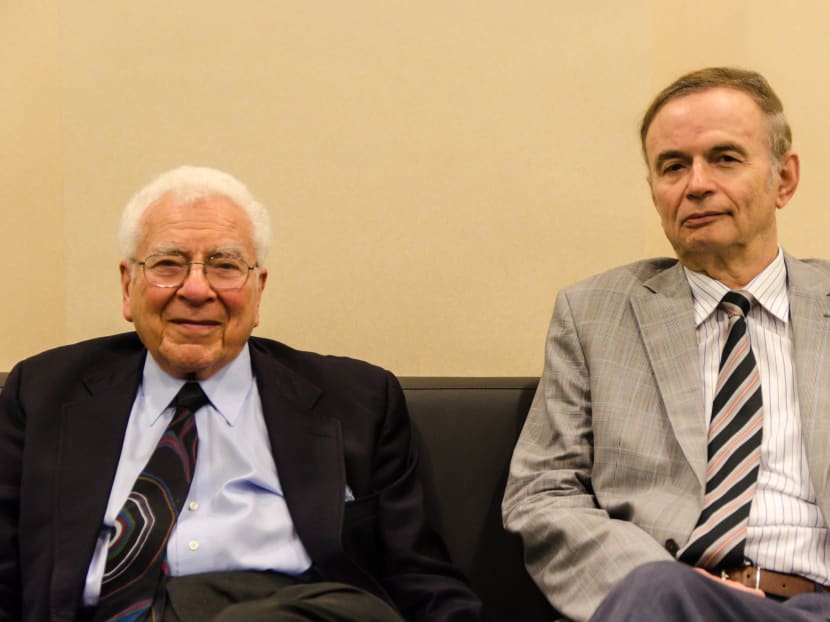
Father of quarks Professor Murray Gell-Mann (left) and Professor Harald Fritzsch. Photo: NTU
SINGAPORE — Quarks, currently held to be the most basic constituents of atoms, might not be true elementary particles.
“We can’t rule (the existence of sub-quark particles) out, but we can say there’s no evidence of it,” said the man known as the father of quarks, Nobel Laureate in Physics Professor Murray Gell-Mann. “There’s no particular reason for believing in it, but who knows?”
Speaking at The Story of Quarks, a talk conducted on Tuesday at the National University of Singapore, Prof Gell-Mann, together with Professor Harald Fritzsch of the Ludwig Maximilian University of Munich, introduced quarks and their properties. The talk was organised by Nanyang Technological University’s Institute of Advanced Studies and the National Research Foundation.
Some people find quarks unusual, and for good reason. Neutrons and protons — the particles recognised in classical thought as the basic unit of atoms before they were usurped by quarks — are each made up of three quarks. Each quark carries a fraction of a proton’s electric charge.
Quarks come in six different varieties that have quirky names — up, down, charm, top, bottom and strange.
It is not hard to see that the neutron, the proton and other such states are composed of quarks, but for those who are not convinced, there are three prohibitions to embracing the idea of quarks, according to Prof Gell-Mann.
“One, believing that neutrons and protons are the elementary particles; two, believing charges to be integral instead of fractional; three, believing that elementary particles can’t be trapped within neutrons and protons.” One must let go of classical ideas of physics to understand quark theory, added Prof Gell-Mann.
On the future direction of physics, Prof Gell-Mann said: “The holy grail of physics is to find the theory that unifies all interactions (between particles), including gravitation. The search for this unifying theory would be a very important future direction for physics. It also needs to be combined with further work on the evolution of the universe … We’ll see how it works out. It’s a very exciting hunt, the hunt for further unification.”
Prof Gell-Mann and Prof Fritzsch also discussed their thoughts on the teaching of science and physics.
“There are many things that learning science can accomplish, and we should not neglect any of them,” said Prof Gell-Mann. “One thing is to lay the groundwork for application, but understanding the fundamentals and the basic laws is an important part of education as well, because really serious students are curious, and pure science is driven by curiosity.”
On the purpose of education, he said: “Is (education) just a utilitarian occupation? We’d like to think that’s not the case, that to some extent, it’s utilitarian and to some extent, it’s about being an educated person.”
The current teaching of physics can always be improved, according to Prof Fritzsch. “We need better teachers,” he said. “Good physicists become physicists, they don’t become teachers.”
Prof Gell-Mann is a strong proponent of collaborating across disciplinary lines.
He dislikes the “departmentalisation of knowledge”, and co-founded the Santa Fe Institute in New Mexico, United States, as an alternative model of research and learning.
“There’s nothing wrong with having departments, but the question is whether the barriers between departments are an impediment to learning, teaching and understanding, and in many cases, they have been,” said Prof Gell-Mann.
Research conducted at the Sante Fe Institute is based on cross-disciplinary collaboration, which brings together the expertise of researchers with varied backgrounds, he added.
On the success of the Santa Fe model, Prof Gell-Mann said more people have come to believe in it and have set up similar institutes.
“Imitation is the sincerest form of flattery,” he said.
Asked why he loved physics so much that he made it his career, Prof Gell-Mann said: “These laws that we study are the laws obeyed by all matter everywhere in the universe … There’s also a connection between (these laws) and the study of the history of the universe.”
On the perception of particle physics as a challenging subject to study, Prof Gell-Mann said: “I don’t believe (particle physics) is so hard to understand, but it has that reputation.
“The best thing is to not be intimidated by the subject. I think a lot of it depends on the mindset. If you think, ‘This is just another theory, and I can learn it the way I learn other things’, then you can learn it!”
Stay in the know. Anytime. Anywhere.

Subscribe to our newsletter for the top features, insights and must reads delivered straight to your inbox.
By clicking subscribe, I agree for my personal data to be used to send me TODAY newsletters, promotional offers and for research and analysis.






