
This round’s on On Chefs With Altitude’s Tristan Stephenson
SINGAPORE — Tristan Stephenson recalls his first cocktail being something fruity and sweet — which probably had a big impact on the bespoke concoctions he would eventually be making.
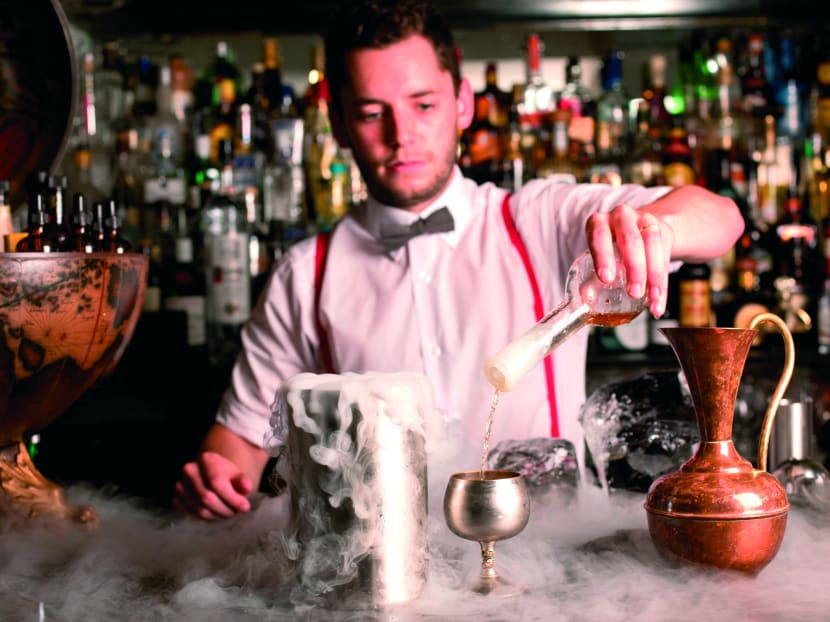
Tristan Stephenson, owner and bartender at Worship Street Whistling Shop (UK).
SINGAPORE — Tristan Stephenson recalls his first cocktail being something fruity and sweet — which probably had a big impact on the bespoke concoctions he would eventually be making.
Working in the hospitality industry for over 10 years, Stephenson started out by helping to set up the bar at Jaime Oliver’s Fifteen Cornwall, where he had free rein to experiment with pairings, seasonal cocktails, home-made soft drinks, bitters and tonics.
Stephenson subsequently assumed the role of Brand Ambassador for the Reserve Brands Group, training bartenders at some of the most highly regarded bars and restaurants including The Dorchester and The Ritz Carlton. His huge passion and aptitude for the trade helped him clinch the third spot at the UK Barista Championships in 2009, and it wasn’t long before he opened his drink consultancy firm, which led to his first bar in 2010 and, eventually, Worship Street Whistling Shop in 2011.
Not one to rest on his laurels, Stephenson is launching his own book, The Curious Bartender, which he says is his proudest moment as one.
In town as part of Chefs With Altitude, a week-long epicurean extravaganza, Stephenson will be showcasing a collection of clever cocktails at City Space at Swissotel The Stamford, Singapore.
Q: When you visit a new bar, what is one drink you use as a benchmark to gauge the skill of the bartender?
A: I wouldn’t order a drink to gauge someone’s skill. In fact, quite the opposite should be true — get them to order your drink for you.
Q: What’s your personal favourite?
A: Depends on a number of factors, but a Manhattan would be up there.
Q: What is the biggest misconception that people have about what you do?
A: That shaking a cocktail is the height of our craft!
Q: What makes a good bartender?
A: There’s a lot: Good social skills, strong work ethics, physical fitness, good memory, good dexterity, cleanliness and hygiene, passion for art, history, science, and research.
Q: What’s one bar kit you never leave home without?
A: Scales.
Q: What is your favourite spirit to work with? And what are the three most versatile ingredients?
A: Probably rum, but also grappa and genever. The most versatile ingredients would probably be salt, coconut water and vermouth.
Q: When did you decide that this was a path you wanted to pursue?
A: I always found the balancing of ingredients quite easy to do. It’s much harder in a kitchen if I had trained as a chef, so I guess bartending seemed like the easier and more enjoyable option!
Q: Have you had to train your palate to be more sensitive to flavours, or would you say you were naturally born with a discerning palate?
A: I’d say I have a naturally good sense of flavour. I used to complain when my mother bought the wrong brand of soft drink — she once gave me a blind taste test of cola and I named each brand. Having said that, the vocabulary of flavour does come through practice.
Q: Would people who are good chefs naturally make good mixologists too? And vice versa?
A: You would think that it would be the case, but many of the best chefs I know have terrible taste in drinks. I think that being a chef is harder than being a bartender, but I also think that applying bartending to cooking is easier than the other way around.
Q: How do you define a bartender and a mixologist?
A: A bartender makes drinks. A mixologist makes drink with a moustache! No, I don’t really see a difference. If you’re good at what you do, you can call yourself whatever you like in my opinion!
Chefs With Altitude 2013 runs from Nov 11 to 17. Check out Stephenson’s cocktail creations at City Space from Nov 11 to 16, 3pm to 1am.
Stay in the know. Anytime. Anywhere.

Subscribe to our newsletter for the top features, insights and must reads delivered straight to your inbox.
By clicking subscribe, I agree for my personal data to be used to send me TODAY newsletters, promotional offers and for research and analysis.






