
2014 a bumper year for marriages, births
SINGAPORE — The number of Singaporeans walking down the aisle shot to a 17-year high last year, as the first wave of baby boomers’ children enter marriageable age at a time when Housing and Development Board (HDB) flats became easier to come by.
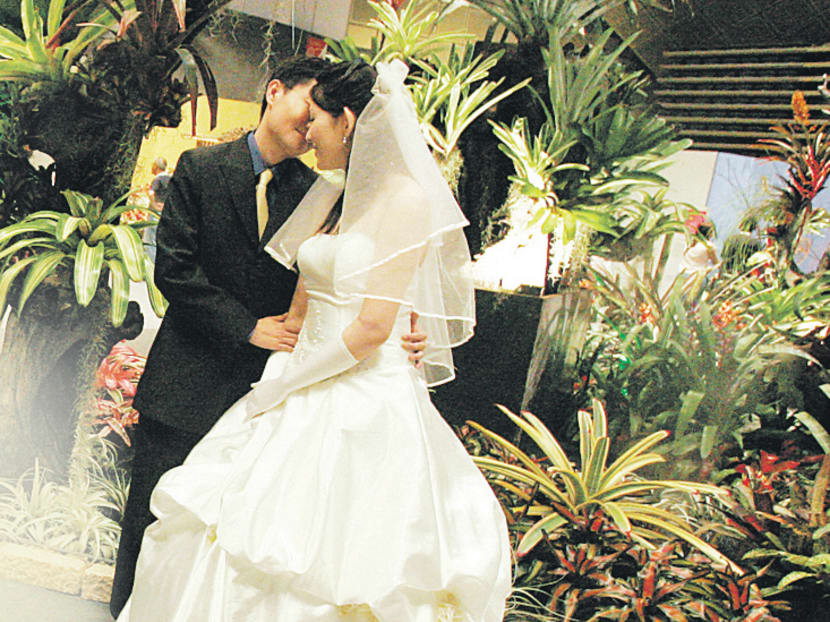
TODAY file photo

SINGAPORE — The number of Singaporeans walking down the aisle shot to a 17-year high last year, as the first wave of baby boomers’ children enter marriageable age at a time when Housing and Development Board (HDB) flats became easier to come by.
The 10 per cent jump in weddings last year coincided with about 2,000 more Singaporean babies being born, compared with 2013 figures, estimates released by the National Population and Talent Division (NPTD) yesterday showed. The roughly 33,000 Singaporean babies born last year pulled total fertility rate up from 1.19 to 1.25, a shade lower than the five-year high of 1.29 in 2012 — the year of the Dragon, which traditionally sees a rise in births.
Good news on these two fronts may yet continue for the next decade or so, say experts, given the coming stream of children of baby boomers reaching marriage and child-bearing age. Singlehood has been seen as the main culprit for the low birth rate here, with the latter being a concern that policymakers have been trying to fix for years.
In a media release yesterday, the NPTD said the higher number of marriages involving a Singaporean bride or groom last year “is likely to be due in part to the greater availability of HDB flats, and in part to more Singaporeans, the children of our Baby Boomers, entering marriageable age”. There were 24,000 or so such unions last year, compared to 21,842 in 2013, and 23,192 in 2012.
More flats have been built in recent years to ease the crunch, which was one way in which the Government has been making it easier for Singaporeans to fulfil their aspirations to tie the knot and have children, said the NPTD. HDB figures show that there were 13,310 keys issued for two-room flats and above between April 2013 and March last year. The number was 10,533 in the year prior.
“We will continue to support Singaporean families, including in the area of child care, and make it easier for both fathers and mothers to share the experience of bringing up their children,” said the NPTD. In the S$2 billion enhanced Marriage and Parenthood package rolled out in 2013, measures like paternity leave and subsidies to defray medical costs were announced, while the Government has also stepped up the construction of childcare centres.
Observers agreed that being able to build your own love nest does spur people to settle down quicker and start families, but added that other factors, such as changing mindsets may have a part to play too.
Noting that the children of Baby Boomers — those born between 1946 and 1964 — are mostly aged between 25 and 35 now, sociologist Tan Ern Ser said healthy marriage numbers could continue for a decade or so.
Institute of Policy Studies Senior Research Fellow Leong Chan-Hoong said the Government’s recent deemphasis on a paper chase, as well as a push to create a more inclusive society, could bode well for marriage and birth rates.
“Having a renewed sense of optimism that there is hope working in Singapore — that makes a difference,” he said.
Agreeing, sociologist Paulin Straughan said the “economic outlook muted the opportunity-cost concerns of starting a family”.
But she brought up again the call for changes to employment conditions to make it friendlier for family formation, such as greater flexibility in working hours to make it easier for working parents.
Stay in the know. Anytime. Anywhere.

Subscribe to our newsletter for the top features, insights and must reads delivered straight to your inbox.
By clicking subscribe, I agree for my personal data to be used to send me TODAY newsletters, promotional offers and for research and analysis.






