
27 Bangladeshis who plotted jihad nabbed
SINGAPORE — Twenty-seven Bangladeshi construction workers were arrested here under the Internal Security Act after they were found to be contemplating armed jihad overseas as well as in their homeland, marking a stark reminder to Singaporeans of the threat of extremism, a point echoed in recent days by the Government.
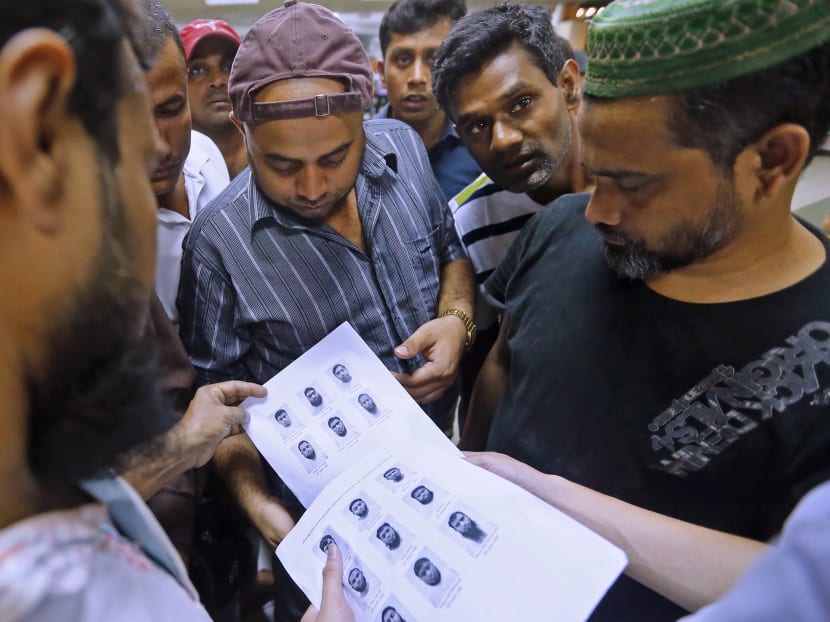
Bangladeshis in Little India looking at photos of the 27 Bangladeshi construction workers who were arrested here under the ISA. Bangladeshis TODAY spoke to condemned the actions of those arrested, with some saying they hope the incident would not stain the image of the Bangladeshi community here. Photo: Ernest Chua/TODAY

SINGAPORE — Twenty-seven Bangladeshi construction workers were arrested here under the Internal Security Act after they were found to be contemplating armed jihad overseas as well as in their homeland, marking a stark reminder to Singaporeans of the threat of extremism, a point echoed in recent days by the Government.
Indeed, Home Affairs and Law Minister K Shanmugam, who delivered a major speech on the scourge just a day earlier, pointedly warned that although the group was aiming for foreign targets, they could have just as easily changed their minds.
“While they were planning attacks outside Singapore, they could have easily changed their minds and attacked Singapore,” he said in a Facebook post.
Prime Minister Lee Hsien Loong also drilled home the point, posting on his Facebook page: “Fortunately they were plotting nefarious activities in Bangladesh, and not in Singapore. But they were still a serious threat to us.” He added: “We are tightening up our security, and acting to protect our racial and religious harmony. Radicalisation and terrorism must never take root in Singapore.”
The arrests, announced by the Ministry of Home Affairs (MHA) today (Jan 20), marked the first time Singapore has uncovered a jihadist terror cell comprising foreigners. Investigations showed that the Bangladeshis arrested were not planning any terrorist attacks in Singapore.
Some among them — working in the local construction industry for between two and seven years but not concentrated in any company, workplace or place of lodging — had encouraged members of their religious study group to return to Bangladesh and wage armed jihad against the Bangladeshi government. They had also donated money to groups believed to be linked to extremist groups in Bangladesh.
The MHA said the group arrested had been meeting since 2013, holding weekly gatherings at a few local mosques near their places of lodging to discuss armed jihad and conflicts that involved Muslims.
Referring to his speech at the second annual Inter-Religious Relations in Plural Societies Distinguished Lecture and Symposium on Tuesday, Mr Shanmugam said: “Our security agencies have done well in picking them up early. I had said (on Tuesday) that the threat of terrorism is real. We are getting daily reminders of that.”
The minister added that the 27 Bangladeshis were meeting at one mosque “on a regular basis”. He did not disclose the name of the mosque but Bangladeshi media reports identified it as Angullia Mosque in Little India.
The men were arrested between Nov 16 and Dec 1 last year. All but one of them were repatriated last month. The remaining man is serving a 12-week jail term for attempting to leave Singapore illegally, after learning about the arrests of his fellow group members. He will be repatriated once he completes his sentence. The Bangladeshi authorities have also been informed of the circumstances of their repatriation, said the MHA.
The religious study group that 26 of them belonged to subscribed to extremist beliefs and teachings of radical ideologues such as Anwar al-Awlaki. Sharing jihadi-related material among themselves, the group members supported the armed jihad ideology of terrorist groups such as Al-Qaeda and the Islamic State. Several contemplated participating in armed jihad in the Middle East.
The remaining Bangladeshi national was not a member of the group, but he was found to be “in the process of becoming radicalised” and was supportive of extremist preachers. He also possessed jihadi-related material, said the MHA.
The MHA said some of the group members admitted that they believed they should participate and wage armed jihad on behalf of their religion, and several of them contemplated travelling to and participating in armed jihad in the Middle East.
Some group members also supported the violent actions of extremist or terrorist groups that killed Shi’ites because they considered Shi’ites to be “deviant”. The men also bore grievances against the Bangladeshi government over its actions against some Bangladeshi Islamic groups and leaders.
The Mufti of Singapore, Dr Mohamed Fatris Bakaram, told reporters on the sidelines of the two-day symposium that it would be hard to identify radical elements in a mosque, given the “casual nature of friends that come together in between prayers”. “Threats like these are something you cannot totally avoid,” he said, adding that he was surprised at the size of the group.
Nevertheless, Islamic Religious Council of Singapore president Alami Musa stressed the need to be vigilant. “When there are groups that congregate in certain places, we have to, in a way, be diligent to find out what is happening, what is being discussed,” he said. “As custodians of spaces like the mosques, the onus is on the mosque to try its best to know what’s happening in the mosque.”
Several ministers and religious leaders reacted with deep concern, with Minister-in-charge of Muslim Affairs Yaacob Ibrahim stressing that terrorism is “a continuing threat that can have a grave impact on all of us”. Nevertheless, Dr Yaacob urged Singaporeans to remain united and “not resort to discriminating foreign workers here”. “The actions of a few cannot determine how we treat others who have worked so hard to build our homes, schools and hospitals,” he said.
Mr Alami added: “Terrorism is transnational ... It is a global phenomenon, facilitated very much by technology and the Internet. So we are living in a dangerous world. We Singaporeans will have to be aware and conscious that the threats to Singapore can come from the outside.”
The MHA reiterated that the Government takes a “very serious view of any form of support for terrorism and will take firm and decisive action against any person who engages in any activity in support of terrorism”. It added: “Foreigners are guests of our country and they should not abuse this privilege and use Singapore as a base to import their own domestic political agenda and carry out activities in pursuit of such an agenda.
“In the same way, foreign religious speakers who propagate divisive doctrines which could lead to mistrust, enmity and hatred among local religious groups and undermine Singapore’s social cohesion are not welcomed and will not be allowed to operate in Singapore.”
The MHA also said that if the public is aware or suspects that a person has been radicalised, or is engaging in extremist activities or propagating extremist teachings, they should promptly inform the Internal Security Department at 1800-2626-473 or call the police.
Stay in the know. Anytime. Anywhere.

Subscribe to our newsletter for the top features, insights and must reads delivered straight to your inbox.
By clicking subscribe, I agree for my personal data to be used to send me TODAY newsletters, promotional offers and for research and analysis.






