
Govt aims to add 30,000 more healthcare workers by 2020 as population ages
SINGAPORE — The Government is aiming to add another 30,000 healthcare workers to the sector by 2020 — expanding its current workforce by 33 per cent — to meet the needs of an ageing population, according to the 2020 Healthcare Manpower Plan released on Thursday (Oct 20).
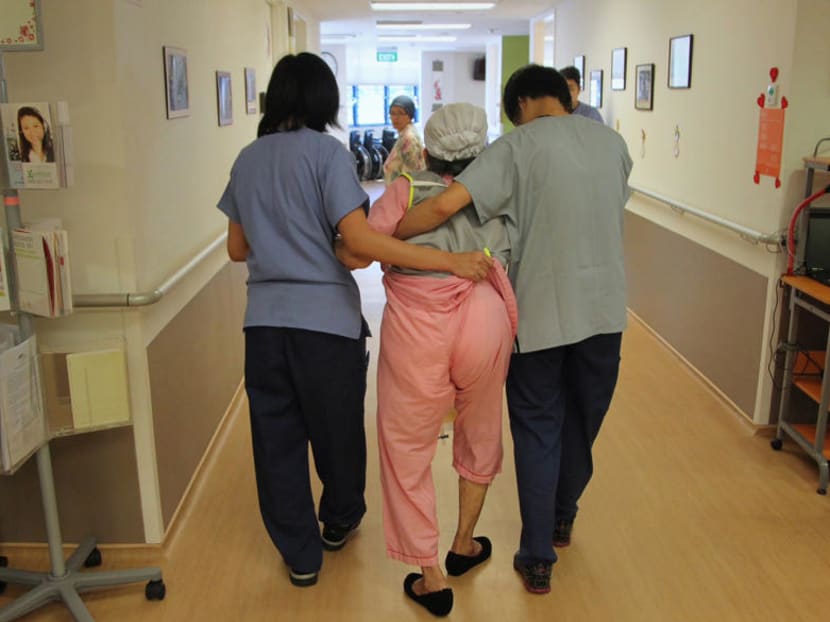
A patient receiving help from nurses at a Dementia Care Ward in a hospital in Singapore. TODAY file photo

SINGAPORE — The Government is aiming to add another 30,000 healthcare workers to the sector by 2020 — expanding its current workforce by 33 per cent — to meet the needs of an ageing population, according to the 2020 Healthcare Manpower Plan released on Thursday (Oct 20).
The latest projection is for the period between last year and 2020, and includes both healthcare professionals and non-professionals such as ancillary and support staff, the Ministry of Health (MOH) said.
Previously, the ministry had said it planned to recruit 20,000 healthcare professionals — for example, doctors, nurses, pharmacists and selected allied health professionals — between 2011 and 2020. “MOH regularly reviews healthcare manpower needs, taking into account population and disease trends,” the ministry said in response to TODAY’s queries.
But as more steps are taken to boost manpower with a “strong local core” for the sector, Singapore cannot provide accessible and quality care “by simply adding more and more staff”, said Health Minister Gan Kim Yong.
There is a need to “make deep and fundamental changes to how we deliver care”, as well as improve productivity by redesigning jobs and using technology.
“Only then can we meet the expected growth in health and aged care demand, and sustain good pay for our workers,” said Mr Gan, who was speaking at the National Seminar on Productivity in Healthcare on Thursday.
The plan estimates that the population of Singapore residents over the age of 65 will rise to 610,000 by 2020, compared with 460,000 last year, and to 960,000 by 2030.
As of last year, the healthcare workforce was 91,000 strong, comprising doctors, dentists, nurses, allied health professionals, ancillary staff, among others.
To meet the needs of the elderly, the Government plans to double the number of medical trainees in internal, geriatric, and rehabilitation medicine, and increase those in family medicine by 30 per cent, between now and 2019.
It is also training more Advance Practiced Nurses who can be involved in more complex programmes, such as prescribing medication and leading clinics in primary and community health settings.
And in December, Nanyang Polytechnic will launch a SkillsFuture Earn and Learn programme in gerontology nursing to equip nursing graduates to work in the community.
The Republic must also push for technology that integrates care with patients’ needs, can be applied across institutions, and redefines the practice of healthcare, Mr Gan said.
For example, the 51-page Healthcare Manpower Plan featured a “ward of the future”, where patient-tracking, and delivery of medication and blood samples are automated. Healthcare workers are assisted by beds that transform into reclining wheelchairs, and ceiling hoists that help them lift patients with minimal effort.
Programmes to improve productivity that have been rolled out include SingHealth’s Match-A-Nurse programme, which works like a taxi booking application.
Piloted at Singapore General Hospital since April, it links patients who require home nursing services to nurses living or working close to them.
A patient’s request is listed in the app, and nurses who successfully “bid” for a job will be notified via text message. After the visit, the nurse updates the observations in the app.
“Traditionally, home nursing involves a nurse travelling from home to home. To boost efficiency, we wanted to test the concept of tapping nurses to perform tasks near their homes,” said project leader Dr Ang Seng Bin, a consultant family physician at the KK Women’s and Children’s Hospital (KKH).
SingHealth hopes to expand the app to KKH, and to offer services for paediatrics and women’s health. There are also plans to collaborate with community partners, Dr Ang said.
Jurong GRC Member of Parliament Tan Wu Meng, commenting on the goal of 30,000 more healthcare workers, said the additional manpower is necessary, particularly when healthcare is moving beyond medication and technology to “building care relationships”, such as a deeper understanding of patients.
“Old folks often have multiple medical conditions. Again, this means we need more people who can co-ordinate, who know the patient well, who walk with the patient on the care journey,” said Dr Tan, an oncologist.
On Thursday, Mr Gan and Senior Minister of State for Health Amy Khor also presented six teams with the inaugural National Healthcare Innovation and Productivity Medals. The recipients came from Khoo Teck Puat Hospital, National University Hospital, SingHealth, St Luke’s Hospital, and Tan Tock Seng Hospital.
Stay in the know. Anytime. Anywhere.

Subscribe to our newsletter for the top features, insights and must reads delivered straight to your inbox.
By clicking subscribe, I agree for my personal data to be used to send me TODAY newsletters, promotional offers and for research and analysis.






