
Abdul Ghani takes Gelang Patah fight to S’pore
JOHOR BARU — In a rare move by a Malaysian politician, caretaker Johor Mentri Besar Abdul Ghani Othman yesterday took his campaign across the Causeway when he made a surprise trip on board the Causeway Link public bus from Gelang Patah to Jurong East Bus Terminal. Along the journey, which took more than an hour, Mr Abdul Ghani, 67, interacted with Malaysians going to Singapore to work.
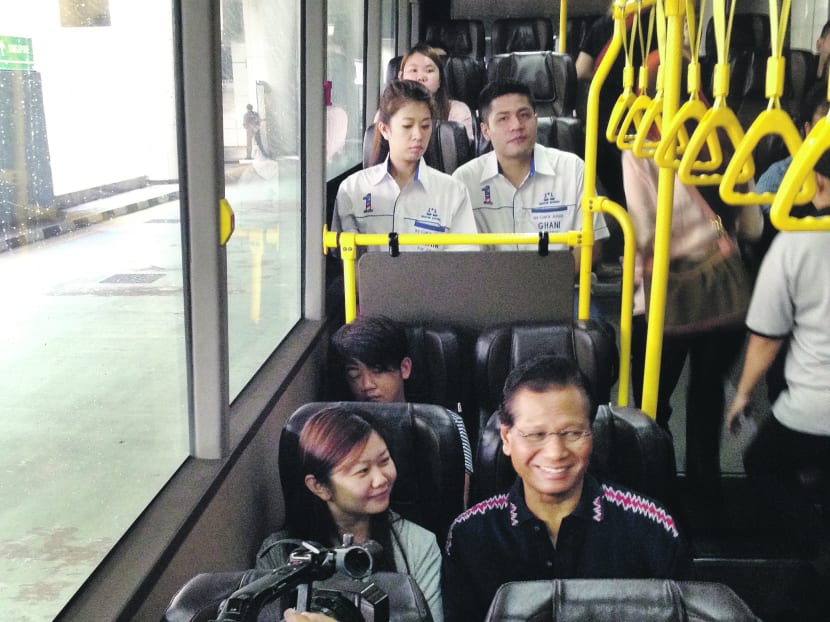
Photo: MediaCorp



JOHOR BARU — In a rare move by a Malaysian politician, caretaker Johor Mentri Besar Abdul Ghani Othman yesterday took his campaign across the Causeway when he made a surprise trip on board the Causeway Link public bus from Gelang Patah to Jurong East Bus Terminal. Along the journey, which took more than an hour, Mr Abdul Ghani, 67, interacted with Malaysians going to Singapore to work.
The trip, which came just three days before Malaysians head to the ballot box on Sunday, prompted his rival, Democratic Action Party stalwart Lim Kit Siang, to declare that he, too, might take his campaign to Singapore, where hundreds of thousands of Malaysians — including many Johoreans — reside.
The high profile match-up between the two men has been dubbed by Malaysian media as “the mother of all battles”.
Mr Abdul Ghani took the opportunity yesterday to announce that Malaysia and Singapore are in the final stages of their plans on the proposed Rapid Transit System (RTS) Link. “Before year-end, I would imagine both governments will decide on the type of RTS to be implemented with the scheduled completion by 2018,” he told reporters at Jurong East Bus Terminal.
Noting that Malaysians who work in Singapore go through a long but convenient journey, Mr Abdul Ghani reiterated the need to explore a single Customs, Immigration and Quarantine (CIQ) complex to smoothen cross-border movement.
Responding to media queries, Singapore’s Ministry of Transport (MOT) said the first phase of the architectural and engineering consultancy study for the RTS was “nearing completion”.
The Joint Ministerial Committee for Iskandar Malaysia would decide on the option for the RTS Link to be further examined as part of the second phase of the study, an MOT spokesperson said.
She added that Singapore and Malaysia have agreed to “co-locate their CIQ facilities at both the Singapore and Johor Baru stations, so that cross-border commuters on the RTS Link need to clear immigration only once at either station”.
‘NO LACK OF JOB OPPORTUNITIES’ IN MALAYSIA
During his bus journey, Mr Abdul Ghani asked some of the Malaysian workers why they wanted to work in the Republic. He told reporters that, based on his observations, the “main reason” was because of the strong Singapore dollar (S$1 = RM2.47). “It is not on the basis of the levels of income ... but more of the income after the exchange rate is taken into account,” said Mr Abdul Ghani.
Neither was it “a question of a lack of job opportunities”, he said, adding that the Iskandar region will create 500,000 more jobs over the next five to eight years.
During campaigning, the opposition has regularly raised the question of why Malaysians chose to work and study in Singapore. The opposition cited this as evidence that the ruling Barisan Nasional coalition has not fulfilled Malaysia’s economic potential.
Johoreans working in Singapore whom TODAY spoke to agreed that there are enough jobs in Malaysia. However, there is a lack of good jobs, particularly those that can pay them as well as those in Singapore, they said. They also pointed to Malaysia’s abundance of natural resources and asked why its economy seemed to be lagging further behind Singapore’s, citing the ringgit’s slide against the Singapore dollar over the years.
Mr Toh Yang Fan, 27, who ditched his carpenter job in Batu Pahat three years ago to work as a supervisor in an exhibitions set-up company in Singapore, said that what he was earning previously was not enough to cover his expenses. “Now I’m earning about double (of what I used to earn), but I am away from my wife,” he said.
Some Malaysians also claimed that race is a factor when it comes to career progression in their country.
A 31-year-old Chinese market researcher who declined to be named said “the opportunities and recognition you can get (in Singapore) is something you’ll never get in Malaysia”.
Those who work in Singapore also noted that Malaysia’s living environment paled in comparison.
Said Mr Roslan Mohd, 55: “In Singapore, no policemen (on the streets), you still feel safe. Here, got policemen or not, not much difference.” Ms Kelly Ee, a 29-year-old recruitment specialist, added: “It’s safer, cleaner, more orderly, better schools, more shopping centres. You can’t even compare.”
Political analysts believe that Malaysians who regularly experience life across the Causeway have a different mindset compared to their compatriots who live and work in Malaysia.
University of Malaya law professor Azmi Sharom said that the former would be “more concerned about bigger issues, such as the direction the country is heading instead of bread and butter, day-to-day issues”.
He said: “The conditions of the roads don’t bother them, for example. They will likely look at matters of principle instead of pragmatic concerns; things like type of government, system of governance, human rights and equal treatment.”
Mr Ibrahim Suffian, Programme Director of the independent think-tank Merdeka Centre, felt that the ruling coalition would have its work cut out to woo these voters. They have “already voted with their feet by working outside of Malaysia”, he noted.
Related topics
MalaysiaStay in the know. Anytime. Anywhere.

Subscribe to our newsletter for the top features, insights and must reads delivered straight to your inbox.
By clicking subscribe, I agree for my personal data to be used to send me TODAY newsletters, promotional offers and for research and analysis.






