
From abroad, tests for a nation as others try their luck
SINGAPORE — Founding Prime Minister Lee Kuan Yew put in place a system here that has proven robust and can run effectively without him, and other countries that deal with Singapore have had the opportunity to take a measure of this system for many years after Mr Lee stepped down in 1990. But following Mr Lee’s death in March 2015, some countries have tried their luck at putting Singapore in its place, shared Ambassador-at-Large Bilahari Kausikan.
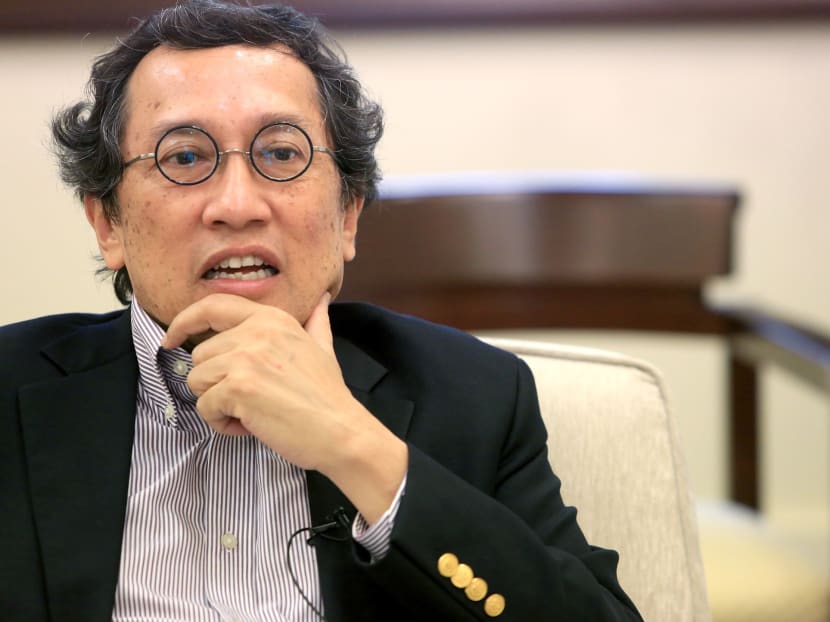
Mr Bilahari Kausikan, Ambassador-at-Large, Singapore, taken on March 3, 2016. Photo: Koh Mui Fong/TODAY



SINGAPORE — Founding Prime Minister Lee Kuan Yew put in place a system here that has proven robust and can run effectively without him, and other countries that deal with Singapore have had the opportunity to take a measure of this system for many years after Mr Lee stepped down in 1990. But following Mr Lee’s death in March 2015, some countries have tried their luck at putting Singapore in its place, shared Ambassador-at-Large Bilahari Kausikan.
He did not specify the countries or elaborate on what they did, but the famously frank diplomat said: “There will be some countries that certainly will probe and test us to see if there are things they can get away with now that Mr Lee is no longer with us, and some such probes have already begun.
“Please don’t ask me which countries. All I will say is that if they persist, they will be in for a rude surprise.”
When asked to elaborate, he candidly added: “They think our ability to stand firm only depends on Lee Kuan Yew — that’s rubbish. Or if they think that now he’s not around you can redo things, no, sorry…”
Mr Kausikan was replying to a question on whether a post-Lee Kuan Yew Singapore is regarded differently by other countries, especially those in the region.
It is a valid concern, one that many observers and diplomats interviewed believe is something to reflect on. “Yes, there is some degree of shift in other countries’ perceptions of Singapore,” said Mr Ong Keng Yong, executive deputy chairman of the S Rajaratnam School of International Studies (RSIS).
“The fact is different leaders have different styles and personal chemistry among leaders works in mysterious ways in international encounters and meetings. Also, the regional and global situations have undergone rapid changes. Technological advancement has compressed the space and time for information exchange between countries and events, resulting in leaders in different parts of the world operating quite differently these days in connecting with their counterparts elsewhere.”
But like Mr Kausikan and Mr Ong, observers are optimistic that Singapore’s fundamentals in foreign policy — laid down by Mr Lee — have survived the founding Prime Minister. He stepped down in 1990 but continued to keep a close watch on global and regional affairs even as his health deteriorated in recent years.
“I think the system can endure. Put it this way, it is for us to screw it up — not that it cannot work without him,” said Mr Kausikan, who was permanent secretary at the Ministry of Foreign Affairs (MFA).
Retired diplomat K Kesavapany noted that Mr Lee was able to bring up a core group of leaders who shared his ideals.
“Mr Lee took pains to make sure that after he’s gone the system will still run, (that) Singapore is still (well) regarded … So long as we remain true to what he has taught us and left behind, then Singapore should be okay,” he said.
Retired diplomat Tan Seng Chye said Mr Lee has set the tone for Singapore’s foreign policy and put in place a system that his successors have further established.
“No country can have just one leader and only that leader can do things, but he must put in place a system, a succession of leaders that can continue to build the country,” said Mr Tan, who stepped down as Singapore’s ambassador to Vietnam in 2005 after a diplomatic career spanning almost four decades, including stints as the Republic’s envoy to four other South-east Asian nations.
Some of Mr Lee’s ideas and values that have lived on in Singapore’s foreign policy include putting Singapore’s interests first, being principled and neutral and making as many friends as possible, said Mr Ho Meng Kit, his former Principal Private Secretary.
“These values are deeply ingrained in the psyche and culture of our leaders and officials,” he added.
Mr Ong noted that Prime Minister Lee Hsien Loong and his senior Cabinet ministers have been working with their counterparts in other countries for many years.
“From various international conferences and events, notably the recent climate change negotiations in Paris, the other countries have seen the leadership capability and effective diplomacy of Singapore. In general, they see a Singapore leadership which is worldly and task-oriented. This leadership exudes Mr Lee Kuan Yew’s visionary intellect, practical approach and focus on the future.”
While Mr Lee had bequeathed enduring systems and institutions to the country, his lasting legacy is building up the Singapore brand name, said experts interviewed by TODAY.
MR LEE’S LEGACY
As an influential interlocutor on the global stage, Mr Lee had advised every United States President from Mr Richard Nixon to Mr Barack Obama, and across the Pacific, he met and counselled every Chinese leader from Mr Mao Zedong to Mr Xi Jinping.
His insightful and incisive views are also valued by leaders in the region, as one of the founding fathers of the Association of Southeast Asian Nations (Asean) who brought together a disparate regional bloc.
On why his views were sought after, dean of the Lee Kuan Yew School of Public Policy Kishore Mahbubani explained that Mr Lee had incredible experience, gave wise advice - including on prickly cross-strait relations between China and Taiwan - and was “remarkably blunt” in offering his views.
Mr Kesavapany added: “He told things as they were and he didn’t try to play games with any of the leaders”. Mr Lee would say things that “they themselves would not say,” he noted.
“It’s his indescribable sense of charismatic personality plus an intelligent mind and he was also a realist who accepted the world as it was and not as he wanted it to be.”
All this made Mr Lee and by extension, Singapore, relevant to the world. This is his legacy that he left behind for Singapore, that observers say current leaders are building on to ensure the little red dot continues its outsized role in the global arena.
Indeed, Mr Lee’s contributions go beyond transforming the country from mudflat to metropolis but also turning vulnerability into invincibility, ensuring that a small island state will not be trampled on or sidelined by bigger powers.
He also elevated the island state’s status to a role model for other developing economies in search of similar success.
“As a small country, we are not a threat. Many regard his advice as neutral and objective. We do not have our own agenda,” said Mr Ho, his former aide and now chief executive officer of Singapore Business Federation.
At the heart of Mr Lee’s overseas overtures was Singapore’s security and survival. To this end, he has been described as a pragmatic realist, hard-nosed and even unsentimental in his approach. Yet he was prepared to change his views as the world changed.
Veteran diplomat and former top civil servant Barry Desker said: “As a realist, he appreciated the need to maintain good links with the West to promote trade and investment at a time when leaders of many newly independent countries believed their own rhetoric and thought that they could adopt autarkic policies.”
In 1967, two years after Singapore gained independence, Mr Lee started making trips to the US to woo American investors.
“Lee did not wait for US investors to serendipitously discover Singapore as a perfect destination for capital. He seized every opportunity to promote Singapore and stressed the efficiency and quality of the labour force in the country,” wrote Dr Daniel Chua, research fellow at the Institute of Defence and Strategic Studies at RSIS.
Political leaders in US also started to pay attention to this young Asian leader. Mr Francis Galbraith, the first US Ambassador to Singapore, wrote a 16-page report recommending the US government to engage closely with Mr Lee and Singapore in 1967.
As Mr Lee built a firm friendship with the US and Europe, he also expanded networks in Asia, such as with growing giants India and China.
His foresight in engaging China early in the 1970s, despite its communist links and even before its opening up and economic reform, was a game changer. He had astutely recognised its potential to be an economic powerhouse that would rival the US.
“Who else had the foresight to engage China just at the right time when China was amenable to adjustments in an evolving world stage,” said Mr Sajjad Ashraf, Pakistan’s high commissioner to Singapore from 2004 to 2008.
“Mr Lee foresaw changing global power equation. In addition to private advice to the American leadership, he said it publicly that with growing economic and political clout that ‘China will want to sit as an equal at the top table’.”
From his vantage point in the early years of being close to leaders in both US and China, and coming from a “non-threatening” position, he was then able to act as a trusted contact to help both sides understand each other better, noted Dr Lam Peng Er, senior research fellow at the National University of Singapore’s East Asian Institute.
Added Mr Ho: “This role as link between US and China crafted a niche for Singapore and enhanced our own relationship with these two countries.”
This philosophy of being friendly to all countries and not making enemies is critical, said Associate Professor Alan Chong from RSIS, adding that the Republic was flexible in its foreign policy and did not see anyone as a permanent enemy.
“While Mr Lee appreciated the fact that we needed to deter certain unfriendly countries within Asia, he did not close the door to sincere forms of cooperation,” he said.
“I can also bet that Singapore would be the first to invest in North Korea if and when that country opens up - this is the extent of our flexibility. Because why should we make other people’s mortal enemies our mortal enemies?”
Such pragmatism also shaped Singapore’s views on geopolitical shifts and stability.
“Mr Lee Kuan Yew was a master of geo-strategic realism and planning for the future. He believed that some issues in international relations would never be resolved. The best way to deal with these challenges would be to manage them coherently, keeping in mind the big picture and looking for the balance needed to prevent upheaval,” said RSIS’ Mr Ong, who’s also an Ambassador-at-Large at MFA.
“This would require longer-term thinking and decisive leadership at the key levels of government. The problem today is often short-term political expediency and inconsistent management of the complexities involved.”
Mr Ong added that Mr Lee’s mindset was all the more relevant today given the tensions over competing territorial claims in the South China Sea and debate about how to reshape security architecture in the Asia Pacific.
“Recently, I attended a conference in China where a prominent Chinese scholar of international studies openly yearned for Mr Lee’s exceptional principled approach in managing the competition and rivalry of big powers in our region.”
BALANCE OF POWER
Mr Kesavapany, who stepped down as Singapore’s High Commissioner to Malaysia in 2002 after spending three decades in the Foreign Service, shared an example of how Mr Lee’s belief in continued American presence in Asia has led to stability in this region.
“Twenty years ago, there was a feeling that after the Vietnam War, American presence should go away. The Philippines asked them to leave Subic Bay and Clark Air Base in a fit of nationalism, but it was Mr Lee who saw above the horizon and saw the necessity of US continued presence in the region,” he said.
“He felt that only the US could counterbalance any attempt by an emerging power to dominate the region. It was this reasoning that led Singapore to establish its naval base and made it clear that the US Navy could make use of the base.”
Mr Lee reiterated his position several times. In his keynote address after receiving a lifetime achievement award from the US-ASEAN Business Council in Washington, DC, in 2009, Mr Lee said: “The size of China makes it impossible for the rest of Asia, including Japan and India, to match it in weight and capacity in about 20 to 30 years. So we need America to strike a balance.”
His comments drew the ire of Chinese netizens and media commentators then, but Chinese leaders continued to welcome him as they understood his position of seeking stability in the region which was also in China’s interest.
Mr Lee’s neutrality was also appreciated, said Dr Paul Evans, visiting professor in International and Asian Studies at the Singapore Management University.
“He steadfastly emphasised that Singapore was independent of both China and US. The ability to have a strong economic and political relationship with China…and to do that while also speaking to Americans bluntly about their strengths and limitations, those were defining features of Mr Lee,” said Prof Evans.
For all his deft diplomacy, Mr Lee did not fancy himself as a statesman.
In an interview, when asked how he wished to be remembered, he said: “I do not want to be remembered as a statesman ... I do not classify myself as a statesman. I put myself down as determined, consistent, persistent. I set out to do something, I keep on chasing it until it succeeds. That is all ... Anybody who thinks he is a statesman ought to see a psychiatrist.”
No matter how Mr Lee viewed his contributions, his pragmatic and prescient advice was clearly valued.
Will his legacy and values that have shaped Singapore linger on without him?
“Obviously, there won’t be another Mr Lee...but there is certainly a need for the clinical, cold-blooded analysis that was his style,” said Mr Kausikan.
Will his legacy and values that have shaped Singapore linger on without him?
“Obviously, there won’t be another Mr Lee...but there is certainly a need for the clinical, cold-blooded analysis that was his style,” said Mr Kausikan
“Actually it is one of the things he bequeathed to Singapore that this is the way we look at the world – at least most of us (in government). So it’s not that we need somebody like Mr Lee, but we need the kind of cast of mind that was, I think, his most valuable legacy, at least in the foreign affairs field.”
Mr Kausikan noted that while no system can last forever as every system is prone to error or sheer bad luck, Singapore has an adaptable and resilient system.
“You can still screw it up completely—the factor that can screw it up completely is politics, if the politics goes wrong or if we all becomes soft-headed… But it does not need him (Mr Lee) to work.”
Stay in the know. Anytime. Anywhere.

Subscribe to our newsletter for the top features, insights and must reads delivered straight to your inbox.
By clicking subscribe, I agree for my personal data to be used to send me TODAY newsletters, promotional offers and for research and analysis.






