
Driverless buses to ply Punggol, Tengah, Jurong Innovation District from 2022
SINGAPORE — Residents and workers of Punggol, Tengah and the Jurong Innovation District will be the first to ride on driverless bus services and hail driverless shuttles, under a pilot that will begin in 2022.
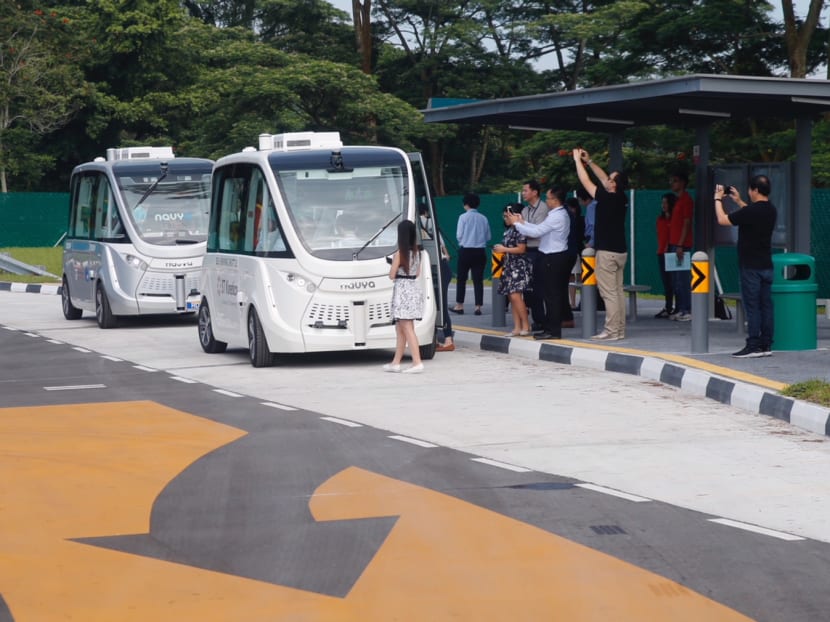
Self-driving shuttle buses are seen at Singapore’s first test centre for autonomous vehicles (AVs) in the Jurong Innovation District, Nov 22, 2017. Photo: Najeer Yusof/TODAY



SINGAPORE — Residents and workers of Punggol, Tengah and the Jurong Innovation District will be the first to ride on driverless bus services and hail driverless shuttles, under a pilot that will begin in 2022.
Transport Minister Khaw Boon Wan said the Government is seeking input from the industry and research institutions on the features needed in these towns for the driverless vehicles to run. Launched on Wednesday (Nov 22), the request for information will close at the end of May next year.
The autonomous services in the towns will travel on less congested roads and during off-peak hours for a start, the Transport Ministry and Land Transport Authority (LTA) said. There will still be regular public buses driven by bus captains. Under the initiative, commuters may book driverless shuttles using their mobile phones.
The LTA is also exploring using driverless buses for express transit links connecting the North-East MRT Line to the North-South, East-West and Thomson-East Coast MRT Lines.
Other recent developments on autonomous vehicles here include the launch of a driverless truck on Jurong Island by Belgium-based company Katoen Natie to transport products between ExxonMobil’s packaging and intermediate storage facilities.
In April, the LTA and ST Engineering’s land-systems arm, ST Kinetics, signed an agreement on a three-and-a-half year autonomous-vehicle trial, which could pave the way for driverless buses to ferry commuters along fixed routes based on selected feeder and trunk bus services. ST Kinetics will build two 40-seat electric buses under the project.
Noting that autonomous vehicles are a promising technology for Singapore given manpower constraints in public transport, Mr Khaw, who is also Coordinating Minister for Infrastructure, said: “We expect that the autonomous vehicles will greatly enhance the accessibility and connectivity of our public transport system, particularly for the old, families with the young and also the less mobile.”
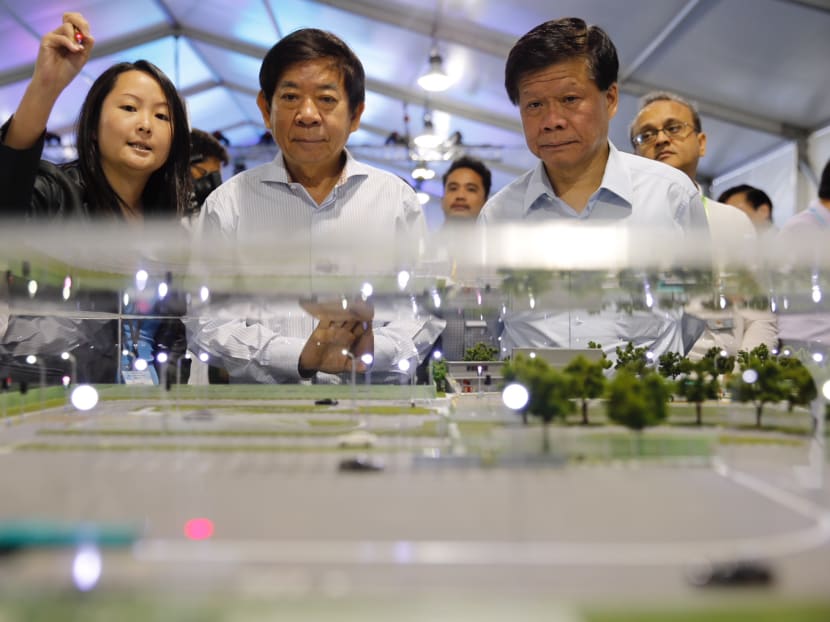
Speaking at the opening of Singapore's first test centre for autonomous vehicles, he said: "Just as our water needs help catalyse our water industry, we believe our land-transport constraints may, in fact, help us become a global player in urban mobility solutions."
The Centre of Excellence for Testing and Research of Autonomous Vehicles – NTU (Cetran) has a 2ha facility in the Jurong Innovation District that replicates various elements of Singapore roads, with common traffic schemes and rules, for example.
Jointly developed by the LTA, Nanyang Technological University (NTU) and JTC, it is run by NTU scientists and engineers.
Its test circuit, about 1.5km long, also has a rain simulator and flood zone to put autonomous vehicles' navigational abilities to the test under these conditions.
.embed-container { position: relative; padding-bottom: 56.25%; height: 0; overflow: hidden; max-width: 100%; } .embed-container iframe, .embed-container object, .embed-container embed { position: absolute; top: 0; left: 0; width: 100%; height: 100%; }Professor Subodh Mhaisalkar, executive director of the Energy Research Institute @ NTU, which oversees the centre, said it expects five or six companies — including start-up nuTonomy and vehicle technology supplier Delphi — to use the circuit over the next six months.
ST Kinetics and NTU plan to test driverless buses at the facility next year.
With their partners, LTA, JTC and NTU will also develop a set of common technical standards for driverless vehicles, including assessment procedures and methods.
Prof Subodh said the initial standards for operating the vehicles with a "safety driver" on board, as well as for running one without a driver, will be released next year.
On-road trials of driverless vehicles could be expanded beyond one-north to Buona Vista by January, said Mr Niels de Boer, Cetran's programme director.
In June, the authorities announced that on-road trials for driverless cars would be extended to areas near one-north such as Buona Vista, Dover and the National University of Singapore, adding 55km to the test routes, which used to span 12km.
Mr Khaw singled out safety as the top challenge for driverless vehicles.
"Until the people are confident that this is a safe technology, the adoption and spread of the technology will take several years," he said.
Prof Subodh said insurance and regulations are among "hurdles (that) now have to catch up with technology … (which) is moving very fast".
Stay in the know. Anytime. Anywhere.

Subscribe to our newsletter for the top features, insights and must reads delivered straight to your inbox.
By clicking subscribe, I agree for my personal data to be used to send me TODAY newsletters, promotional offers and for research and analysis.






