
Childhood sexual abuse: Too devastating to be hushed
SINGAPORE — Unlike the sexual assault victims who have stepped forward in the wake of allegations against disgraced Hollywood mogul Harvey Weinstein, Alice (not her real name) will not be declaring #metoo to the world.
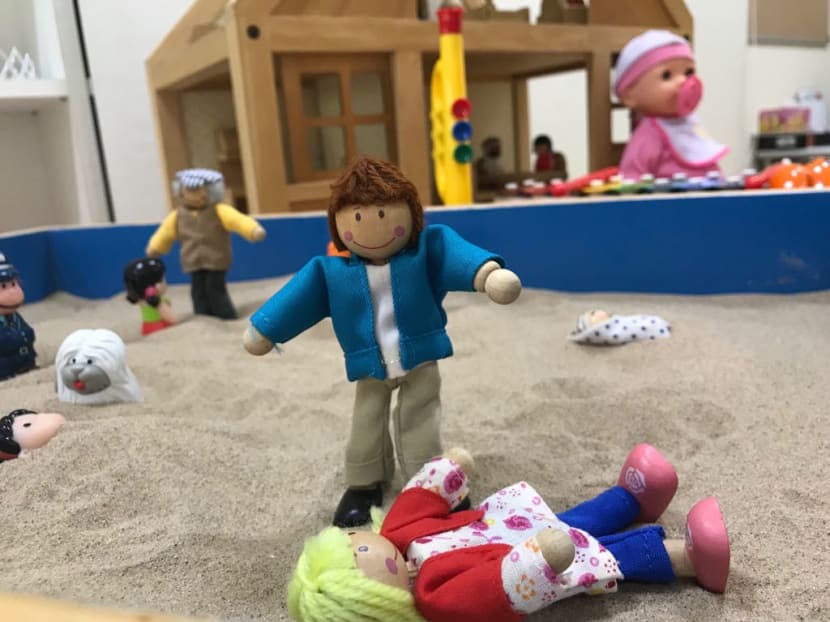
The Institute of Mental Health's Play Therapy Room. Toys are used as a medium through which children can express their feelings. Therapists may use other tools to assess children, such as questionnaires. Photo courtesy Institute of Mental Health

SINGAPORE — Unlike the sexual assault victims who have stepped forward in the wake of allegations against disgraced Hollywood mogul Harvey Weinstein, Alice (not her real name) will not be declaring #metoo to the world.
Sexually abused by her biological father at the age of nine, the 29-year-old told only a friend and a teacher at the time.
The authorities were alerted and, in the aftermath, her family was torn apart and Alice was placed in a shelter. Her mother’s anger towards her intensified her guilt and shame.
In an email interview with TODAY, she said she would have thought twice about telling someone had she fully understood the implications of the disclosure.
“The case had a huge impact on my loved ones. I wished they didn’t have to suffer the way they did. If I hadn’t told my teacher, I would have suffered alone although I do not know how long (the suffering would have lasted),” said Alice, who has two older sisters in their 30s.
Her father is currently serving his sentence of 20 years’ jail and is due to be released next year.
Alice recently decided to share her account anonymously in a book along with 11 other survivors of child sexual abuse from other countries.
Molested by her father for two years on the pretext of carrying out physiotherapy exercises, Alice, who was born with physical challenges, was also instructed to perform sexual acts on him.
Describing how things started in the book, Alice said: “(My father) put a pillow cover over my eyes. The next thing I knew, he had taken off my pants... a touch here, a touch there.”
“At first, you’d tell yourself, maybe it would be just this once or twice. Maybe it happened accidentally, but the frequency became worse,” she said in Survivors: Breaking The Silence On Child Sexual Abuse.
While Alice is the only Singaporean featured in the book, her case is not the exception here.
Singapore was recently ranked the top-performing country among 188 countries in the United Nations’ health-related Sustainable Developments Goals (SDG) index but childhood sex abuse was one of its worst-performing indicators – as was the case among top-ranked countries overall.
The SDGs are a set of targets that include goals for infectious diseases, environmental and mental health issues, among others. In the study published in The Lancet medical journal in September, the childhood sexual abuse indicator looked at the prevalence of women and men aged 18 to 29 who had experienced sexual violence by 18.
MORE CASES COMING TO LIGHT
In recent years, more cases of violence against children have come to light.
The number of sexual abuse allegations involving children under the age of 16 has risen, along with physical abuse and neglect cases, according to the Ministry of Social and Family Development (MSF).
Last year, the MSF investigated 107 allegations of child sexual abuse, up from 56 cases in 2014.
Cases may include molestation, rape and exposing a child to sexual acts or pornography. Most involve an allegation of molestation. The majority of the cases handled by the ministry involve a family member, said a spokesperson.
The MSF attributed the higher number of cases investigated since 2015 to more rigorous screening tools and training for professionals as well as greater public awareness.
Last year, more than half of the 422 new cases seen at the Institute of Mental Health’s (IMH) FRIENDS, an assessment and intervention service for children facing mental health issues, were for sexual abuse.
Experts told TODAY many cases may go unreported due to the stigma and shame.
“The absolute numbers of child sex offenders and victims are unknown but it is almost surely under-reported because of the shame experienced by the families concerned, or the threat of family dissolution and, possibly, loss of sole provider (of income),” said Dr Kenneth Koh, senior consultant at IMH’s department of general and forensic psychiatry.
Dr Daniel Fung, chairman of the IMH’s medical board and co-author of the book, said many cases remain buried, particularly in Asia where people tend not to publicly talk about such matters.
Some cases may be dropped due to lack of evidence, he said. Young children are especially vulnerable as they often cannot clearly verbalise the abuse they experienced.
“We’ve seen four-year-olds who have been clearly sexually abused but we don’t know who the perpetrator is,” said Dr Fung.
In a 2003 review by IMH on 38 local child sex abuse cases, more than seven in 10 of the victims were under the age of nine. The youngest was a three-year-old toddler. Most of their abusers were males, and usually someone the child knew.
In young children, some possible signs of sexual abuse include acting out in an inappropriate sexual way or having unusual sexual knowledge. For instance, they may touch their genitals excessively, said Dr Fung.
Victims may also experience physical trauma, such as a hymen tear or bruises, as a result of the abuse, said MSF’s spokesperson.
But the signs of trauma may not always be immediate, especially in cases where the child has been groomed.
“Some children who are asked to perform sexual acts, like oral sex, may not even realise those are not normal games one would play with an adult they trust,” said Dr Fung. “They may only realise the betrayal later, when they are older and reach puberty.”
About 17 per cent of clients who reached out to gender equality advocacy group Aware’s Sexual Assault Care Centre (SACC) in the first half of this year reported experiencing sexual abuse as a child, said its centre manager Anisha Joseph.
The centre, which provides support to sexual violence victims aged 16 and above, has also offered support to men as well as children under 16 who have experienced sexual assault, she said.
WHO’S AT RISK?
Childhood abuse cases cut across socio-economic backgrounds, family structures and profiles, said MSF’s spokesperson.
Issues such as past trauma or violence, stressors such as poor health, unemployment, mental health issues like substance abuse or a history of violence, and lack of knowledge of safe and appropriate parenting may be why some parents abuse their children, said the spokesperson.
But some children may be at greater risk.
According to Dr Fung, they include children from “complicated” family systems, such as families with serious marital conflicts, the absence of one or both parents due to reasons such as divorce, death or illness, or the presence of a non-familial parent at home such as a stepparent or mother’s boyfriend.
“Children who have certain disabilities, who are less able to protect themselves or are dependent on adults, may have a higher risk of becoming victims. Some adults may take advantage of the child because they think he or she can’t report them,” said Dr Fung.
Sexual abuse involving a family member or a caregiver is typically more damaging, the experts said.
“If the abuser is outside the family, then it’s easier for everyone to work together to reassure the child. All the blame is directed outside the family,” said Associate Professor John Elliott from the Department of Psychology at the National University of Singapore.
“But if it’s a family offender, there’ll be a schism in the family. Parents may be reluctant to accept that a family member is abusing the kid.”
The more longstanding the abuse, the harder it is to undo the damage, said Assoc Prof Elliott, who has conducted research on the topic.
“The abusive behaviour might have become habitual, and the children may learn to accept the abuse. For example, they sometimes become sexualised and act provocatively: They’ve come to terms with their situation. Their childhood has been destroyed and that’s something which is very hard to undo,” he said.
Dr Fung said the trauma can have significant long-term effects on mental health. It might lead to sexuality issues, and the individual becoming either frigid or hyper-sexualised.
Well-documented effects of sexual abuse include post-traumatic stress disorder, depression as well as suicidal behaviour and thoughts. According to the American Academy of Experts in Traumatic Stress, it is estimated that 90 per cent of patients with addiction issues have a history of some form of childhood abuse.
“When we see a teenager with depression, there’s a good chance he or she has experienced childhood abuse,” said Dr Fung.
Growing research suggests that childhood trauma may affect physical health later in life. It has been linked to conditions such as obesity, arthritis, back problems, migraine headaches and even cancer in adulthood.
It could also change the way the child’s brain develops. Individuals who were maltreated during childhood, for instance through physical or sexual abuse, had much smaller volumes of gray matter in certain brain areas responsible for information processing and cognitive control, compared with those who had no history of child abuse, according to a study published in the American Journal of Psychiatry in 2014.
PROTECTING VULNERABLE CHILDREN
To pick up more potential child abuse cases for intervention, the MSF has stepped up on the training of community partners using an evidence-based framework since mid-2015.
The screening tools and guidelines help professionals such as teachers to better recognise child abuse and, where necessary, escalate the concerns promptly, said MSF’s spokesperson. To date, about 2,500 professionals have been trained to use the tools.
Last year, the ministry launched a three-year campaign against family violence to raise awareness on the issue and child protection. One of its aims is to urge bystanders of family violence to detect, prevent and safely interrupt and report suspected acts of family violence, which may include sexual abuse.
The Singapore Children’s Society has started a programme for preschoolers, called KidzLive, to stress the importance of “good” and “bad” touch, and what to do if they have been sexually abused.
Parents and families are ultimately still the best protection against childhood sexual abuse, said experts.
“Parents need to know who are the adults who are spending time with the child and what they are doing. You need to ask the child about his or her life and keep yourself updated,” said Dr Fung.
In cases of sexual abuse within the family unit, members have to accept that a problem exists before they can move forward, said Assoc Prof Elliott.
For survivors, the first step towards closure is to confront their inner demons.
“You need to be able to talk about it, tell someone you can trust or share it in a trusting environment, such as a support group comprising other survivors,” said Dr Fung.
He said more should be done to address the needs of adult survivors. He and the book’s co-author, child rights advocate Eirliani Abdul Rahman, founded a non-profit called YAKIN (Youths, Adult survivors and Kin In Need) to help fill the gap.
Although Aware’s SACC runs a support group for women above 21 who have faced penetrative forms of sexual assault, there is presently no support group in Singapore that specifically helps survivors of child sexual abuse.
For Alice, time, as well as therapy and support from counsellors and social workers, have healed some of the wounds. Her sisters were her pillars of strength during the recovery process. Her father regularly writes to her from prison and has apologised for what he did.
Now working in a charity, she said her experiences have toughened her.
“I’m thankful for my family. The silver lining is that we were able to pick up the pieces even as we fell apart. Reconciliation is not easy... not everyone has that second chance to make things better,” she said.
Her message to other survivors: Even when bad things happen, it is still possible to do the right thing by making a conscious choice. For her, it meant not succumbing to her childhood trauma.
“It’s dark when you are in that tunnel. You just have to keep walking. One day, you will look back at how far you’ve come and be glad you made it. It is not by chance. It is by choice,” she said.
Stay in the know. Anytime. Anywhere.

Subscribe to our newsletter for the top features, insights and must reads delivered straight to your inbox.
By clicking subscribe, I agree for my personal data to be used to send me TODAY newsletters, promotional offers and for research and analysis.






