
Four taps and a foresight that won’t let them run dry
Madam Halimah Salleh, 68, remembers how she had to queue to fill a pail of water for her family as a child. Running water from a tap at home was a luxury then, and most Singaporeans had to queue with pails to get clean water from lorries supplied by the government that went to the villages, she said.
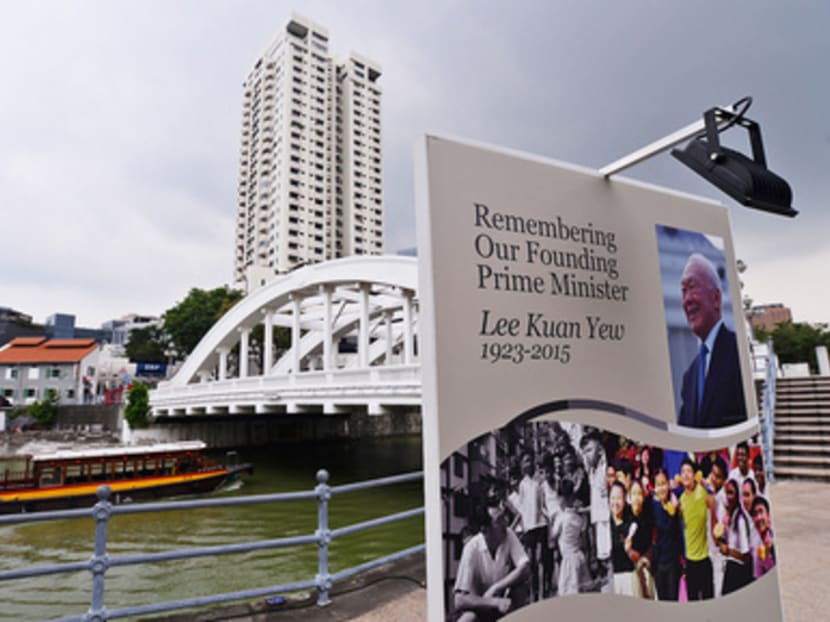
A tribute to Mr Lee Kuan Yew by the Singapore River. Mr Lee saw the need to clean up the Singapore River in 1977. Photo: Robin Choo

Madam Halimah Salleh, 68, remembers how she had to queue to fill a pail of water for her family as a child. Running water from a tap at home was a luxury then, and most Singaporeans had to queue with pails to get clean water from lorries supplied by the government that went to the villages, she said.
“When the lorry came, all of us had to rush to queue and, since only one pail was allowed per person, we had to rush home and come back out again ... I had nine siblings, but only the older ones did the manual work,” said the retiree, in Malay.
Mdm Halimah, a Punggol resident for five years, was among the visitors to Punggol’s inaugural Waterway Day last Sunday, an event that also commemorated the first death anniversary of Mr Lee Kuan Yew.
Her childhood experience is vastly different from the reality today, thanks in part to the foresight by Singapore’s founding Prime Minister to ensure clean waterways, reservoirs and tap water for the people.
The late Mr Lee introduced the nation’s first Water Master Plan in 1972 that outlined long-term plans to develop sustainable local water resources for Singapore. This was to ensure that Singapore did not have to depend on Malaysia for its supply of fresh water. Singapore’s current water agreement with Malaysia will end in 2061.
Besides ensuring a sustainable and diversified water supply for future generations through the four National Taps — local catchment water, imported water, NEWater and desalinated water — Mr Lee also saw the need to clean up the Singapore River. In 1977, he challenged the Environment Ministry to clean up the river over the next 10 years.
The Singapore River today, which locals and tourists can stroll along and admire the modern skyline from comfortable river boats, is his legacy.
Mr Richard Wong, 61, agreed that the clean-up helped heighten Singapore’s profile as a tourism hub, as “tourists (who) come to Singapore tend to visit those areas of interest”.
He added: “(Previously), the Singapore River had a lot of floating debris and it was dirty and it smelled bad. No fish lived in it. After the clean-up (of) the waterway, people can even swim in it.”
Some older interviewees felt the younger generation may not be fully prepared to handle the problem of water scarcity in future, but one younger Singaporean was more confident. Mr Lai Zhenwei, 29, said Singapore could be a role model for neighbouring countries in overcoming “natural obstacles” such as “not having fresh water (sources of our own)”.
“I am pretty confident that we will reach a stage of water sustainability for the whole nation, but I think it takes the whole nation to do it together, rather than just a small party (of people) doing it,” he said. ASYRAF KAMIL
Stay in the know. Anytime. Anywhere.

Subscribe to our newsletter for the top features, insights and must reads delivered straight to your inbox.
By clicking subscribe, I agree for my personal data to be used to send me TODAY newsletters, promotional offers and for research and analysis.






