
Go beyond car-free Sundays to push people out of comfort zone: Expert
SINGAPORE — While enjoyable, car-free Sundays do little to shift people’s attitudes enough to make them switch from cars to more environment-friendly modes of transport, an expert said.
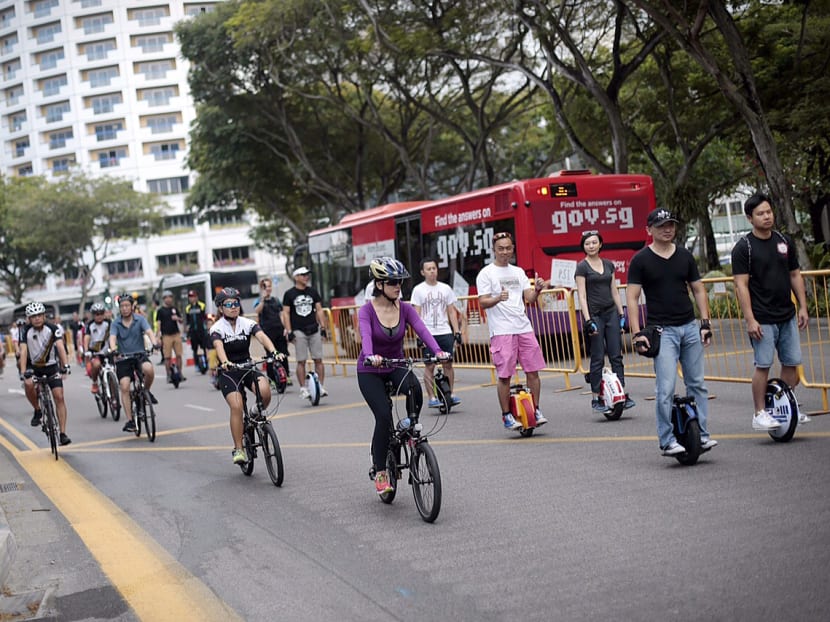
People take part in car-free Sunday on March 27, 2016. Photo: Jason Quah



SINGAPORE — While enjoyable, car-free Sundays do little to shift people’s attitudes enough to make them switch from cars to more environment-friendly modes of transport, an expert said.
This is because such car-free days do not affect people’s “day-to-day” lives and do not compel them to re-organise their routines to be more green-conscious.
Mr Konrad Otto-Zimmermann, a former secretary-general of ICLEI — Local Governments for Sustainability, was speaking to TODAY on Monday (July 11) after a panel discussion on the role of sustainable urban mobility in creating liveable cities at the World Cities Summit, which is being held here until Thursday. ICLEI is a global network of more than 1,500 cities, towns and regions committed to preparing cities and governments for a sustainable future.
Commenting further on Singapore’s car-free Sunday initiative, Mr Otto-Zimmermann said that efforts must go beyond such events if cities are to change how people move and how streets are used in the long haul.
“(Car-free Sundays are) enjoyable; you can drink, you can eat, you can cycle. But it’s of not so much value when you want to change people’s attitudes,” he said.
For example, he said, car-free Sundays could be expanded to cover a greater number of days, such as Friday to Saturday, or ideally, all weekdays.
“In some cities, we have tried events that were a full month, so that nobody could work around that,” he added.
Citing an example, he said that the Haenggung-dong neighbourhood in the South Korean city of Suwon, about 30km south of Seoul, went car-free for the month of September in 2013. The effort was part of the EcoMobility World Festival, a programme that Mr Otto-Zimmermann initiated in his role now as the creative director of The Urban Idea, a creative studio promoting eco-mobility as a way to improve cities.
Residents of the neighbourhood, comprising about 4,300 people and 1,500 cars, had to “reorganise their daily schedules and adopt eco-mobility as their mode of mobility”, he said.
Another panellist at the World Cities Summit discussion, former Chicago and Washington DC transportation chief Gabe Klein, observed that Singapore excelled at large infrastructural projects, such as building MRT lines, but the city struggled in other areas, such as taking street space away from cars.
He was asked what was the most important step Singapore should take to go car-lite. Acknowledging that changing the culture here is tough, Mr Klein recounted a meeting with the Land Transport Authority, where he told the agency that certain steps must simply be taken.
“You just have to do it, and you have to explain to the public and... stakeholders, not (in terms of) we want your feedback on whether we should do it or not,” he said.
“You have to say we’re going to do it and we want your feedback on how to do it, and you get a very different response.”
Among the panellists was Copenhagen’s mayor for environmental and technical affairs, Mr Morten Kabell, who said that the key to nudging people towards cycling as a mode of transport was to build infrastructure.
“Building a coherent network... that reaches all parts of the city, makes it possible to go wherever you want, from A to B,” he said, adding that a comprehensive cycling network made people feel safe to be on a bicycle. More than 40 per cent of the Danish capital’s population commute by bicycle today, he said.
In Singapore, the authorities have been making efforts to realise the Government’s goal of being a car-lite city.
Ang Mo Kio, for instance, is being transformed into a model walking and cycling town, with the first phase of works featuring a 4km cycling path completed and launched by Prime Minister Lee Hsien Loong last Saturday.
When rolled out completely in 2019, the town will have a cycling path network totalling 20km, the longest in any residential town here.
In February, the Government launched a six-month pilot to close about 5km of roads around the central business and civic districts every last Sunday of the month. The pilot ends this month, but car-free Sundays will resume in October, possibly spanning a bigger area.
The panel discussion on Monday was organised by the Centre for Liveable Cities (CLC) and the Urban Land Institute as they unveiled their preliminary recommendations from a joint research project on preparing cities to take on a car-lite urban mobility future.
The project’s final publication will be unveiled in October.
Among the 10 key recommendations is expanding public transport amenities to meet first- and last-mile needs — commuting from bus interchanges and train stations to homes, for instance.
Public transport providers must foster strong “intermodal” partnerships with taxi, car-sharing and bicycle-sharing providers to “complete the trip ecosystem”, they recommended.
There was also a need to put a stop to cheap and easy parking. One proposed strategy was to consider a more stringent parking provision framework, while calibrating standards against factors such as accessibility to public transport.
Pointing out that 12 per cent of Singapore’s land area is already devoted to transport infrastructure, CLC’s director of research Hee Limin said that Singapore could not afford to increase road space.
“Adopting a car-lite mobility is not really a matter of choice, but something we really have to do,” she said.
Stay in the know. Anytime. Anywhere.

Subscribe to our newsletter for the top features, insights and must reads delivered straight to your inbox.
By clicking subscribe, I agree for my personal data to be used to send me TODAY newsletters, promotional offers and for research and analysis.






