
Government to ensure ‘Singapore society remains fair’
SINGAPORE — The Government yesterday pledged to intervene “boldly” to ensure Singapore society remains fair and just, while ensuring that policies “can be funded and sustained, well into our children’s generation”.
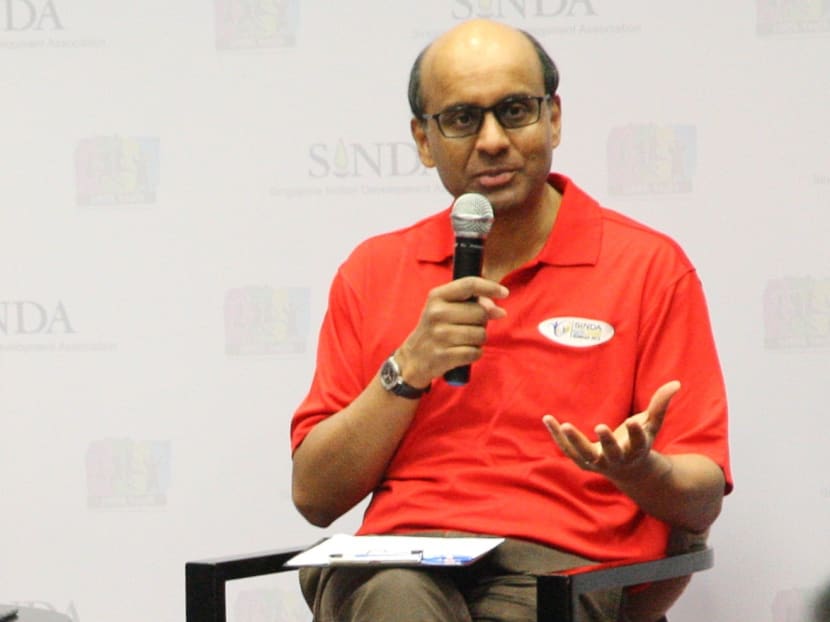
Deputy Prime Minister Tharman Shanmugaratnam. TODAY file photo

SINGAPORE — The Government yesterday pledged to intervene “boldly” to ensure Singapore society remains fair and just, while ensuring that policies “can be funded and sustained, well into our children’s generation”.
Speaking at an event admitting 101 medical specialists as fellows of the Academy of Medicine, Singapore, Deputy Prime Minister Tharman Shanmugaratnam laid out five future priorities, so that policies for a fair society “are not just for two or three electoral terms, but for generations ahead”.
And while the Republic faces “many challenges” — such as keeping median incomes growing and social mobility up — it is starting from a position of strength, with among the best education systems and most successful housing programmes in the world alongside “one of the better healthcare systems” around.
Mr Tharman also pointed out that while the more mature economies built up large debts during their rapid growth years, Singapore did the opposite and built up savings.
“They will now have to take significant sums from their budgets each year — at least 2 per cent of gross domestic product — to service these national debts. We are in the opposite position of being able to get 2 per cent of GDP from the income on our reserves, to spend each year on our social and economic priorities,” said Mr Tharman, who delivered the biennial Gordon Arthur Ransome Oration, which is held during the Singapore-Malaysia Congress of Medicine.
Prime Minister Lee Hsien Loong on Sunday had charted a “new way forward” in his National Day Rally speech, where the Government and community would play a greater role to support individuals. Mr Tharman said last night that the Government is “doing so with our eyes open”, but redistribution efforts to maintain a fair society must not reduce its vim and energy.
Rising inequality in Singapore has come about due to globalisation and the transformation in education standards over a single generation, he said. The latter means that while one in two aged above 55 have primary education or less, many more younger Singaporeans are getting secondary and tertiary education.
As a result, both low- and highly educated cohorts are in the workforce at the same time, and the Government is helping older workers and working with companies to increase salaries for the lowest-paying jobs.
Inequality is “not new”, and has been high in Singapore since the ’80s given its nature of city-state and hub economy. The Gini coefficient — an indicator of inequality that varies between 0 and 1, with a higher number indicating greater inequality — was 0.44 in 1980. Now, after taxes and transfers are factored in, it stands at 0.46.
Neither did an increase in inequality happen recently — it rose from the late 1990s and is hence not the result of economic growth strategies in recent years, said Mr Tharman.
Inequality does not mean economic policies are failing, he said. It has been accompanied by a “significant increase in standards of living for most of the population over the years”, with the income of the bottom 20 per cent of households increasing by 60 per cent over the last 20 years.
He noted that higher inequality and slowing or stagnating incomes for the majority are testing social systems all over the world. “Established approaches to economic and social policy are being questioned, and new solutions being sought,” Mr Tharman said.
While Singapore will continue to watch and learn from the experiences of other societies, he said policies such as targeted subsidies designed to reinforce individual responsibility as well as a progressive tax and benefits system will remain.
The Government will preserve and build on the progressive system of taxes and subsidies even when it finds it necessary in future to raise revenues to support growing healthcare needs, said Mr Tharman, who is also Finance Minister.
The Republic’s tax system is “more progressive than meets the eye”. Income taxes for the top income bracket is 20 per cent, but with the Government’s Workfare programme supplementing 20 to 30 per cent of the income of older, lower-earning workers, “our income tax schedule is actually 50 percentage points wide”, he said.
The system is even more progressive when housing grants and other subsidies are factored in. Taking Workfare together with housing grants, low-income couples at the 10th percentile of the income ladder are provided with benefits equal to about 30 per cent of their lifetime incomes — a conservative estimate, according to Mr Tharman.
And government spending and subsidies should be designed to reinforce individual effort and responsibility, as these are values that keep society strong, said Mr Tharman.
“This is not about leaving things to self-reliance, or about leaving families to face uncertainties on their own,” he said. “It may be a paradox, but this paradox of active government support for self-reliance has to run through all our social policies. It is how we help people to stand with pride and contribute to society.”
Stay in the know. Anytime. Anywhere.

Subscribe to our newsletter for the top features, insights and must reads delivered straight to your inbox.
By clicking subscribe, I agree for my personal data to be used to send me TODAY newsletters, promotional offers and for research and analysis.






