
Grass-cutting goes automatic during NParks trial at public gardens
SINGAPORE — Robotic mowers could soon be used to maintain the lawns in Singapore’s parks and gardens.
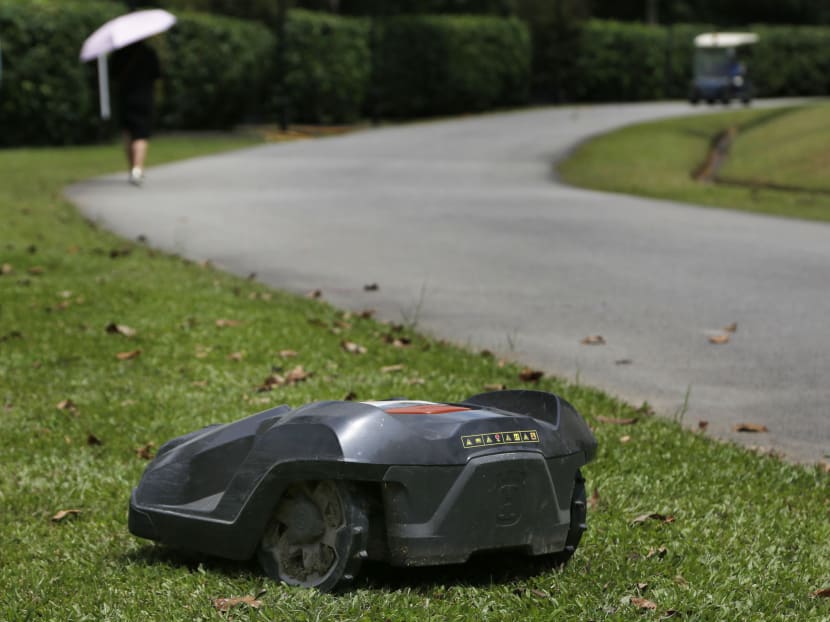
Nparks has just recently tested out robotic lawnmowers in a trial at Botanic Gardens. They are considering using such robotic mowers to maintain the greenery in its parks. Photo:Raj Nadarajan/TODAY

SINGAPORE — Robotic mowers could soon be used to maintain the lawns in Singapore’s parks and gardens.
The National Parks Board (NParks) conducted a trial recently for such mowers at Singapore Botanic Gardens which ended on Jan 10 after about two months. A demonstration of the robotic lawn mower was also conducted at HortPark in August last year, as part of the Landscape Industry Fair.
The machines, which operate like robotic vacuum cleaners that are made for home use, were tested for safety and battery life, among other things.
Responding to queries from TODAY, Mr Tan Chong Lee, assistant chief executive officer of corporate development and services at NParks, said that the robotic mowers could “reduce reliance on manpower and ensure that our lawns are well-maintained throughout the year”.
This is part of its efforts to ramp up productivity, and using these robotic mowers can potentially reduce reliance on manpower by half, TODAY understands.
However, manual labour is still needed to work on certain parts of the landscape, because the robotic mower is not able to trim the edges if there is a kerb, for instance.
At the Singapore Botanic Gardens, the Husqvarna Automower is provided and installed by landscaping company Greenova Landscape. Its owner Gerald Tan explained that once a boundary wire is set up around the field, the mower would cut within the designated area at a scheduled time, and return to its base to be charged when the battery is low. It is “designed to cut 24/7”, he added.
Another advantage is that as it is able to cut the grass continuously, the grass clippings would be small and would fall and be left on the ground to act as fertiliser, reducing the need for someone to manually clear the grass clippings.
As part of its security and safety systems, the mower can be tracked with its in-built GPS (global positioning system), and can be controlled remotely through the user’s smartphone application. There is also an anti-theft alarm.
The downside is that this piece of high-tech equipment comes with a high initial cost due to the “tedious” installation work, Mr Gerald Tan said.
One set costs S$2,000 and has the capacity to work on a 600sqm area, while a S$5,300 set can cover 5,000sqm.
Such robotic mowers are already being used in private homes, Mr Tan added.
Pointing to how the Government is encouraging everyone to work towards building a smart nation, Mr Gerald Tan said that “a focus on automation and green technology will be the way ahead for lawn maintenance”.
Apart from this project, NParks has been exploring other smart technologies to raise efficiency, such as deploying GPS and Lidar (Light Detection and Ranging) sensors to remotely track grass-cutting operations and detect the height of grass. This cuts down on the manpower needed for onsite inspections.
Stay in the know. Anytime. Anywhere.

Subscribe to our newsletter for the top features, insights and must reads delivered straight to your inbox.
By clicking subscribe, I agree for my personal data to be used to send me TODAY newsletters, promotional offers and for research and analysis.






