
Hri Kumar slams COE tweak, urges push for cleaner cars
SINGAPORE — The change to the Certificate of Entitlement (COE) system announced last week was a “lost opportunity” for the Land Transport Authority (LTA) to “articulate a meaningful strategy or provide a clear vision” that Singaporeans could support, said Member of Parliament (Bishan-Toa Payoh GRC) Hri Kumar Nair yesterday.
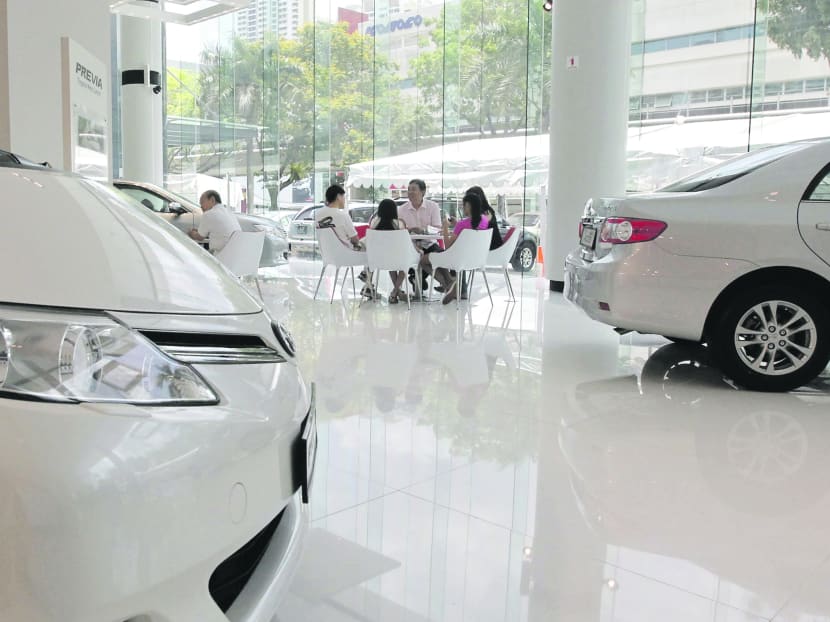
TODAY file photo

SINGAPORE — The change to the Certificate of Entitlement (COE) system announced last week was a “lost opportunity” for the Land Transport Authority (LTA) to “articulate a meaningful strategy or provide a clear vision” that Singaporeans could support, said Member of Parliament (Bishan-Toa Payoh GRC) Hri Kumar Nair yesterday.
Instead, the move to impose a cap on the engine power of cars under Category A — which would shift certain luxury makes from the small car category into Category B — was “in short, an act of appeasement”, wrote Mr Hri Kumar in a Facebook post.
Last Monday, the LTA announced that cars under Category A of the COE system must have an engine power output of not more than 130 brake horsepower, on top of having engine capacities of not more than 1,600cc. The change, which will kick in from February next year, will bump these cars to Category B.
Mr Hri Kumar argued that “differentiating cars by engine capacities and power output is meaningless”. “Indeed, as some have rightly pointed out, we now disadvantage cars with more efficient engines. How does that make sense?” he questioned.
He added: “Appeasement never works. If a system has no backbone, it will wilt under pressure.”
His critical comments come less than a week after Robert Bosch (South East Asia) — one of the world’s leading suppliers of automotive components — called on the LTA to “reconsider” the new criteria for Category A cars. Among other things, Bosch said the change would bring cars with “outdated technologies” into the market.
In response, the LTA said carbon emissions are already accounted for under the Carbon Emissions-based Vehicle Scheme (CEVS). It added that carbon emissions and fuel efficiency are not good proxies for the value of a car — and could end up penalising mass-market models.
With COEs controlling the number of cars on the road, the LTA should then “focus on what type of cars we should promote”, suggested Mr Hri Kumar, noting that “very few will disagree that we should encourage cleaner, quieter, more energy-efficient cars”.
“If 1.3L turbo-charged car is cleaner and more efficient than a 1.6L car, should we not encourage more people to buy the former?” he said.
To ensure an element of social equity — LTA’s reason for tweaking the COE framework — Mr Hri Kumar said this could be achieved by allocating more COEs to cleaner cars and bringing down their prices so that they are more affordable.
He added that Singapore could consider pursuing a vision with more electric cars on the road.
By mandating all new public and private housing developments, malls and commercial car parks have sufficient charging stations, for instance, the Government could create the infrastructure that will encourage consumers to buy an electric car, he said.
While National University of Singapore transport researcher Lee Der Horng agreed with Mr Hri Kumar’s suggestion of allocating more COEs to cleaner cars, he said “more detailed, thorough standards” have to be set first.
On top of the CEVS — which looks at the vehicle’s carbon emission and fuel efficiency — other criteria that look at the pollutant output levels of cars, such as that of sulphur oxide, nitrogen oxide and particulate matter, could also be considered.
“So, the moment we have that, we are in the position to allocate more COEs to cleaner vehicles,” he said.
Singapore Vehicle Traders Association Honorary Secretary Raymond Tang, however, felt that the change is a targeted move to reclassify cars and introduce fairness to the mass-market Category A system.
Many powerful cars have encroached into Category A over the years, Chairman of the Government Parliamentary Committee for Transport Cedric Foo pointed out. “Whenever we try to build in social equity, there will always be different voices as to who has merits to own a car, so we’ll never be able to satisfy that,” he said.
There are other ways to achieve other objectives of emissions, efficiency and progressivity of taxes, Mr Foo added, pointing to the CEVS and the Additional Registration Fee scheme as examples.
With the COE system being “fundamentally a congestion measure”, Mr Foo said: “I don’t think the COE is such a tool where you can embed every single objective into.”
Related topics
transportStay in the know. Anytime. Anywhere.

Subscribe to our newsletter for the top features, insights and must reads delivered straight to your inbox.
By clicking subscribe, I agree for my personal data to be used to send me TODAY newsletters, promotional offers and for research and analysis.






