
Inquiry panel tasked with identifying factors behind riot
SINGAPORE — Beyond establishing how last Sunday’s riot in Little India unfolded and how the authorities managed the incident, the Committee of Inquiry (COI) appointed yesterday by Deputy Prime Minister Teo Chee Hean will also identify the factors and circumstances that led to the Republic’s worst outbreak of violence in more than 40 years.
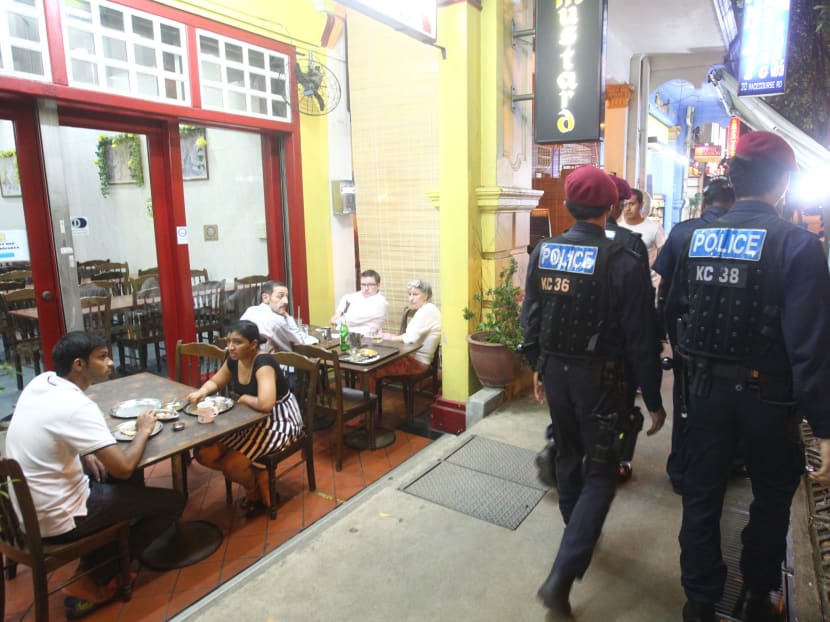
Police patrols along Race Course Road. Photo: Ernest Chua

SINGAPORE — Beyond establishing how last Sunday’s riot in Little India unfolded and how the authorities managed the incident, the Committee of Inquiry (COI) appointed yesterday by Deputy Prime Minister Teo Chee Hean will also identify the factors and circumstances that led to the Republic’s worst outbreak of violence in more than 40 years.
The four-member committee, headed by former Supreme Court judge G Pannir Selvam, will review whether current measures to manage such incidents in areas where foreign workers congregate are adequate. It could also recommend further measures to improve the management of these incidents and prevent such incidents from recurring.
The committee has been tasked to submit a report of its findings and recommendations within six months, and the findings will be made public.
Mr Teo, who is also Home Affairs Minister, said the COI comprises individuals who are “experienced in the law, understand security requirements and are familiar with workers’ issues as well as in managing relations between the community and workers”. Mr Selvam, who has the discretion to decide on the manner of the inquiry, is keen to start work “as soon as possible”, added Mr Teo.
The announcement came as the police said last night that a 31-year-old Indian national will be charged in court today with rioting. So far, 31 Indian nationals, aged between 22 and 45, have been charged in connection with the incident.
Speaking to reporters, Mr Teo said the COI will determine the causes of the riot and make recommendations, and is separate from the ongoing police investigations. An inter-ministry committee has been set up to look into issues concerning foreign workers’ grievances, he added.
In a Facebook post last night, Acting Manpower Minister Tan Chuan-Jin said the workers involved were housed in different dormitories and were employed by different companies. “There is nothing thus far to suggest that they have existing employment and workplace issues,” he added.
Mr Tan acknowledged that the landscape in Singapore “is not perfect”, but stressed that rogue employers formed a small group. Non-government organisations this year have referred 718 cases to the Manpower Ministry (MOM). About 3,700 employment-related claims have been dealt with by the ministry.
“We have about one million foreign workers on work permit. This amounts to less than 1 per cent of the workforce. Every problem is one case too many, but neither should we generalise without basis,” Mr Tan added.
In addition to the alcohol ban in Little India this weekend, a series of “cooling off” measures, including suspending 25 private bus services which ferry workers to the area, has been rolled out by the authorities.
Acknowledging that the restrictions may impact different segments of Singapore, Mr Teo said there is “no simple solution”. Nevertheless, the new rules are aimed at “calming the situation after the very serious incident last week,” he added.
The authorities will examine the situation again after this weekend, Mr Teo said. “Where we can, in a graduated and calibrated way, (we will) ease (these measures) in the coming weeks, so we can maintain security while allowing life to proceed as normally as possible in this area.”
The ongoing public consultation on implementing possible no-alcohol zones and restricting the hours for sale of alcohol will continue independently of the COI.
“If we have good findings from this (consultation), which are implementable, we will do so. We won’t have to wait for the COI,” Mr Teo added. “And similarly, if there are other issues we need to address, we will do so without waiting for the COI.”
Under the Inquiries Act, the COI Chairman has the discretion to decide on the manner of the inquiry, such as whether it will be held in open court.
Related topics
riotStay in the know. Anytime. Anywhere.

Subscribe to our newsletter for the top features, insights and must reads delivered straight to your inbox.
By clicking subscribe, I agree for my personal data to be used to send me TODAY newsletters, promotional offers and for research and analysis.