
From IPPT training to HIIT: Singapore’s soldiers to undergo revamped fitness regimes
SINGAPORE — The fitness regimes of soldiers will undergo sweeping changes from next year in the bid to maximise combat performance.
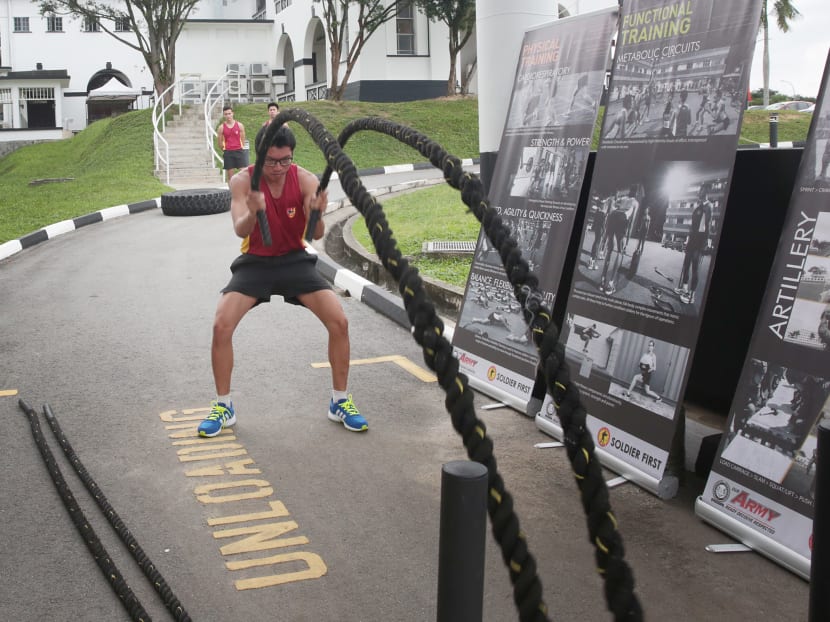
A soldier demonstrates a rope battling exercise during a media session at the Centre of Excellence for Soldier Performance on Nov 28, 2017. Photo: Jason Quah/TODAY



SINGAPORE — The fitness regimes of soldiers will undergo sweeping changes from next year in the bid to maximise combat performance.
In a shift away from a cookie-cutter style of training centred around the Individual Physical Proficiency Test (IPPT), the Singapore Armed Forces (SAF) will focus on boosting the physique of soldiers according to their vocation.
Where load lifting is a major part of the combat task, such as for artillery soldiers, exercises to strengthen the arm and back muscles will be emphasised.
And for infantry soldiers who need to bear heavy loads and walk long distances in combat, the training will focus on building core and lower-body muscles, with lower back strengthening exercises thrown in to reduce the risk of injury.
Soldiers are still required to take the IPPT. But on top of IPPT-specific training, soldiers will be exposed to new training methods such as High-Intensity Interval Training (HIIT). Proven to optimise performance within a shorter time, HIIT – which could include tyre flips, kettleball swings and rope battling – will also make training more varied and engaging.
The greater variety in physical training will extend to non-combat full-time National Servicemen and operationally ready NSmen. They may, for instance, opt for the metabolic circuit which incorporates HIIT workouts, weight loss, as well as sports and games that build agility.
The enhanced fitness programmes were crafted by about 20 experts such as sport scientists, nutritionists, physiotherapists and psychologists at the new Centre of Excellence for Soldier Performance (CESP).
Noting that some NSmen tend to intensify physical training in preparation for IPPT, CESP exercise scientist Cheryl Lim said the programmes seek to build a “fitness culture so (that) fitness exists as a continuum throughout (a soldier’s) two years (of full-time NS) plus 10 (years of operationally ready NS), instead of ramping it up for specific fitness tests”.
This is done by expanding “repetitive, mundane sort of fitness trainings” to include a “repertoire of fitness training modalities”, she said.
Speaking at its inauguration on Friday (Dec 1), Second Minister for Defence Ong Ye Kung said performance science already plays a major role in sport.
Citing an example from his favourite team in the English Premier League – understood to be Manchester United – he said its manager would only let a star player of the team play only up to 60 minutes of a match to avoid aggravating his old injury.
“During my time (as) sportsmen, we were asked to play through pain,” he said. “If even in the competition of football and sports, the science for performance has received so much attention, what more the competition of sovereignty and our dignity. The SAF will therefore also do so, and do it well.”
The CESP merges three centres: The Soldier Performance Centre focused on injury rehabilitation, heat injury prevention and building hydration standards; the Army Fitness Centre; and the Soldier Systems Integration Lab, which designs systems and equipment to optimise soldier performance. They were set up in 2004, 2005 and 2016 respectively.
Colonel Andrew Lim, commander of the 9th Division and Chief Infantry Officer, said the changes are already afoot for vocations like the infantry. Instead of “rushing them into carrying heavy loads too fast too soon” – which may increase the chances of injuries – they are building their core strength with specialised equipment.
Infantry soldiers’ diets have also been tweaked to maximise their training. In addition to the usual breakfast, lunch, dinner and a snack at night, there will now be pre-workout snacks to enhance performance and recovery.
Two sets of snacks could be given out in a day – a sweetcorn bun with a pack of low-fat milk, or a whole grain muesli bar with a pack of soy bean milk, for example. Containing about 250 calories, each set makes up about 9 per cent of the soldiers’ daily recommended dietary allowance.
Soldiers may also be given wearable tech in the future to monitor their individual performance so their training can be tweaked accordingly, said Senior Lieutenant Colonel (SLTC) Yee Kok Meng, who heads the centre.
The centre also aims to boost mental resilience and injury management.
From July to September, some Basic Military Training recruits underwent a more structured curriculum that included civilian-military transition, anxiety control, positive framing, stress management and self-confidence.
This paves the way for task-specific courses to strengthen resilience post-BMT, which will be tied to the soldiers’ vocation. Trials are expected to begin next year and could involve gradual exposure to stressors typically encountered in operational settings.
“Such training will increase their situational awareness, improve their adaptive skills, and strengthen them holistically as individuals,” said Mr Ong.
As for injury management, soldiers in rehabilitation will be expected to keep up their overall fitness by strengthening other muscle groups. Soldiers will also have their pre-existing injuries or weak joints identified and addressed through specific strength and conditioning exercises.
Stay in the know. Anytime. Anywhere.

Subscribe to our newsletter for the top features, insights and must reads delivered straight to your inbox.
By clicking subscribe, I agree for my personal data to be used to send me TODAY newsletters, promotional offers and for research and analysis.