
Main spark of Little India riot was accident: Inquiry panel
SINGAPORE — After a six-month inquest into the Little India riot, the Committee of Inquiry (COI) has determined that the incident was triggered by a fatal traffic accident and escalated into a full-blown riot by three factors: An alcohol-fuelled crowd, a misperception that the responders were trying to protect the bus driver and timekeeper instead of attending to the victim, and that the rioters desired “street justice” that is prevalent in their own cultures.
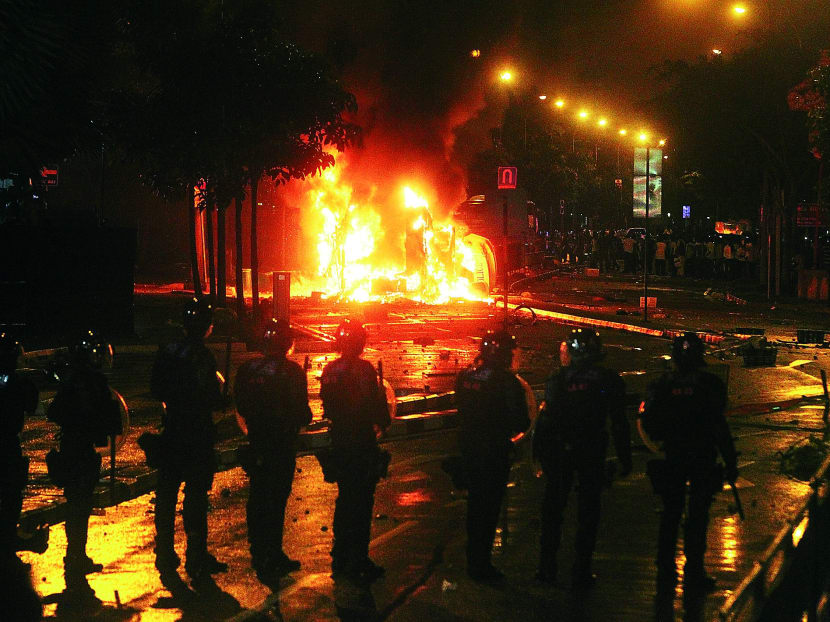
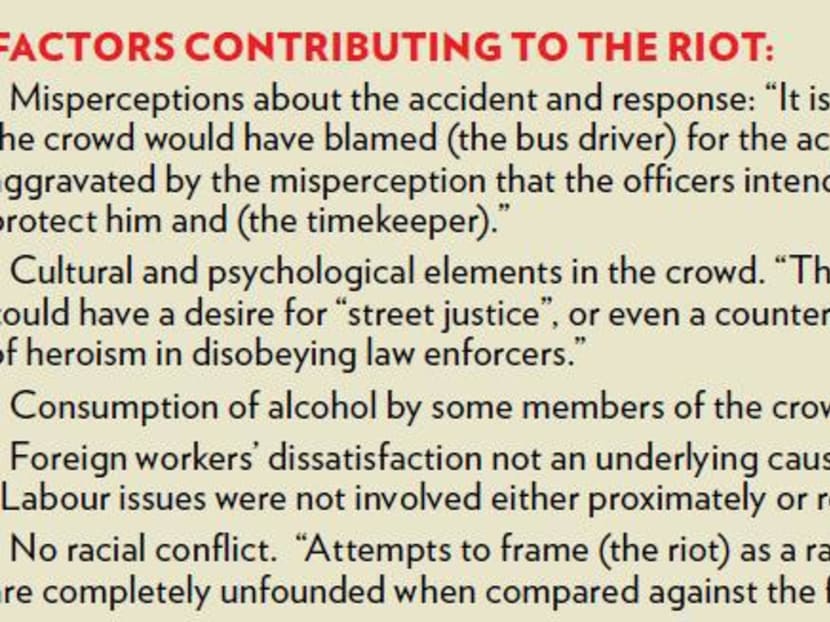

SINGAPORE — After a six-month inquest into the Little India riot, the Committee of Inquiry (COI) has determined that the incident was triggered by a fatal traffic accident and escalated into a full-blown riot by three factors: An alcohol-fuelled crowd, a misperception that the responders were trying to protect the bus driver and timekeeper instead of attending to the victim, and that the rioters desired “street justice” that is prevalent in their own cultures.
The 76-page report by the COI, which interviewed more than 300 witnesses and held a public inquiry, was submitted to Deputy Prime Minister and Home Affairs Minister Teo Chee Hean last Friday. It was released to the public yesterday.
Apart from determining what caused the riot, the four-member committee chaired by former Supreme Court Judge G Pannir Selvam also concluded what did not: “Based on the evidence gathered, the COI does not think that the riot was a result of dissatisfaction among foreign workers with their employment and living conditions in Singapore.”
It was also not a racial conflict. “Attempts to frame (the riot) as a racial issue are completely unfounded when compared against the facts. Racial or ethnic issues did not arise from any of the evidence tendered or discussions the COI had with a spectrum of witnesses,” the report said.
While the COI praised the initial response of the Singapore Civil Defence Force and the Singapore Police Force, it criticised the police officers’ decision to hold their positions instead of confronting the rioters pending the arrival of the Special Operations Command.
Tanglin Division Commander Lu Yeow Lim had said during the public inquiry that he made the call because his troops were outnumbered. But the COI disagreed. There were sufficient officers to make arrests and their inaction emboldened the rioters. “The rioters were destroying property and pelting the officers with objects, but the COI does not agree that it was a life-threatening situation,” the report said.
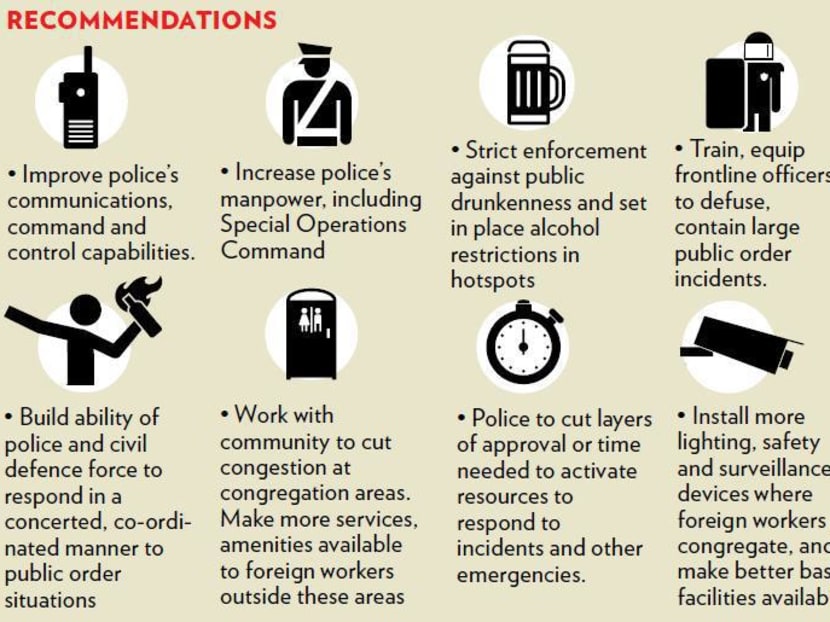
In all, the committee made eight recommendations, which include improving the police’s communications, command and control capabilities, training and equipping frontline officers to effectively defuse and contain large-scale public order incidents, as well as increasing police manpower resources. It also recommended making more services and amenities available to foreign workers outside of the usual areas where they congregate.
In a letter addressed to the committee, Mr Teo said the Ministry of Home Affairs and the Ministry of Manpower will study the report and its recommendations carefully. Mr Teo and Manpower Minister Tan Chuan-Jin are expected to deliver ministerial statements in response to the report when Parliament sits on Monday.
As part of its work, the COI conducted visits to foreign worker dormitories and spoke to many migrant labourers. It also interviewed 20 of 57 foreign workers who were repatriated in December last year for their involvement in the riot before they left the country.
The COI concluded that the primary cause of the Dec 8 riot was a traffic accident at the junction of Race Course Road and Hampshire Road, in which Indian national Sakthivel Kumaravelu, 33, was run over by a private bus ferrying foreign workers back to their dormitories. The report said the crowd misunderstood that the SCDF and police officers at the scene were protecting bus driver Lee Kim Huat — who subsequently underwent a criminal investigation and was cleared of all charges — and timekeeper Wong Geck Woon instead of arresting them.
Dr Majeed Khader, senior consultant psychologist at the Home Team Behavioural Sciences Centre, convened a behavioural analysis group at the request of the COI Investigation Team. After a review of scientific literature on crowd psychology in addition to all of the available evidence, the group felt that what happened “violated (the crowd’s) expectations that the responding agencies ought to be fair and to respond to the deceased first rather than to the locals”. The group also identified the rioters’ desire for “street justice” or “retributive justice” as a contributory factor.
The group noted: “In many countries and especially in rural and sub-urban settings, there is a ‘retaliatory ethic’ and a sense of the need for retribution for ‘wrongdoing’.” Witnesses who lived in India testified that such a mindset was predominant in the country.
The COI said the role of alcohol in the riot was discussed widely following the riot. It did not think that alcohol was a direct cause of the riot. However, it was a major contributory factor. “Many of the foreign workers the COI spoke with who had been present at the scene of the riot admitted to having consumed alcohol that night,” the committee said. It pointed out that one of the foreign workers who had been convicted of rioting told the COI he was so drunk that he did not remember what he had done, until he was shown video footage later.
The incident involved 400 rioters and injured dozens of police officers and SCDF personnel, as well as damaging public property and vehicles. About 200 foreign workers were issued formal police advisories, while more than 20 were charged. Twelve men have been convicted to date.
CORRECTION: The original article said that to date three men have been convicted for their involvement in the riot. This is incorrect. It should be 12 men. We apologise for the error.
Related topics
riotStay in the know. Anytime. Anywhere.

Subscribe to our newsletter for the top features, insights and must reads delivered straight to your inbox.
By clicking subscribe, I agree for my personal data to be used to send me TODAY newsletters, promotional offers and for research and analysis.






