
Minority representation for Elected Presidency not 'tokenism', says PM Lee
SINGAPORE – Addressing concerns from the minority races over a seemingly easy ride into the Istana should changes be made to the Elected Presidency (EP) scheme to ensure minority representation, Prime Minister Lee Hsien Loong noted that such sentiments were entirely understandable and reflected the Republic’s success in building a meritocratic system.
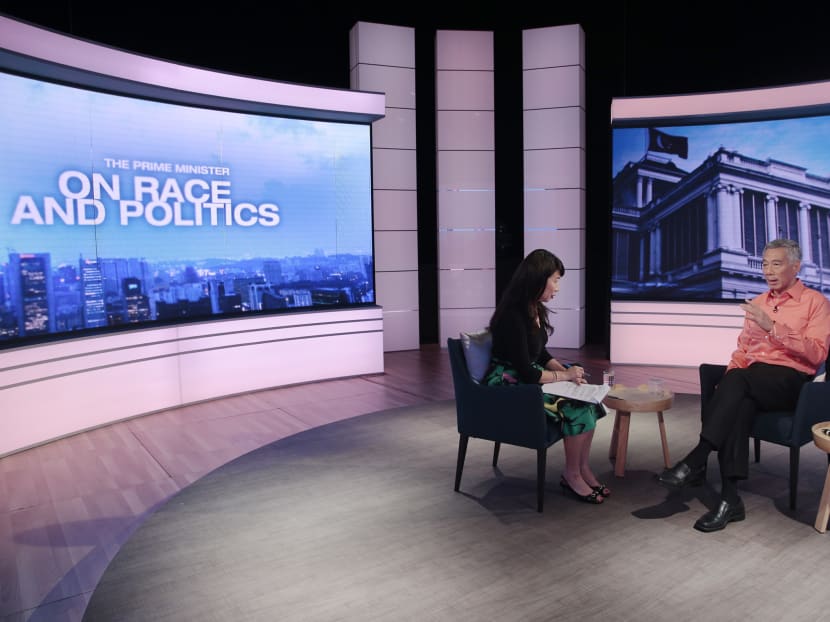
Prime Minister Lee Hsien Loong (right), during his interview about race and politics. Photo: Jason Quah

SINGAPORE – Addressing concerns from the minority races over a seemingly easy ride into the Istana should changes be made to the Elected Presidency (EP) scheme to ensure minority representation, Prime Minister Lee Hsien Loong noted that such sentiments were entirely understandable and reflected the Republic’s success in building a meritocratic system.
“People want to succeed on their own merits. Nobody wants to come in on a free ride and see that standards have been lowered for a particular race,” said Mr Lee in a Mediacorp interview on race and politics which was aired on Sunday (Sept 4).
Dismissing the notion of tokenism, he stressed that the same qualifying criteria for the EP would apply to all races, without “any relaxation or any doubt” that the elected candidate is qualified.
Faced with the reality of a smaller pool of qualified minority candidates, compared to the Chinese, Mr Lee believes that the numbers will grow over time, as the various communities continue to progress in the private and public sectors, and minorities climb the ranks.
While the numbers game involving minority candidates would become “less of a problem” in time, getting them elected as president “is something which we have to continue to pay attention to”, he said.
Before Singapore’s first presidential election was held in 1993, the country had “eminently qualified” minority presidents such as Mr Yusof Ishak, Mr Devan Nair and Mr Benjamin Sheares.
“They were appointed by Parliament and they served with distinction,” said Mr Lee. “I think we want a mechanism which can produce this kind of outcome (and) this kind of diversity as an assured outcome, which presently, we don’t have.”
He stressed that the move was “a very necessary symbolism” of Singapore’s multiracial society. Other diverse countries, such as Switzerland and New Zealand, have already put in place a system to ensure fair representation.
Acknowledging that it is a concern that a minority candidate could lose to a Chinese rival even if the former is more eminently qualified, the Prime Minister noted that while any voter would insist that he or she supported the best candidate, the very definition of “best” was subjective, and hinged on factors such as a common language, race and identity.
Mr Lee stressed: “We must have a minority president from time to time, a non-Chinese, a Malay one, an Indian or other minority, and then people see that yes, this is my country, someone like me can become the head of state (and) can represent the country.”
Furthermore, the push for minorities to take on the mantle of President on a regular basis harks back to Singapore’s early days of fostering a harmonious and multiracial society, with the Chinese majority taking “an extra step” to ensure that minorities had equal opportunities.
“We’re here today as a multi-racial society because the majority Chinese accept that we cannot be a Chinese-Chinese society ... If we had tried to be a Chinese society… insist on Chinese dominance, it would have been a very unhappy and failed Singapore,” Mr Lee said.
“If they (the Chinese population) look at (the) Elected Presidency changes in that spirit – this is part of being a harmonious, happy multi-racial society – then I think people will understand and will accept and support,” he added.
In Mr Lee’s prepared speech for the National Day Rally – which was not delivered in full after he was taken ill but was released to the media - Mr Lee pointed to Mr Barack Obama’s win in the historic 2008 presidential elections in the United States. He had noted that based on exit polls, only 43 per cent of white voters supported Mr Obama, compared with 67 per cent of Hispanic voters and 95 per cent of black voters.
“It shows that a black man can now win but it shows that race is still a big factor in American elections which is not so surprising,” Mr Lee reiterated during the Mediacorp interview.
“In Singapore, can it happen? Well not as extreme as this but I think in Singapore, race is also a factor and it puts into perspective our position that it’s something which is not quite natural, something which we have to accept and something which we have to take into account and decide what we’re going to do about it.”
Stay in the know. Anytime. Anywhere.

Subscribe to our newsletter for the top features, insights and must reads delivered straight to your inbox.
By clicking subscribe, I agree for my personal data to be used to send me TODAY newsletters, promotional offers and for research and analysis.






