
The model prosthetist sportsman
At the age of 22, Mr Desmond Tong had the world at his feet. He was about to start an undergraduate course in business administration and was an active sportsman, having represented Singapore’s judo national youth team.
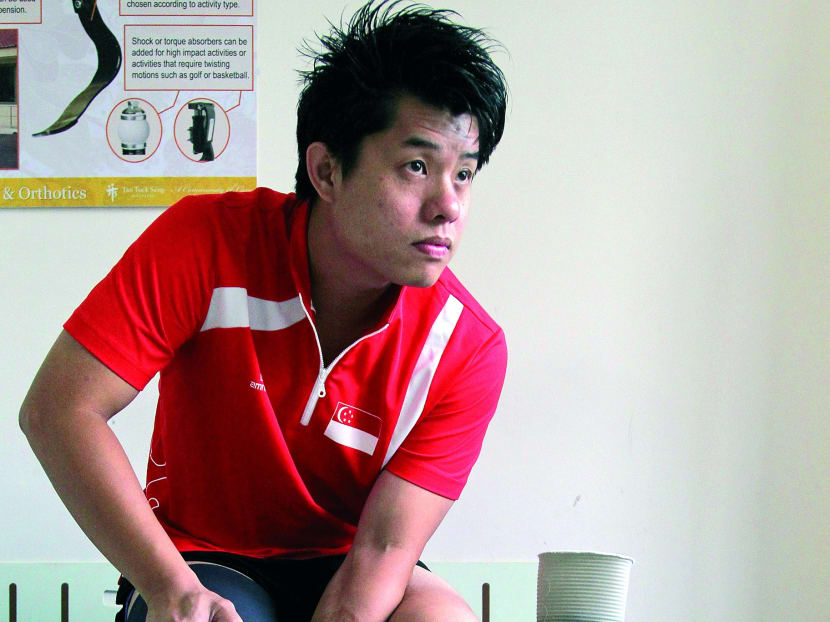
Mr Desmond Tong’s condition helped him greatly in his studies when he took up a Bachelor of Science degree in Prosthetics and Orthotics in 2007. PHOTO: DON WONG

At the age of 22, Mr Desmond Tong had the world at his feet. He was about to start an undergraduate course in business administration and was an active sportsman, having represented Singapore’s judo national youth team.
But this changed overnight: He was involved in an accident on his motorcycle, which severed his right leg from the knee down and crushed his right ankle. Doctors managed to reattach the severed part, but he had to undergo partial foot amputation and skin grafting. His ankle was reconstructed using a metal rod, leaving him with a limp and chronic pain. His suffering worsened when he developed gangrene and underwent six amputations over three months to stem the infection.
The accident in 1999, as well as the subsequent pain and trauma, took a toll on him. He dropped out of university after one semester because he felt demoralised and was ostracised by his classmates. He became depressed and suicidal for a more than a year. He cooped himself up in his room and cut off contact with his friends.
Today, after a long and difficult journey — and a decision to amputate his leg from the knee down so he can be fitted with a prosthetic limb — he has turned his life around.
Mr Tong, who got married two years ago and hopes to start a family soon, works as a prosthetist at Tan Tock Seng Hospital’s (TTSH) Foot Care and Limb Design Centre. As far as he knows, he is the only prosthetist here who uses a prosthetic leg himself, he quips. And this has helped draw him closer to his patients, whom he hopes to inspire.
“I can identify with them ... and share with them what I’ve been through, so they are more willing to listen to my advice,” he says, in a recent interview with TODAY. “I can’t help take away their pain all the time, but I can share with them how painful it was for me and that over time, it got better.”
GETTING THROUGH THE DARK TIMES
Recalling the dark times, Mr Tong says: “I felt a sense of helplessness. I was so active, doing all these sports and suddenly overnight, I couldn’t even walk and I was unsure what my future would be.”
If it were not for the support of his family, especially his mother, he feels he would not have got through that period. “They never gave up on me, no matter how ridiculous and difficult I was. They never stopped believing in me,” he says.
What struck him most was when he overheard his mother asking his doctor whether he could cut off her leg and transfer it to him. That showed him how much his mother loved him and made him realise how much his situation affected his family.
Two years after the accident, he decided to amputate his right leg from below the knee to be fitted with a prosthetic leg, which would alleviate the pain his reconstructed ankle was causing him. A prosthetic limb would also improve his mobility and allow him a chance to play sports again.
He gradually picked himself up and found work as an information technology systems administrator. His bosses knew of his condition and were supportive. During his four-year stint, he was even promoted once.
“I really appreciated that they looked at whether I could do the job, and not whether I am handicapped or not,” he said. He then worked as a property agent.
Looking back, he says it was in 2007 when his life really turned around. Encouraged by his prosthetist, he enrolled in a Bachelor of Science degree course in Prosthetics and Orthotics at the University of Salford in the United Kingdom.
He had regretted dropping out of university after the accident. Unlike his previous experience, he found himself quickly accepted by his classmates and as the only amputee in his course, they often used him as a model in class.
He excelled in the course, scoring straight As in his first year of study and snagging a scholarship from the National Healthcare Group along the way. Three years ago, he graduated with first-class honours.
His condition aided him greatly in his studies. “Being a user yourself, you understand the pressure points, the possible abrasions, what works better, and the gait dynamics and all. You have a wider perspective and can understand better,” he says.
EMBRACING LIFE
Now 37, Mr Tong’s sunny disposition made it hard to imagine how he almost succumbed to his inner demons more than a decade ago. He credits his new lease of life to his current job, which he took up upon graduation.
Apart from his day job, Mr Tong is also part of the committee that runs TTSH’s Amputee Support Group, which is a collaboration with Ang Mo Kio-Thye Hua Kwan Hospital. Once a month, the group holds sharing sessions among patients. It also organises outings four times a year.
Mr Tong also reaches out to his patients during his free time. He visits them during lunch and takes them out to dinner sometimes. Many have become his good friends as a result, he says.
He has returned to playing sports — he runs as well as plays basketball and golf. Since last year, he has started taking part in competitive sports for people with disabilities. He participated in the 100m sprint and discus event at the ASEAN Para Games earlier this year.
Mr Tong hopes to encourage more amputees to embrace life. “I want them to stop hiding behind the shadows, thinking they can’t lead a normal life because in most cases, they can if they try,” he said. “Life does not end with disability, but instead it begins with new abilities.”
He has set up a Facebook group, ASAP Singapore (Amputee Sports Activity Passion), which provides a platform for people to learn more about sports for the disabled. He also worked with the Singapore Disability Sports Council (SDSC) and managed to get prosthetic company Ossur to sponsor five prosthetic running blades — worth S$6,000 to S$7,000 apiece — for amputees who wish to use them for trial running sessions or to train for competitions.
Mr Tong says it took him about five months to prepare a proposal. “I hope to see more amputees running, say, around Bishan Park, with prosthetic legs some day. It should be a more common sight,” says Mr Tong, who also accompanies some of his patients after work or during weekends to the SDSC to introduce them to various sports.
He adds: “Sports is very rewarding ... It gives people purpose, that they can overcome challenges despite their condition. It also helps with a healthier lifestyle and allows them to make friends with those with similar conditions.”
Mr Tong is also planning to take up archery. He hopes to take part in the Paralympic Games and his biggest dream is to compete against able-bodied athletes, a feat accomplished by well-known “blade runner” Oscar Pistorius, whose achievements have been tainted by the murder charge he is facing. “Oscar’s achievement as a para-athlete is something everyone with disabilities should aim towards. We should always strive to be better and improve ourselves,” Mr Tong says.
On the personal front, Mr Tong has much to look forward to as well, including plans to start a family.
He met his wife in 2009, when he was helping out at his cousin’s pizzeria. She was a friend of his cousin’s. His wife, who works as a pharmaceutical sales representative, and her parents are extremely supportive, he says. He knows this cannot be taken for granted — he broke up with his girlfriend of six years when she was unwilling to tell her parents he was an amputee.
“We don’t want pity, we just want to be treated as normal, without discrimination or disapproval (on) other people’s faces, like we are aliens or freaks.”
Stay in the know. Anytime. Anywhere.

Subscribe to our newsletter for the top features, insights and must reads delivered straight to your inbox.
By clicking subscribe, I agree for my personal data to be used to send me TODAY newsletters, promotional offers and for research and analysis.






