
Greater number of Singaporeans not identifying with any religion
SINGAPORE — While there have been concerns about growing religiosity here in recent years, the General Household Survey 2015 report revealed that more Singapore residents are not identifying themselves with any religion, compared with the situation six years ago.
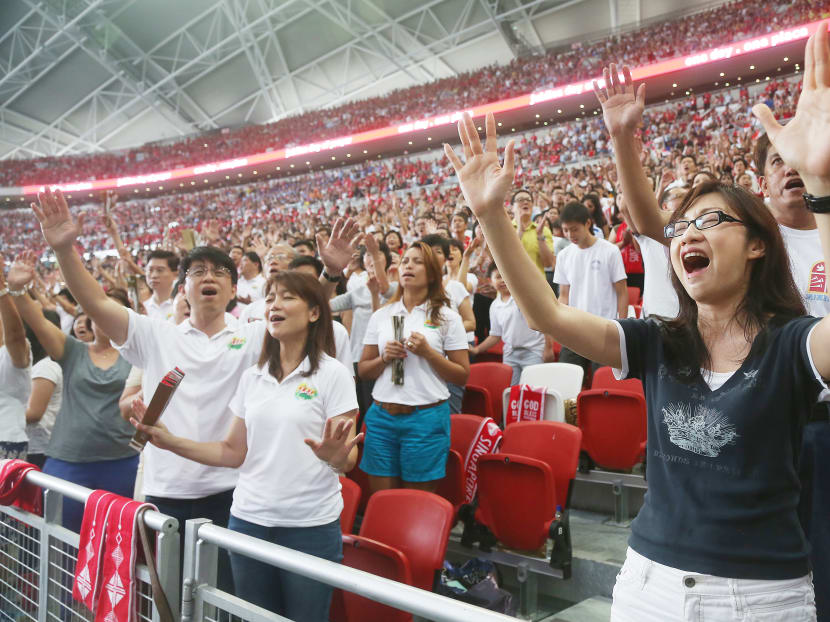
More than 50,000 Christians gathered to give thanks and pray for the growing unity among churches and within the nation at the Jubilee Day of Prayer 2015 event to
mark Singapore’s 50th year of independence in July. The share of those identifying themselves as Christians has increased marginally. Photo: Ooi Boon Keong

SINGAPORE — While there have been concerns about growing religiosity here in recent years, the General Household Survey 2015 report revealed that more Singapore residents are not identifying themselves with any religion, compared with the situation six years ago.
Those without religious affiliation took up 18.5 per cent of the Singapore resident population last year, up from the 17 per cent in 2010, with the numbers being higher among younger residents compared with 2010. Of those aged 15 to 24, 23 per cent said they had no religious affiliation, compared with 14.6 per cent among residents aged 55 and above.
Breaking it down by ethnicity, the Chinese also had a higher proportion of residents (23.3 per cent) who identified themselves as having no religious affiliation, as compared with the Malays (0.3 per cent) and Indians (1.4 per cent).
And more of the higher-educated residents were not affiliated to any religion, compared with less-educated residents. For instance, 25.8 per cent of the university graduates reported having no religious affiliations, which was higher than the 10.6 per cent among those holding below-secondary qualifications.
But while the share of those identifying themselves as Christians increased marginally while all other major religious groups declined slightly, the findings showed the religious composition of the resident population remained “relatively stable” over the five-year period.
The Singapore resident population remained diverse in their religious affiliations, where 43.2 per cent identified themselves as Buddhists or Taoists, 18.8 per cent as Christians, 14 per cent as Muslims and 5 per cent as Hindus.
Despite the proportion of those with no religious affiliation edging up, senior research fellow at the Institute of Policy Studies Mathew Mathews noted it is “hard to say whether they really don’t hold religious beliefs”.
“They may subscribe to religious beliefs, but just not feel comfortable in identifying with any single group,” he said. This growing group, he said, might also feel stronger about keeping religion out of discussions on public morality.
National University of Singapore sociologist Tan Ern Ser said it was possible to see both growing religiosity and more people without religious affiliation at the same time.
Among the religionists, their move towards fundamentalism may be a response to secularisation, added Assoc Prof Tan. The non-religionists, on the other hand, might actually have a religion, broadly defined as the belief in some supernatural beings or forces, rather than the mainstream religions.
Stay in the know. Anytime. Anywhere.

Subscribe to our newsletter for the top features, insights and must reads delivered straight to your inbox.
By clicking subscribe, I agree for my personal data to be used to send me TODAY newsletters, promotional offers and for research and analysis.






