
MP proposes piloting cluster of schools without exams, streaming
SINGAPORE — A school without high-stakes examinations or streaming, but offers 10 years of through-train education for students of all backgrounds to learn and interact together.
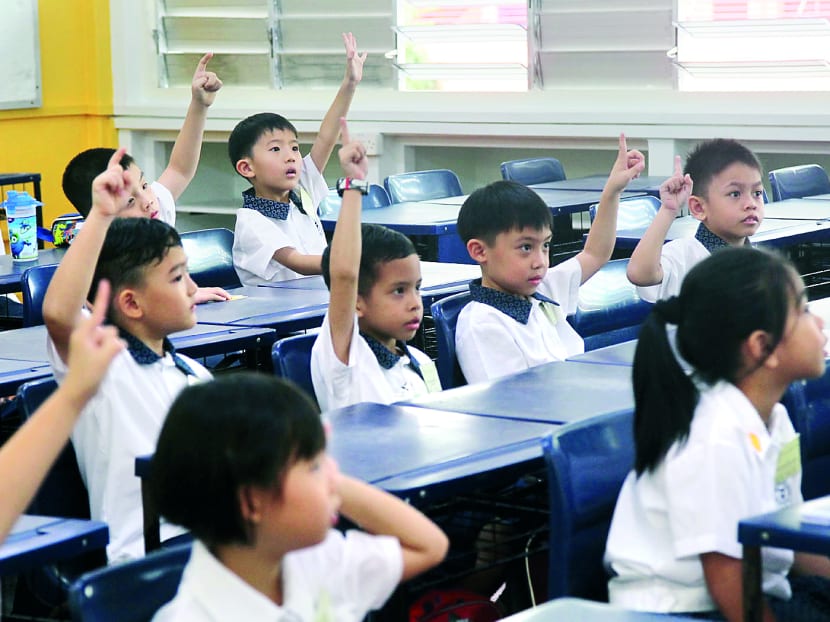
Primary One students at St Hilda's Primary School. Photo by OOI BOON KEONG.

SINGAPORE — A school without high-stakes examinations or streaming, but offers 10 years of through-train education for students of all backgrounds to learn and interact together.
Moulmein-Kallang GRC Member of Parliament (MP) Denise Phua laid out her proposal in Parliament yesterday to pilot a cluster of such schools, so as to “go beyond the current trimming of the excesses of the (education) system”.
Speaking during an adjournment motion, she called on the Ministry of Education (MOE) to experiment with the idea, just as it had started its own kindergartens.
In these pilot schools, she envisions that students will develop their own portfolios instead of being excessively tested. These schools will also be a “microcosm of society” and students will not be physically segregated into groups, but would benefit from programmes that suit their individual learning needs.
The idea of a pre-school to secondary school model had been raised in Parliament in recent years by Ms Phua herself, while Nominated MP Laurence Lien and Non-Constituency MP Yee Jenn Jong have suggested a direct primary-to-secondary-education model.
In his response, Education Minister Heng Swee Keat promised to give “serious consideration” to Ms Phua’s proposal. However, he stressed the importance of ensuring that changes are made horizontally across the board. For example, with innovations in curriculum, such as inquiry-based learning for science, their impact is felt across the entire school system.
He also cited coming policy shifts, such as tweaks to the Primary School Leaving Examination (PSLE) scoring mechanism and reservation of places at Primary One.
“We are changing at a pace that allows our students, parents and educators to adapt and to build capacity to sustain these changes,” added Mr Heng. As systemic changes are implemented, he reiterated that pacing and prioritisation are critical.
Ms Phua acknowledged these future enhancements to the education system, but noted that pervasive challenges still dot the current landscape.
Among other things, she pointed to the excessive focus on academic performance among Singaporeans, as well as the Direct School Admissions potentially opening up another form of competition for schools to admit students talented in sports, arts or leadership fields.
She also singled out the tuition conundrum, where the recent global education survey Programme for International Student Assessment showed Singapore as having the highest number of pupils with one-on-one tuition. “The longer we delay in working out a multiple of solutions, and thereby allow this thriving shadow education industry to keep growing, the harder it will be for us to trim this elephant to size,” added Ms Phua.
Mr Heng noted that these education issues are the result of a complex mix of policy, expectations, mindsets, perception and ground realties. While there may be criticisms, he pointed out that Singapore’s education system is highly regarded internationally as academic excellence is encouraged here, among other things. “We must be careful not to throw the baby out with the bathwater … We need a balance,” said Mr Heng.
Ms Phua stressed that she is not seeking to copy the much-touted Finnish education system, where students have their first exams at 18 but the country still manages to dominate international ranking tests. She said Singapore has to create its own brand of education.
“The traditional model of the educator being the teacher and chief dispenser of knowledge ... is a model that will not stick in the digital age.” As such, educators in the proposed pilot schools must take on roles as content curators to guide students to access online information, as well as being life coaches to shape their characters and values, she added.
Speaking to TODAY on why she had raised the proposal, Ms Phua said: “Everyone should be given a good shot at maximising his potential whatever his ability, learning profile or social background. I myself was from a poor background when I was young and I experienced the power of a good education .”
Related topics
EducationStay in the know. Anytime. Anywhere.

Subscribe to our newsletter for the top features, insights and must reads delivered straight to your inbox.
By clicking subscribe, I agree for my personal data to be used to send me TODAY newsletters, promotional offers and for research and analysis.






