
New Zika cluster at Flower Road/Hendry Close, close to ongoing Simon Place cluster
SINGAPORE — The second Zika cluster of this year has been confirmed at Flower Road/Hendry Close, said the National Environment Agency (NEA) on Thursday (April 6), less than a kilometre away from the Simon Place cluster reported last week.
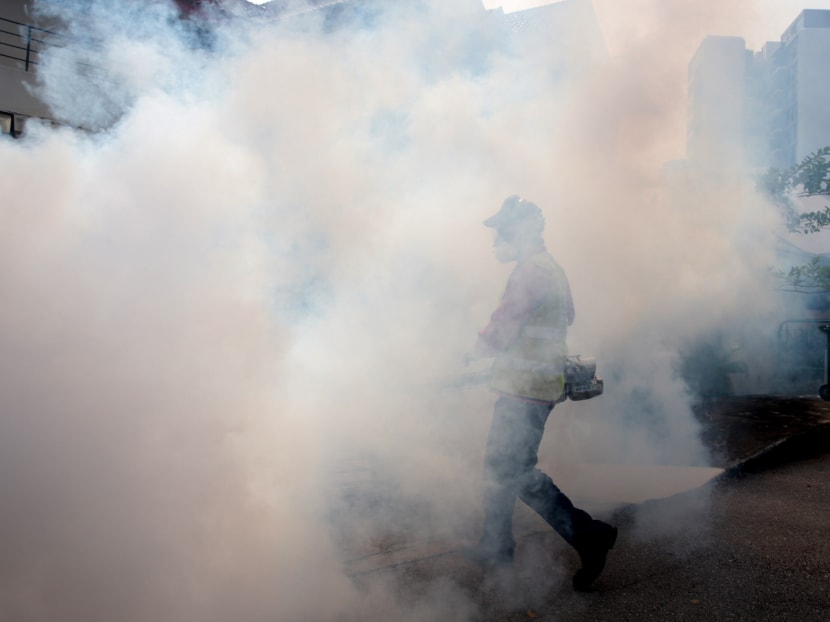
Thermal fogging carried out at Simon Place on March 30, 2017. Photo: Jason Quah/TODAY

SINGAPORE — The second Zika cluster of this year has been confirmed at Flower Road/Hendry Close, said the National Environment Agency (NEA) on Thursday (April 6), less than a kilometre away from the Simon Place cluster reported last week.
Two cases of locally transmitted Zika virus infection in Singapore were found at the latest cluster. Both of the new cases are residents in the vicinity.
The NEA said vector control operations are ongoing. Meanwhile the agency has urged residents to maintain vigilance and continue to eliminate mosquito breeding habitats.
“There could still be asymptomatic or mild, undiagnosed cases which might result in further transmission of the virus if there are mosquitoes in the vicinity,” the NEA added.
These latest cases came just a week after two members of the same household at the nearby Simon Place were found to have contracted the Zika virus.
The NEA had been conducting preventive inspections in the vicinity even before the cluster was notified to detect and destroy any potential mosquito breeding habitats.
Together with grassroots volunteers, outreach efforts are continuing in the vicinity of Flower Road/Hendry Close to distribute Zika information leaflets and insect repellents to households to raise general awareness of Zika, reiterate the need for source reduction to prevent mosquito breeding and advise residents to apply repellent as a precaution, the agency said in its release.
Residents are requested to allow NEA officers to carry out inspections and indoor spraying of their homes. NEA also urged all residents and stakeholders to maintain vigilance and take immediate steps to eliminate mosquito breeding habitats by practising the 5-step Mozzie Wipeout.
Most people infected with the Zika virus do not develop symptoms, which heightens the risk of a Zika resurgence as it may take some time before a reintroduced Zika virus is detected.
Members of the public are advised to seek medical attention if they are unwell, especially with symptoms such as fever and rash. They should also inform their doctors of the location of their residence and workplace.
Singapore had its first locally transmitted case of the mosquito-borne Zika virus in August last year. The virus is known to cause abnormally small heads in babies whose mothers were infected while pregnant — a condition called microcephaly.
Around mid-October, the NEA said that the first and largest locally transmitted Zika cluster at the Aljunied Crescent/Sims Drive area, which had seen nearly 300 cases since August, had been closed.
By December last year, the number of Zika cases had tapered off.
Stay in the know. Anytime. Anywhere.

Subscribe to our newsletter for the top features, insights and must reads delivered straight to your inbox.
By clicking subscribe, I agree for my personal data to be used to send me TODAY newsletters, promotional offers and for research and analysis.






