
No Committee of Inquiry into MRT tunnel flooding as cause of incident ‘clear’: Khaw
SINGAPORE — No Committee of Inquiry (COI) will be convened to look into the recent tunnel flooding on the North-South Line (NSL) because the facts of the incident are "not complicated and the cause of the incident is clear", Transport Minister Khaw Boon Wan said in a ministerial statement addressing a raft of questions from Members of Parliament in the House on Tuesday (Nov 7).
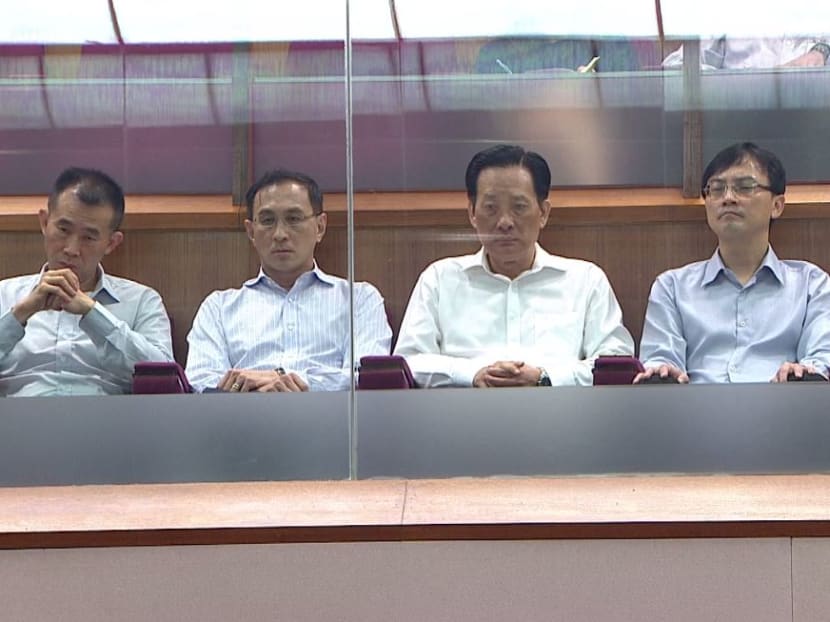
SMRT's Group Chief Executive Officer Desmond Kuek (2nd from left), and Chairman Seah Moon Ming (centre) attend Tuesday's Parliamentary session, where Transport Minister Khaw Boon Wan spoke about the tunnel flooding incident that shut down a segment of the North-South Line for about 20 hours last month.



SINGAPORE — No Committee of Inquiry (COI) will be convened to look into the recent tunnel flooding on the North-South Line (NSL) because the facts of the incident are "not complicated and the cause of the incident is clear", Transport Minister Khaw Boon Wan said in a ministerial statement addressing a raft of questions from Members of Parliament in the House on Tuesday (Nov 7).
Eleven MPs had tabled questions for the Parliament sitting. After Mr Khaw delivered his statement, 15 MPs across both sides of the House peppered the minister with more queries.
Questions raised included how SMRT staff morale can be boosted, and whether the employees who volunteered information during the amnesty period would receive the same bonuses as their counterparts. Other queries were about the system of checks and balance in light of the regulator and operators working together as “one team”, which Mr Khaw had emphasised in his speech. The supervision over SMRT’s internal audits was also raised by several MPs.
The unprecedented tunnel flooding with water up to 1m deep and spanning 100m of tracks both ways, which stopped services along a stretch of the NSL for more than 14 hours over two days last month, happened because the anti-flooding system at Bishan station had not been maintained for nearly a year. Maintenance crew had submitted doctored records to cover up the fact that they had not maintained the system, and are facing impending disciplinary action by SMRT.
Mr Khaw said the Land Transport Authority (LTA) will assess the operator's findings separately on the "extent of dereliction of duties and falsification of records".
On Tuesday, the minister reiterated that last month's incident was not triggered by inadequacies in the design of flood-protection measures, nor was it due to an "extraordinary storm". The sump pit has a capacity of over 5,000 cubic metres, or roughly the size of two Olympic-sized swimming pools. On Oct 7, the total rainfall in the area was only about 640 cubic metres, which would have filled just 13 per cent of the pit's capacity even if all three pumps were not working.
Rather, the flooding was the result of "poor maintenance and neglect of duties" by the SMRT maintenance team overseeing the Bishan water pump system, said Mr Khaw. He gave a sense of the neglect by the maintenance crew: "Any maintenance crew looking through the grating at the top of the stormwater sump pit can easily tell whether the pit is full or not."
Mr Khaw said that all three pumps in the Bishan stormwater sump pit were found to be in working order, as they could be activated manually after flooding was detected. Testing and inspection provider Singapore Test Services had also confirmed independently that each of the five float switches that control the pump system were "functional in themselves". The LTA is investigating why these float switches had failed to function normally on the day of the flooding, he said.
Apart from SMRT replacing all the float switches at Bishan, the authority has replaced the pumps with heavier-duty ones that can handle water carrying more sediments and installed extra parallel float switches.
To monitor water levels in the pit independently, a radar-based sensor system has also been added, while the sump-pump control panel has been relocated away from the tracks to allow easier manual access to pump operations during operation hours.
Work is also in progress to remove the sludge, silt and debris that have accumulated in the sump pit at Bishan.
Meanwhile, SMRT carried out checks on the stormwater pump systems at four other tunnel portal locations in Redhill, Kembangan, Lavender and Changi after the flooding incident at Bishan. The operator found that two of the eight pumps at Kembangan and three out of four at Lavender were not in "serviceable condition". The operator has since replaced or repaired all the non-serviceable pumps, said Mr Khaw.
Pointing to SMRT group chief executive Desmond Kuek's revelation last month of "deep-seated cultural issues" in the company which has taken longer than expected to weed out, Mr Khaw stressed that growing the right culture was the responsibility of all — from the leadership to workers.
"I look to the SMRT management to set the right tone of professionalism and excellence, to complement the audit systems that are being put in place. This is our Singapore way," added Mr Khaw. "If there is poor work culture, the CEO is responsible. You set the corporate culture."
Noting that the LTA was responsible for ensuring that Singapore's transport infrastructure was designed appropriately with the right specifications, Mr Khaw noted that in this instance, the design and construction of the MRT infrastructure has been infused with "ample flood-resistant specifications and redundancies".
He reiterated that under the regulatory framework, there has been no shortcomings or lapses in oversight by the LTA, which will set up a new Joint Readiness Inspection team with SMRT to supplement the operator's own internal audit system.
Dr Richard Kwok, the former executive vice-president and chief technology officer at ST Kinetics, will helm SMRT's augmented audit team, starting next month, said Mr Khaw.
While the more robust audit system will pinpoint any deficiencies so as to deal with them early, Mr Khaw stressed that "no regulatory oversight can fully guard against intentional efforts to hide mistakes and negligence, especially if it's by a group".
"Our operators' efforts to create the right organisational culture of professionalism, excellence and discipline are, therefore, important and they complement the audit systems in place," Mr Khaw added.
Stay in the know. Anytime. Anywhere.

Subscribe to our newsletter for the top features, insights and must reads delivered straight to your inbox.
By clicking subscribe, I agree for my personal data to be used to send me TODAY newsletters, promotional offers and for research and analysis.






