
Non-payment by firm in govt project raises issue of responsibility
SINGAPORE — Questions on corporate responsibility and the low financial requirements of enterprises undertaking government research projects here have been raised in the wake of news that a clean-energy firm has left its sub-contractors high and dry for an uncompleted project at a PUB water reclamation plant here.
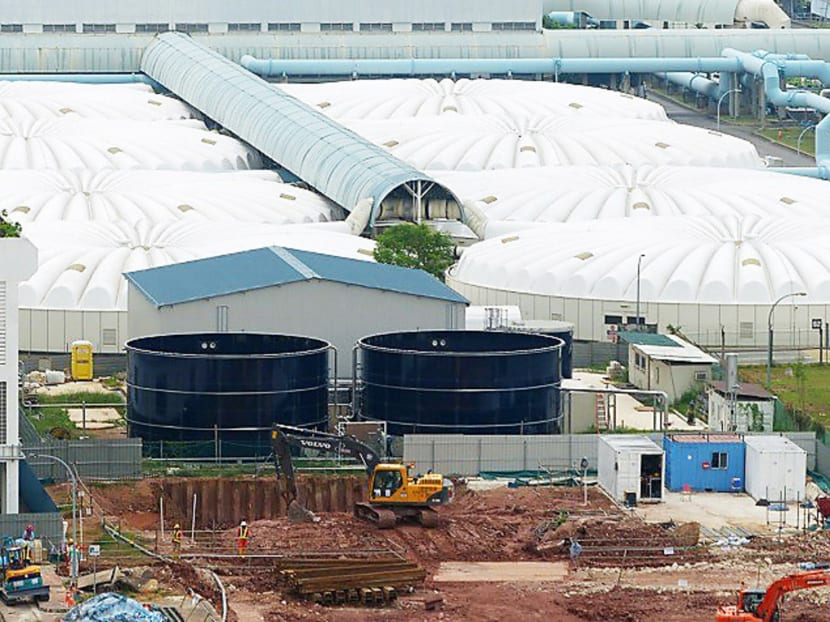
The codigestion plant, a collaboration between national water agency PUB and Anaergia Pte Ltd. It was to be completed by last September but is now expected to be completed by the end of the year. Photo: Structura Construction

SINGAPORE — Questions on corporate responsibility and the low financial requirements of enterprises undertaking government research projects here have been raised in the wake of news that a clean-energy firm has left its sub-contractors high and dry for an uncompleted project at a PUB water reclamation plant here.
Business and corporate governance experts have questioned the conduct of Anaergia, the multi-national firm whose former affiliate, Anaergia Pte Ltd, has not paid more than S$1.2 million to sub-contractors for a project to use food waste to generate more electricity.
The project involved building a co-digestion plant at PUB’s Ulu Pandan water reclamation plant, where food waste would be added to used water sludge to generate more energy for the plant’s needs. It was to have been completed last September but is now expected to be completed by the end of the year. TODAY reported on May 3 that PUB had paid Anaergia Pte Ltd S$3.3 million for about 60 per cent of work done, but Anaergia Pte Ltd’s sub-contractors — Structura Construction and Brilliant Engineering — have been paid only about S$638,000.
While it owed sub-contractors money, Anaergia Pte Ltd was sold last December and no longer has anything to do with Anaergia.
National water agency PUB said this is the first time in 500 research and development projects undertaken since 2002 that a case of non-payment by its contractor to sub-contractors has happened (not all research projects involve sub-contractors).
While minimum paid-up capital of up to millions of dollars applies to contractors of government construction projects, there is no minimum paid-up capital requirement set by the Economic Development Board (EDB) and PUB for research projects, which are to demonstrate effectiveness of a technology and are generally short-term and lower in dollar-value.
This is to “avoid disadvantaging small firms with promising new technologies”, said an EDB spokesperson. PUB said its research projects are mostly less than S$1 million, although demonstration projects like the co-digestion plant could be worth more.
When evaluating proposals, the EDB also looks at the overall financial capacity of a company — including its parent — to complete a project, the spokesperson added.
Ethics and corporate responsibility
Corporate governance expert Lan Luh Luh of the National University of Singapore (NUS) felt Anaergia Pte Ltd’s paid-up capital of S$100 was “too low” for a multi-million dollar grant. There should be a good balance between nurturing tech start-ups on one hand and, on the other, having a sufficient level of financial commitment by the entrepreneurs — getting their skin in the game — and the need for good accountability, as taxpayers’ money is used to fund these projects, she said.
Director of environmental sustainability consultancy Green Future Solutions, Mr Eugene Tay, however, agreed with PUB’s lower financial requirements for tech providers, so as to allow start-ups with limited capital to commercialise their new technology through test-bedding opportunities such as PUB’s. “The Anaergia case is an unfortunate and isolated one, where a rogue company failed to pay its sub-contractors and should not affect the trust in other start-ups,” said Mr Tay. “Nevertheless, PUB can assess its payment process and consider reimbursement of the technology provider only after payment receipts for work done by sub-contractors or equipment bought are verified.”
The EDB said “economic deliverables” are imposed on grant recipients to safeguard public interest. The government can hold back disbursements and require funds to be returned, where necessary, if a recipient fails to fulfil its commitments. Grants are also given on a reimbursement basis, based on actual expenditure, a spokesperson said.
This was not foolproof in the case with Anaergia Pte Ltd.
Brilliant Engineering project director Philip Sheng said his company was told by Anaergia Pte Ltd to issue an invoice of about S$223,000 last year so that Anaergia Pte Ltd could then claim the amount from the PUB. But it never paid Brilliant for the invoice issued, said Mr Sheng.
Besides minimum paid-up capital, government agencies can impose a condition to prevent the original owners who bid for the research grant from disposing their shares to a third party within a certain time frame, suggested Associate Professor Lan. This is to ensure time or cost commitment by the entrepreneur on the project.
According to PUB — which is in talks with another Anaergia subsidiary, Anaergia Singapore Pte Ltd, to complete the co-digestion plant — there was no clause in its contract with Anaergia Pte Ltd to prevent selling of shares or change of ownership of Anaergia Pte Ltd before the plant’s completion.
Asked about opening the project to other companies with co-digestion expertise, PUB said the plant is built to the blueprint of Anaergia’s technology and the multinational has resolved to dedicate Anaergia Singapore Pte Ltd to complete the project.
Strategic management expert Tan Wee Liang of the Singapore Management University said that in general, the underlying motivation behind any processes or procedures is the management of risk. At times, research sponsors might wish to be involved in the appointment of sub-contractors or third parties to the project. Sponsors might also have oversight mechanisms such as forming a committee with the researcher to approve phases and payments for steps in the project, said Assoc Prof Tan.
To NUS corporate governance expert Mak Yuen Teen, however, the Anaergia episode is an issue of ethics and corporate responsibility, and not of tech providers, research and innovation. “I found it odd that (Anaergia) would incorporate S$100 subsidiary here, sell it off without either making sure that the subsidiary’s debts are settled or that the buyer would settle the debt, incorporate another company with almost the same name, and then continue the project with PUB,” he said. “What is there to guarantee that this will not be repeated with Anaergia Singapore Pte Ltd? This is not what a responsible multinational company would do.”
Assoc Prof Mak felt Anaergia had a moral responsibility to the sub-contractors of Anaergia Pte Ltd. “The sub-contractors may have done business with Anaergia Pte Ltd on account of its parentage and the fact that it has the support of PUB ... (Anaergia) washing its hands of the obligations of its S$100 paid-up capital subsidiary raises great doubt in my mind about the company.”
TODAY previously reported Anaergia Singapore Pte Ltd managing director Luca Belli maintaining that Brilliant’s and Structura’s contracts are with Anaergia Pte Ltd, which was “sold back in December 2015 to a third party which bears no relation to the Anaergia group of companies”.
Asked about non-payment for work done by the sub-contractors prior to December, Mr Belli had said to contact Anaergia Pte Ltd. According to latest Accounting and Corporate Regulatory Authority records, Anaergia Pte Ltd was renamed APL Bioengg Pte Ltd on May 5 and has changed directors twice since being sold.
Stay in the know. Anytime. Anywhere.

Subscribe to our newsletter for the top features, insights and must reads delivered straight to your inbox.
By clicking subscribe, I agree for my personal data to be used to send me TODAY newsletters, promotional offers and for research and analysis.






