
Not settling for the short end of the stick
SINGAPORE — Growing up, Ms Sharmaine Wang, 25, who suffers from a growth hormone deficiency, put up with many comments from strangers about how different she looked from her twin sister.
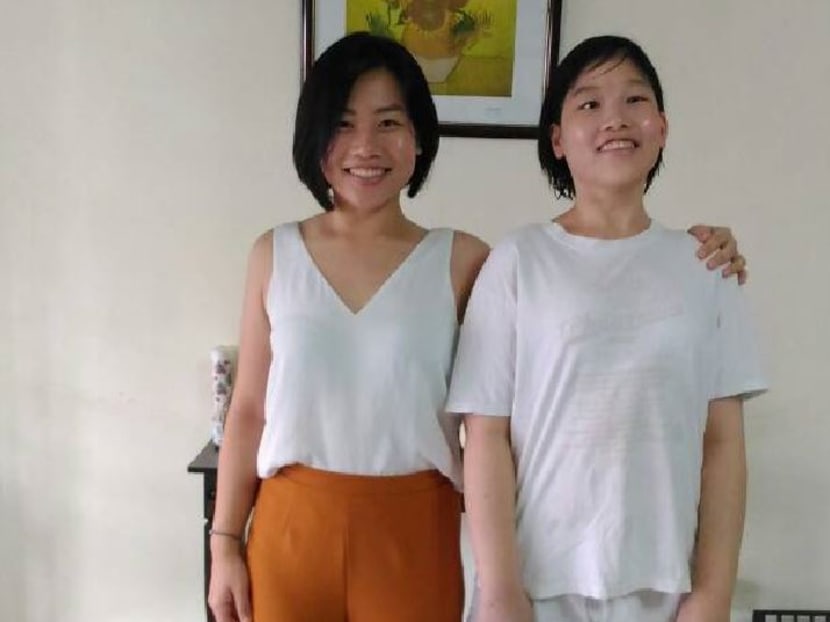
Ms Sharmaine Wang, 25, (right) and her twin Sharlene. Ms Sharmaine Wang had a growth hormone deficiency and was significantly shorter than her sister when they were growing up, but with treatment, she has caught up and is now 2cm taller at 1.67m. Photo courtesy Vivian Lim

SINGAPORE — Growing up, Ms Sharmaine Wang, 25, who suffers from a growth hormone deficiency, put up with many comments from strangers about how different she looked from her twin sister.
She survived a brain tumour when she was four, but its lasting damage on the pituitary gland affected her ability to grow normally. As a result, she was almost a head shorter than her older twin for most of their childhood.
Like adults, children come in varying heights and sizes. Children whose heights are between the third and 97th percentile on the growth chart and who are growing at a steady rate are usually considered to have normal growth.
But when they are significantly dwarfed by their peers, a growth disorder may be at play. Ms Wang was one of the patients the National University Hospital (NUH) saw for growth disorders, which refer to conditions that prevent children from achieving a normal height and weight compared to children of the same age and gender.
In recent years, NUH’s paediatric endocrinology division has seen an increase in the number of parents seeking help for their children’s growth-related issues.
Last year, it saw about 200 cases of growth-related problems, which is an estimated 60 per cent increase in the last five years, said Associate Professor Loke Kah Yin, head and senior consultant of NUH’s paediatric endocrinology division. Experts attributed the increase in numbers mainly to greater awareness of growth-related issues in children.
“It is not that there is an increasing number of short children, but parents are now realising the problem and that something can be done about it,” said Dr Warren Lee, a paediatric endocrinologist at Camden Medical Centre.
“The health of Singaporeans is getting better. Most of our children grow well. If you’re a parent of a child who is much shorter than his peers, you’ll feel it more acutely,” he said.
There are currently no local statistics on childhood growth disorders here, which can occur due to various reasons.
Factors such as genetics, poor nutrition and a deficiency in certain hormones can affect a child’s growth, which goes through three important phases in infancy (the first year of life), childhood and adolescence, said Assoc Prof Loke.
Some research suggests that about one in 3,500 children do not produce enough growth hormone for normal development — a condition known as growth hormone deficiency.
At NUH’s paediatric endocrinology division, about 80 per cent of children reviewed for short stature at its outpatient clinic either inherited short genes from their parents or have constitutional growth delay, also known as “late bloomers”, said Assoc Prof Loke.
Childhood growth disorders are not always due to an endocrine problem, said the experts.
It could sometimes be the first sign of an underlying serious medical condition, such as a brain tumour or kidney disease, said Assoc Prof Loke. It can also be due to congenital heart disease or thalassaemia.
COMMON CONDITIONS LIKE ASTHMA MAY INTERFERE WITH GROWTH
Even common childhood issues may interfere with a child’s growth.
“For instance, medications for certain chronic illnesses like asthma may interfere with growth. A blocked nose may interfere with sleep and affect growth hormones release. Food intolerances, such as intolerance (of protein from cow’s milk), can cause malabsorption and interfere with the growth process,” said Dr Lee.
Growth issues may also occur in babies who are born small, or are small for their gestational age, which can occur due to factors such as a premature birth, multiple pregnancy and high blood pressure during pregnancy. About one in 10 children are born premature, and about 10 to 15 per cent of them do not catch up on growth, said Dr Lee.
Another commonly-seen group in Singapore are children who experience early or abnormal puberty, which affects their final height in adulthood, said Dr Lee.
Most people usually stop growing growth by the age of 18. But when early puberty sets in (before eight years old in girls and nine in boys), the child’s bones fuse earlier and growth stops permanently, said Dr Lee.
“More recently, we’ve realised that there is (something) called fast puberty, where the age of the onset of puberty is normal but it progresses very quickly. It is important for parents to realise that the kid could be the tallest in class and still be the shortest among peers as an adult,” he added.
CLOCK’S TICKING, SO SEEK TREATMENT EARLY
While some parents prefer to adopt a wait-and-see approach, Dr Lee said “waiting is not the answer” when it comes to tackling growth-related issues in children.
If a child’s growth is below the third percentile, parents are advised to see a paediatrician or a paediatrician specialising in endocrinology to determine the cause and to seek treatment early, if necessary, said Assoc Prof Loke.
Children who are born premature or small for their gestational age, or whose growth is observed to have petered out, should see a doctor who has experience in treating growth-related problems, said Dr Lee.
“The clock of growth and puberty is ticking,” he said. “Once a problem is detected, it is best to act as early as possible. Once the bones have fused, nothing can be done.”
Untreated growth disorders may lead other problems such as a lower muscle mass and bone mineral density, and a higher risk of high cholesterol.
Bullying by their peers can also take an emotional toll on children, said Assoc Prof Loke.
Treatment depends on the underlying cause and can range from a prescription of growth hormones to treatment of a chronic disease, he said.
For Ms Wang, a freelance motivational cards designer, treatment lasted more than a decade, from around the age of 11 to last year and involved daily injections to replace missing growth hormones. The frequency of the injections decreased to alternate days in the final two to three years.
Her mother Vivian Lim is glad she did not delay her child’s treatment.
“I wanted Sharmaine to feel ‘normal’ and not any lesser than others. With her being a twin, comparisons were inevitable. She had gone through so much and I could not bear to put her through more challenges, emotionally or mentally,” said Mdm Lim, 53, a senior manager.
Ms Wang’s height caught up with her sister’s when they were about 13. She even outgrew her twin by 2cm and now stands at 1.67m.
Stay in the know. Anytime. Anywhere.

Subscribe to our newsletter for the top features, insights and must reads delivered straight to your inbox.
By clicking subscribe, I agree for my personal data to be used to send me TODAY newsletters, promotional offers and for research and analysis.






