
Nuclear attack by terrorists very plausible, says PM Lee
WASHINGTON/ NEW YORK — As terror attacks escalate around the world, a nuclear attack by terrorists using devices bought off the black market is “very plausible and believable”, and is a threat that countries must take seriously, said Prime Minister Lee Hsien Loong.
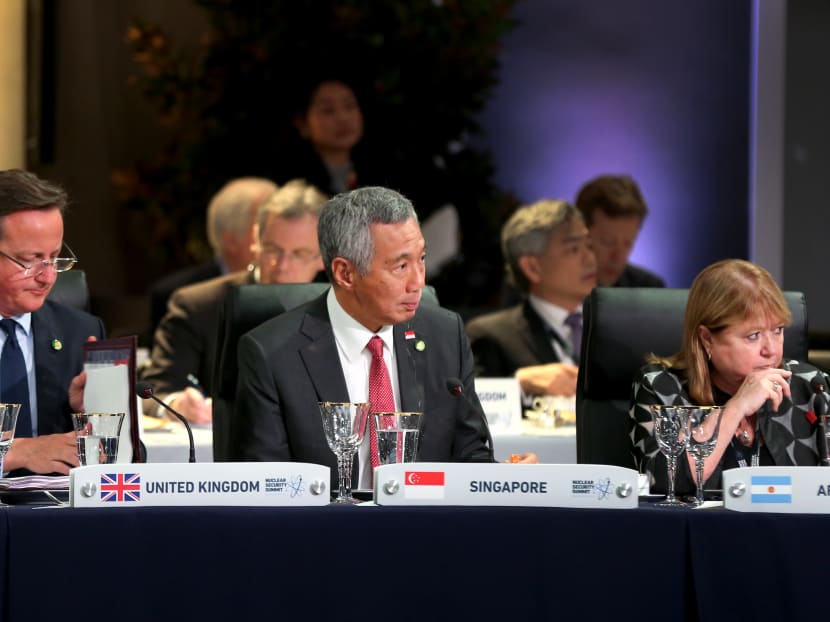
Prime Minister Lee Hsien Loong at a working lunch during the Nuclear Security Summit (NSS) in Washington on April 1, 2016. Photo: Ministry of Communications and Information

WASHINGTON/ NEW YORK — As terror attacks escalate around the world, a nuclear attack by terrorists using devices bought off the black market is “very plausible and believable”, and is a threat that countries must take seriously, said Prime Minister Lee Hsien Loong.
Nuclear terrorism may not be the most imminent of threats, but any such incident would be “disastrous” and the international community, Singapore included, must continue to fight this, said Mr Lee during a plenary session of the final Nuclear Security Summit (NSS) in Washington yesterday, where he also provided an update on Singapore’s progress in strengthening nuclear security.
Noting that an issue of the Islamic State’s (IS) English magazine Dabiq published last May highlighted a nuclear terrorism scenario, Mr Lee said this “shows their intent, and it is a threat which countries must take seriously”.
“I hope this summit will see countries committing to reduce their nuclear material stockpiles further, which can make for ready terrorist targets,” said Mr Lee.
He added that Singapore is very concerned by developments in North Korea. “I hope all countries will encourage (North Korea) to restrain itself and work towards denuclearisation of the Korean peninsula,” he said.
Despite not having significant nuclear material or facilities, Singapore, being a global trans-shipment hub, takes its responsibilities seriously.
“We could be a place where illicit material passes through. We could be a target of attack. Even if the incident occurs beyond our borders, its spill-over effects could affect our population,” said Mr Lee. “Therefore, we actively support counter-proliferation and nuclear disarmament.”
Since the first NSS in 2010, Singapore has tightened its export control regime and upgraded radiation screening technology at its ports, and every case of nuclear fuel transiting through Singapore is tracked. “From time to time, we have intercepted cargo and confiscated items,” said Mr Lee.
The Protective, Analytical and Assessment Facility, a border laboratory first announced in 2011, will be operational by this year at Pasir Panjang and will be able to conduct radiation-nuclear detection and analysis.
Other actions Singapore has taken include cooperating with international efforts like the Proliferation Security Initiative, which sees supporting countries commit to impede the trafficking of weapons of mass destruction.
Mr Lee said it would be difficult for Singapore to act unilaterally. “The Iranian nuclear dossier is another example. Singapore did our part and fully implemented the UNSC (United Nations Security Council) resolutions.
“There was some expectation that we go beyond that. But as a small, open economy, dependent on the international rule of law, it would be very difficult for us to act unilaterally, and exceed what had been mandated by the UNSC,” he added.
Mr Lee is on a working visit to the United States, which began in New York City last week.
In an interview with the Wall Street Journal on Tuesday, Mr Lee noted that hundreds of individuals from Indonesia and Malaysia have gone to the Middle East to join the IS. He described the terror threat facing the Republic as a “cancer, which we take very, very seriously”. In particular, he warned of IS’ desire to set up a wilayat, or province, in South-east Asia in places where the government’s writ “does not run strong”, citing several potential locations such as Aceh, Poso, Mindanao in the southern Philippines, southern Thailand and Bangladesh.
He noted that IS has a battalion formed with volunteers from South-east Asia. “It must be (made up of) 500 to 600 people, maybe more,” he said.
Reiterating that the security threat posed by IS is larger than that by Al Qaeda, he said: “With Al Qaeda we did not have hundreds from South-east Asia going to join them in Afghanistan after 9/11 ... Now, you have hundreds from the region.”
On Thursday, Mr Lee attended a working dinner hosted by US President Barack Obama, after separate meetings with US Federal Reserve chair Janet Yellen and US Trade Representative Michael Froman. He is scheduled to meet with several heads of state on the sidelines of the summit before leaving the US today.
Stay in the know. Anytime. Anywhere.

Subscribe to our newsletter for the top features, insights and must reads delivered straight to your inbox.
By clicking subscribe, I agree for my personal data to be used to send me TODAY newsletters, promotional offers and for research and analysis.






