
PM Lee singles out two sectors in the Middle East that S'pore firms can tap on
TEL AVIV — Water management and technology ventures are two sectors in the Middle East that Singaporean companies could do well in, said Prime Minister Lee Hsien Loong.
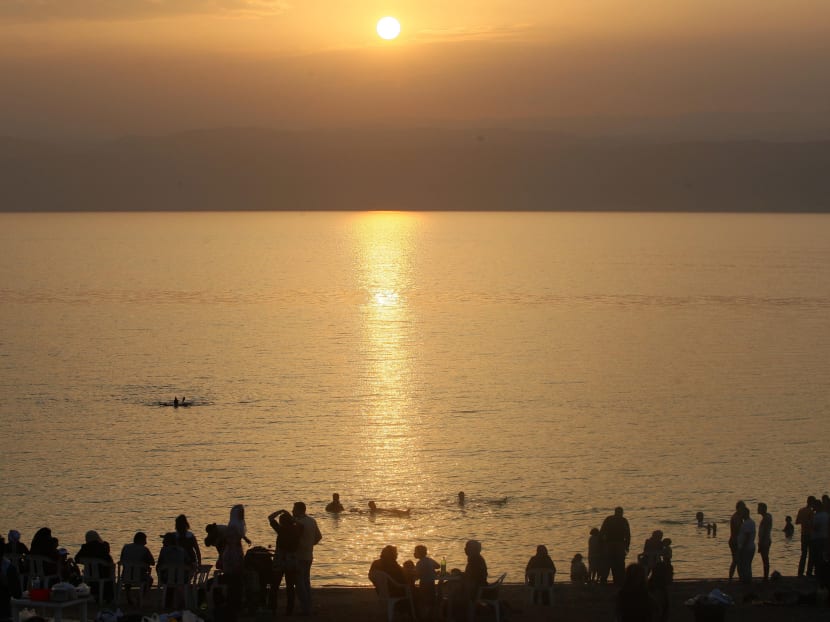
The Dead Sea, a salt lake bordering Israel, the West Bank and Jordan. The Red Sea-Dead Sea project will involve building a canal to bring the waters of the Red Sea into the Dead Sea. Prime Minister Lee Hsien Loong believes that Singapore companies could potentially play a role in the project. Photo: AFP

TEL AVIV — Water management and technology ventures are two sectors in the Middle East that Singaporean companies could do well in, said Prime Minister Lee Hsien Loong.
Speaking to the Singaporean media as he wrapped up a week-long trip to Jordan, Israel and the Palestinian Territories, Mr Lee pointed out that a project in the Levant that Singaporean companies could potentially play a role in is the Red Sea-Dead Sea canal project.
“One of our companies is interested in bidding for the project and we hope that they put in good bids and will be well considered,” said Mr Lee, without naming the company involved.
The Red Sea-Dead Sea project will involve building a canal to bring the waters of the Red Sea — an inlet of the Indian Ocean located between Africa and Asia — into the Dead Sea, a salt lake bordering Israel, the West Bank and Jordan.
The Jordanian and Israeli governments this week published a joint tender to call for qualified companies, investors and developers to submit pre-qualification documents for the project on a build-operate-transfer basis, a sign that despite the political differences that exist in the region, there is room for practical cooperation.
The project will generate hydropower, which can be used for desalination in the region to generate more water supply for Jordan. Some of the water produced can also flow into the Dead Sea and help to slow down evaporation there. The current rate is around one meter a year.
The first phase of the project is expected to cost around US$2.5 billion (S$3.4 billion).
Hyflux, Sembcorp and Keppel are some of the Singaporean companies that have a track record in the Middle East, in water management and treatment.
Mr Lee said that there are also potential economic opportunities for Singapore and Israel in technological venture funds.
“We already have companies here in Israel. And we would also like to encourage Israeli companies to have a presence in Singapore,” he said.
“We hope more of them will come and we hope that they will develop the capabilities so that they find it worthwhile to come to Singapore to use our engineers and use our expertise and work together.”
Addressing a media query on how the Government could encourage more Singaporean companies to venture to the Middle East, Mr Lee said that it depends on the industry these companies are in.
“Not every company has a good fit with Israel or with Jordan. These (water management and technology) are fields where there is a good fit and I hope there will be more over time as they (companies) discover what the conditions are and what they can do.”
Stay in the know. Anytime. Anywhere.

Subscribe to our newsletter for the top features, insights and must reads delivered straight to your inbox.
By clicking subscribe, I agree for my personal data to be used to send me TODAY newsletters, promotional offers and for research and analysis.






