
Presidential Elections to be held in September
SINGAPORE — Polls to elect the next President will be held in September should more than one candidate step forward to stand for elections, the Government announced on Monday (Feb 6), citing the need to move the campaigning period of Presidential Elections (PEs) out of the month of August, to avoid clashing with National Day celebrations.

The Presidential Chair flanked by the State Flag and the Presidential Flag at the Istana. TODAY file photo

SINGAPORE — Polls to elect the next President will be held in September should more than one candidate step forward to stand for elections, the Government announced on Monday (Feb 6), citing the need to move the campaigning period of Presidential Elections (PEs) out of the month of August, to avoid clashing with National Day celebrations.
Traditionally, the full six-year terms of Singapore’s Elected Presidents expire at the end of August. The changes mean that this year, an Acting President will assume the office after President Tony Tan’s term expires on Aug 31, until his successor is elected and assumes office.
The period during which the Acting President shall exercise the functions of the office should not exceed one month, from Sept 1 to the date the new Elected President assumes office.
The Constitution provides for the chairman of the Council of Presidential Advisers (CPA) — a position currently held by Mr J Y Pillay — to be the Acting President. If the CPA chairman is unavailable, the Speaker of Parliament is next in line.
Announcing these changes at the start of the debate on the Presidential Elections (Amendment) Bill on Monday, Minister in the Prime Minister’s Office Chan Chun Sing said the Government had sought the advice of the Attorney-General’s Chambers, which confirmed that the timing of the PE this year can be adjusted under current laws.
If the Government had wanted to extend Dr Tan’s term, it would have had to amend the Constitution.
“Given the slightly longer time required for the new process and to avoid holding Presidential Election campaigns during the National Day celebrations period, we will adjust the timing of the polls for the forthcoming elections,” he said.
He added: “This resets the clock, so that, in future, Presidential Elections campaigning will take place outside of the National Day period, assuming Presidents serve their full six-year terms.”
Last November, changes to the Elected Presidency scheme were passed into law, including instituting a mechanism that reserves an election for a particular ethnicity that has not had an elected representative for five consecutive terms. The upcoming presidential race, which is due in August, will be reserved for the Malay community.
In the 2011 PE, the writ of election was issued in the first week of August, and campaigning started after National Day.
During the public consultation period for the review of the EP scheme last year, some had said that the 2011 PE was being politicised. Dr Tan Cheng Bock, one of the 2011 candidates, has previously revealed that he had declined invitations by some political parties to attend their National Day celebrations as he felt it was “inappropriate” for him to do so as a presidential hopeful.
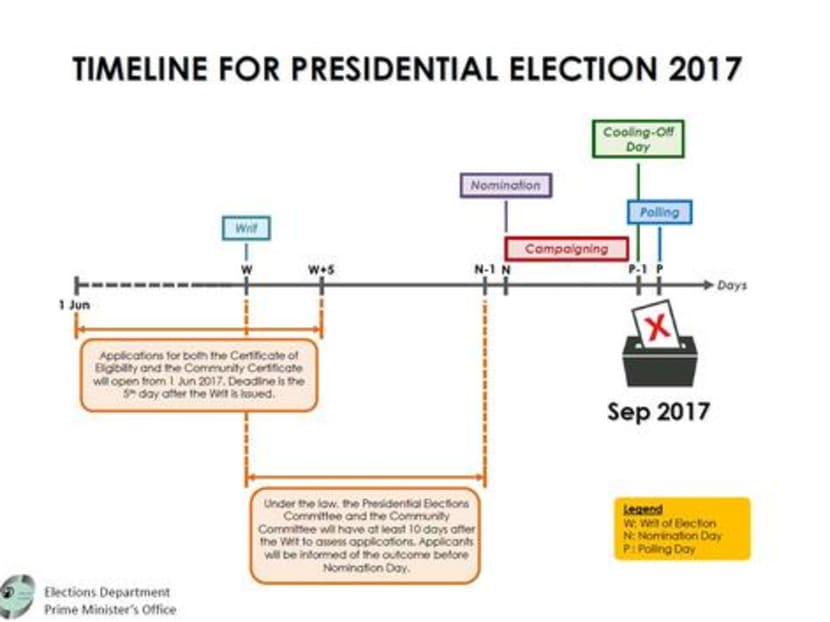
For coming polls, presidential hopefuls may start applying for the necessary certificate of eligibility and community certificate from June, in order to contest.
On Monday, a slew of changes to the Presidential Elections Act were passed to put into effect the Constitutional amendments made last year, as well as tweak election procedures and align the Act to that of provisions under the Parliamentary Elections Act.
Applicants will now have up to five days — up from three days currently — after the writ of election is issued to submit their applications to the Presidential Elections Committee (PEC).
This is to give prospective candidates more time to prepare their applications, Mr Chan said.
Concurrently, they will have to submit a community declaration to a newly-set up Community Committee to certify their ethnicity. Their application to contest in the PE can be rejected if they fail to submit an application with either the PEC or the Community Committee. Applicants will be informed of the outcome before Nomination Day.
The 16-member Community Committee will comprise a chairman and five members each from the Chinese, Malay, Indian or other minority communities, all of whom will be appointed by the Prime Minister on nomination of the Presidential Council for Minority Rights. The five members belonging to the different communities will make up the respective sub-committees.
An applicant has to first declare whether or not he belongs to one of the three major communities. If the respective sub-committee is satisfied with the application, it will issue the certification.
Mr Chan noted that an inclusive approach will be adopted to “welcome and embrace” individuals who identify themselves with a particular community, such as declarants of mixed-race parentage.
The arrangement is similar to the approach under the Parliamentary Elections Act to determine whether a potential candidate contesting in a Group Representation Constituency belongs to a certain minority group.
“The method of certifying race through community committees has worked well for our GRC system; it should similarly serve us well in the Presidential Elections,” said Mr Chan.
Stay in the know. Anytime. Anywhere.

Subscribe to our newsletter for the top features, insights and must reads delivered straight to your inbox.
By clicking subscribe, I agree for my personal data to be used to send me TODAY newsletters, promotional offers and for research and analysis.






