
Private community homes for seniors needed for S’pore, property firm says
SINGAPORE — A property consultancy has offered its view that private residential developments catering to seniors, akin to the community homes in the United States, may be something that Singapore need.
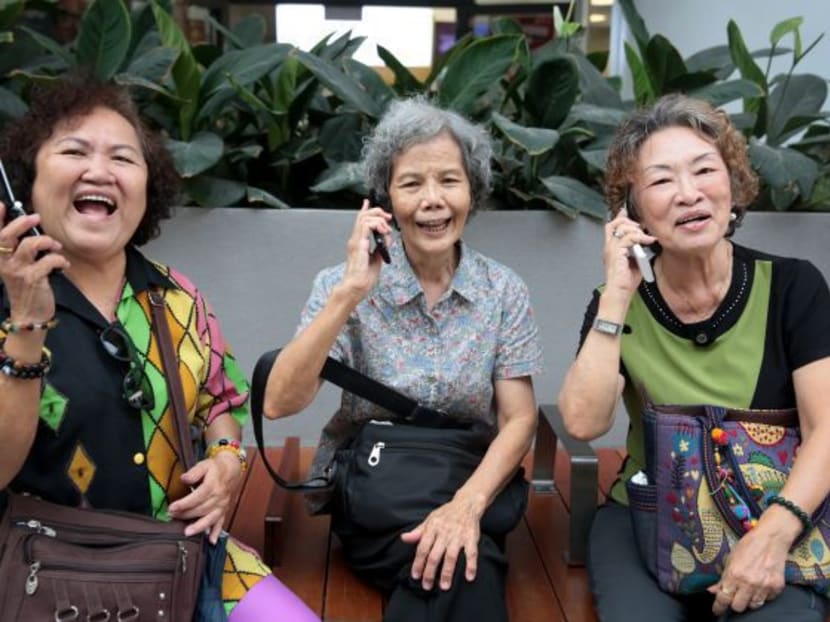
The greying population is a concern for Singapore, where one in four Singaporeans will become senior citizens by 2030, compared to one in eight who were seniors in 2015. TODAY file photo



SINGAPORE — A property consultancy has offered its view that private residential developments catering to seniors, akin to the community homes in the United States, may be something that Singapore need.
Edmund Tie & Company said in a report on Monday (Oct 30) that as Singapore’s population ages, there would be a bigger pool of more affluent seniors who may prefer to age in place, but they would face fewer options to monetise their property, being “asset rich (but) cash poor”.
The firm added that with higher demand for nursing home places, a township that has appropriate facilities catered to retiring private homeowners and dormitory-like co-living spaces for the growing proportion of retiring singles, may be an idea that would take off.
“With IoT (Internet of Things) and the shift towards a shared economy, we are likely to see more shared services in co-living arrangements to reduce the cost of living,” the consultancy said. People can split the costs of accommodation and services provided by domestic helpers, for instance.
Judging by examples in the US, residents in these communities typically lead an independent, active lifestyle “in a country club setting”, with amenities such as a clubhouse, golf course, walking trails, hobby centres, computer labs and other recreational spaces, it added.
One age-restricted community in Florida, US, called The Villages, spans 547 square miles — bigger than the size of Singapore — and has close to 42 golf courses on its grounds. Home prices there ranged from US$120,000 (about S$163,500) to USS$600,000. The estimated monthly cost of living in a home (worth S$250,000) there is about S$993.
The most suitable place to build a similar facility is across the Causeway in Iskandar Malaysia, Johor, the firm said. “It may not be ideal to do it in Singapore, given the high land costs. The neighbouring countries — namely Malaysia’s Iskandar, where healthcare facilities are being developed, and Penang, given its strong medical sector — are likely to offer better options, if they can create a gated community that ensures safety and 24-hour surveillance, Edmund Tie & Co said.
DEVELOPER INTEREST MAY NOT BE STRONG
The greying population is a concern for Singapore, where one in four Singaporeans will become senior citizens by 2030, compared to one in eight who were seniors in 2015. This will place pressure on medical facilities and nursing homes.
Property academics and sociologists told TODAY that they are not optimistic about developer interest in such private properties aimed at seniors at this point.
Mr Alan Cheong, senior director of research and consultancy at Savills Singapore, said that current co-living models catered to millennials still operate as “alternative” business models, and they could be loss-making, “very much like co-working space operators”. These ventures typically grow by first losing money to gain market share, he explained.
However, this cannot be the case for a home for seniors, because “failure is not an option” for the retirees who are bent on settling there.
Mr Cheong proposed that co-operatives such as the National Trades Union Congress (NTUC) is the country’s best bet to make private property for seniors a viable offering.
“(The community home) has to be operated on a cost-plus basis (where the operator is paid all the costs to run the facility plus a profit), not by someone who is out there to create a newfangled idea. It should never fall in the hands of private equity and venture capital firms, or high-net-worth individuals who would then export and expand the idea of this disruptive model into co-living for the aged,” he cautioned.
Associate Professor Sing Tien Foo from the National University of Singapore’s Department of Real Estate said that “a lot of creativity” is needed to keep costs low, whether it is in terms of structure or leases. “How to keep the revenue models and how to integrate these housing, medical, social features together requires a lot of risk-taking,” he added.
PRACTICAL FOR THOSE WHO ARE HEALTHY
National University of Singapore sociologist Tan Ern Ser said that the community home is a “practical proposition” aimed at older people who are “largely healthy, ambulant, and able to take care of themselves”, and there would be an “economy of scale” with respect to shared services and amenities, including the benefits of community living and aging-in-place.
“I presume nursing homes are mostly for those elderly persons who also need some nursing care. Mixing those who need care and those who don’t may increase the costs for those who don’t need the care,” he said.
Another challenge is the demand for such housing and whether people are willing to take to this idea.
“Do people want to live together with (others) with the same interest?” Assoc Prof Sing asked, giving the example of Jurong Kechil’s Hillford Condo, which saw many families move in although it is meant to be a retirement village.
To attract more demand, Mr Wong Xian Yang, assistant director of research and consultancy at property agency Orange Tee, said that the Government should consider removing the additional buyer’s stamp duty (ABSD) for the purchase of “retirement projects”, or increasing the maximum number of dwelling units for such projects.
“Given that Singapore is an affluent nation and faces an ageing population, there should be demand for elder-friendly private properties. However, the properties need to be priced affordably, as senior citizens would have limited incoming cashflow,” Mr Wong said.
Stay in the know. Anytime. Anywhere.

Subscribe to our newsletter for the top features, insights and must reads delivered straight to your inbox.
By clicking subscribe, I agree for my personal data to be used to send me TODAY newsletters, promotional offers and for research and analysis.






