
Public transport fares likely to rise but will stay affordable: Lui
SINGAPORE — Public transport fares are likely to increase in the first half of next year, as the Government yesterday said it has fully accepted the recommendations submitted last week by the Fare Review Mechanism Committee.
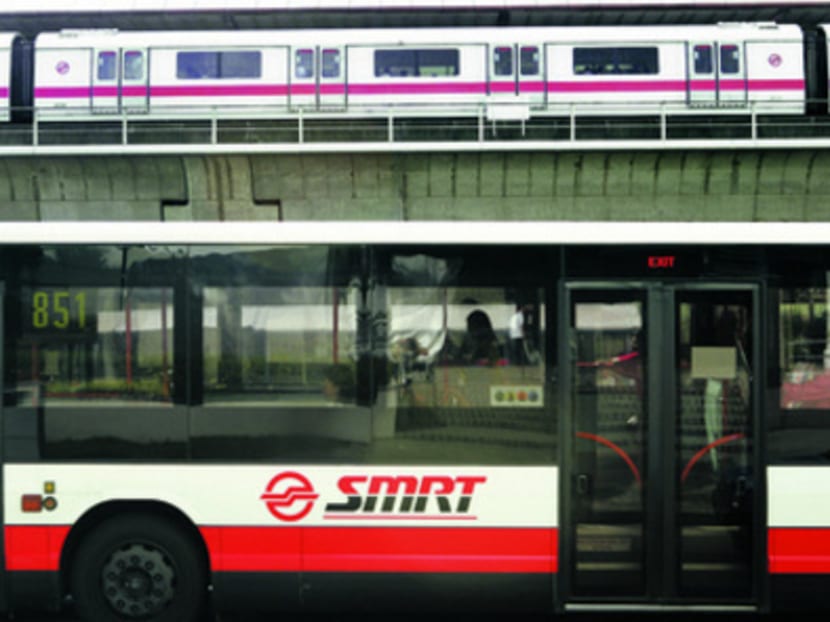
An SMRT bus passing by the MRT. Photo: Ooi Boon Keong

SINGAPORE — Public transport fares are likely to increase in the first half of next year, as the Government yesterday said it has fully accepted the recommendations submitted last week by the Fare Review Mechanism Committee.
Outlining the Government’s response to the slew of proposals — which included a revised fare formula that takes into account changes to fuel costs and new concession schemes for the low-income and people with disabilities to be funded by taxpayers, among other things — Transport Minister Lui Tuck Yew stressed in Parliament that the higher fares will remain affordable, noting that “wages over the past few years have gone up at a much faster rate than fares, which means that fares have actually become more affordable for the average commuter”.
Responding to questions filed by Members of Parliament (MPs) on the affordability of public transport and concessions — perennial topics at Parliament sessions, Mr Lui noted — he took the opportunity to address the committee’s recommendations.
For the coming fare review exercise — which may begin in the weeks ahead — Mr Lui reiterated that he would urge the Public Transport Council (PTC) to consider not granting any fare increase that exceeds the average national wage increase this year.
He added: “While fares are likely to have to go up in the coming years, they will not become less affordable for the average commuter, and will be considerably more affordable for the low-income and disadvantaged groups.”
Apart from the new concession schemes, the committee also proposed enhancements to five existing schemes — to be cross subsidised by full fare paying adults — that will cover children, polytechnic students, the elderly and heavy public transport users.
Over about half an hour, six MPs weighed in on the recommendations, with some voicing concerns over components of the new fare formula, whether the concessions would reach the targeted users and the burden of cross subsidisation on commuters.
Mr Lui said that the committee had been mindful of the potential burden, which was why it had proposed that the Government fund the new concession schemes. He added that the Government was “committed to further strengthening our social safety net on the public transport front”.
The new concession schemes — which will entail the issuing of concession passes — will go beyond giving these two groups of Singaporeans ad hoc assistance through Public Transport Vouchers, said Mr Lui, who added that only half of the 200,000 available vouchers have been disbursed.
The PTC would need time to work out the details of the concession schemes, said Mr Lui. “However, it is my intention to ensure that the discounts given will more than offset any fare increase in the next fare (review) exercise,” he added.
The rolling out of any fare hike would only be made in the first half of next year, for practical reasons, he said.
Since 2005, wages have risen by about 30 per cent. Over the same period, public transport fares have increased by 2.7 per cent cumulatively, Mr Lui said. “Public transport fares for the average commuter have become more affordable, not less.”
The committee had also proposed that the PTC be given the discretion to defer a portion of any fare hikes to spread out the impact of large increases.
Mr Lui said that the PTC will consider the 2012 fare cap based on the old formula — which was suspended pending the review — and the 2013 fare cap based on the new fare formula. Should the PTC decide not to effect both fare caps in one go, it may allow for part of the increase to be rolled over, he said.
Non-Constituency MP Gerald Giam said he was concerned that by expliciting taking into account energy costs, the new fare formula could pave the way for the public transport operators to be protected in the future from other cost components such as manpower expenses.
In response, Mr Lui said that the new formula better reflected the operators’ cost structure, where more than 20 per cent of expenditure goes to energy costs which have risen significantly over the last decade.
Mr Lui added that under the formula, fares will correspond with changes to electricity and energy prices. Should these be relatively stable in a particular year when inflation was largely driven by increases in prices of houses and cars, for example, the new formula would lead to less hefty increases in fares.
“Regardless of a smaller or larger number, (the committee) really wanted a fare formula that was more reflective of the overall cost structure,” he said.
Stay in the know. Anytime. Anywhere.

Subscribe to our newsletter for the top features, insights and must reads delivered straight to your inbox.
By clicking subscribe, I agree for my personal data to be used to send me TODAY newsletters, promotional offers and for research and analysis.






