
Refunds for train disruptions can improve customer satisfaction
Despite the disruptions on MRT lines, commuters here have received only ad hoc compensation, if anything. To improve commuter satisfaction, policymakers or train operators here could start by establishing clear and easily-accessible guidelines on fare refunds, says this commentary writer.
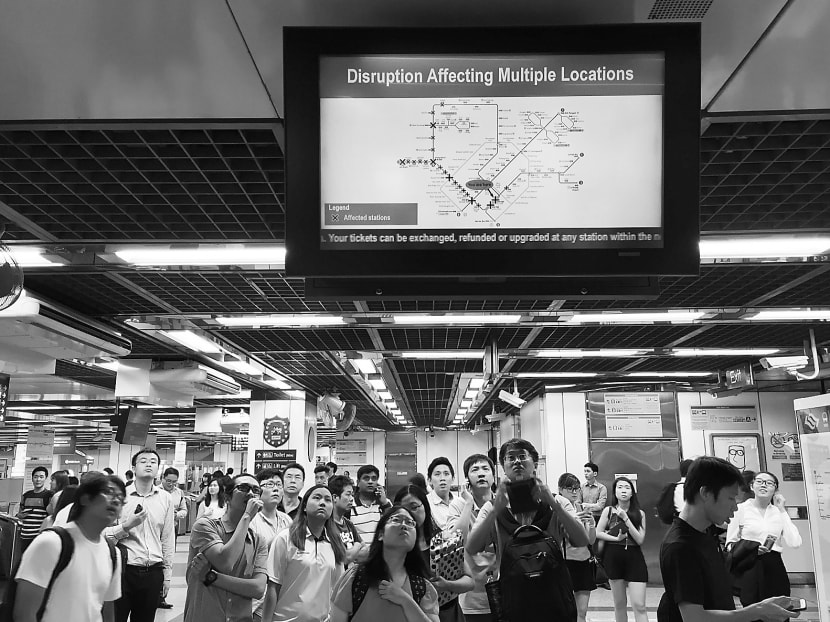
Commuters at City Hall MRT Station being notified about a disruption. TODAY file photo

Despite more than 80 disruptions on MRT lines last year, hours of cumulative delays, and more delays this year, commuters here have received only ad hoc compensation, if anything.
Commuters in other countries are far more fortunate. Go Transit in Canada, for instance, is giving C$100 (S$104.30) credit to every passenger stuck on its Lakeshore East train for three hours last month.
“If you got stuck on that train, we want to compensate you,” a spokesman said. Go Transit also refunds fares for anyone delayed more than 15 minutes.
In Australia, Metro Train Melbourne promises that it will compensate customers for missing service standards, such as delays of no more than five minutes. Train passengers in Adelaide travelled free for a day recently as part of a goodwill gesture to compensate them for previous train service disruptions.
The United Kingdom has gone even further, by extending Consumer Rights laws to transport services. Commuters will be able to receive compensation if their trains are late and refunds, which vary between companies and can be as low as 25 pence (S$0.43), will be made uniform.
Transport operators are also starting to do more to make sure commuters actually receive refunds.
Virgin Trains does not even require commuters to apply for refunds, for instance, as commuters receive refunds automatically on their cards when trains are delayed.
In Singapore, despite the dozens of delays this year and last year, compensation is limited and there is no clear MRT fare refund policy.
SMRT and Transitlink provide details about refund practices for bus breakdowns, for example, and the Land Transport Authority (LTA) has said bus operators agreed to offer free bus services during MRT service disruptions.
For trains, commuters seem to be offered refunds on an ad hoc basis.
SMRT did give fare refunds after a power trip caused delays on the North-South, East-West and Circle Lines in April this year, and also after the massive service outage on those same lines in July 2015.
In other cases, SMRT commuters received nothing.
In October last year, SBS Transit, which operates the North-East Line, offered refunds to commuters who paid for bus rides after train service was disrupted for about two hours.
Calls for train operators to compensate commuters for service disruptions are not new.
The issue was raised in Parliament as far back as 2008, when then-Minister of State Lim Hwee Hua said it “was not appropriate” for LTA to prescribe such actions for public transport operators and that hefty penalties served as a deterrent to ensure the system works well.
Yet with major train disruptions on the rise — there were 14 such breakdowns in 2015, 40 per cent more than in 2014 — as well as changes in technology and practices around the globe, it is timely to re-examine the issue in order to create more fairness for commuters and to motivate operators to improve.
The delays for train commuters, which continue to occur frequently, have a significant cost.
Commuters or their companies face lost wages or work hours during a disruption.
With the median monthly income last year being S$3,949 — according to the Ministry of Manpower — a 30-minute delay could cost an average of more than S$11.
There is also little data on how many commuters actually collect refunds when they are eligible for them.
The LTA did say in October last year after testing an incident management plan that it was working on improvements.
Buses would be free when there is a network-wide rail disruption, for example, and that it would look at ways to make fare refunds easier so that commuters do not have to stand in long queues.
Although compensating commuters for their fare would not cover all of their costs, which may include lost wages or other expenses, it is a start. Refunds could also increase commuter satisfaction, which is what research by the Office of Rail Regulation in the UK has shown.
To improve commuter satisfaction, policymakers or train operators here could start by establishing clear and easily-accessible guidelines on MRT fare refunds and compensation based on the length of delay.
Commuters should know exactly how much they should receive.
This change could also prompt operators to improve their service reliability, since they, too, would have a clear idea about how much delays would cost them.
Next, operators could consider following the example of Go Transit and offering larger compensation in the event of egregious multi-hour delays.
Again, that would signal that the company cares about its customers.
Finally, train operators should make refunds automatic, similar to what Virgin Trains has done in the UK.
Making refunds automatic would eliminate the need for commuters to queue for a refund and ensure that customers receive what is due to them.
Providing compensation and making the refund process easier is a good start, both while improvements are ongoing and even after most problems are resolved.
ABOUT THE AUTHOR:
Richard Hartung is a consultant and freelance writer based in Singapore.
Stay in the know. Anytime. Anywhere.

Subscribe to our newsletter for the top features, insights and must reads delivered straight to your inbox.
By clicking subscribe, I agree for my personal data to be used to send me TODAY newsletters, promotional offers and for research and analysis.






