
Review underway to address additional fares when switching between MRT lines: Khaw
SINGAPORE — With the rail network getting denser, public transport fare rules will be reviewed to allow for transfers across MRT lines at different stations, said Transport Minister Khaw Boon Wan at the opening ceremony of the Downtown Line 3 (DTL3).
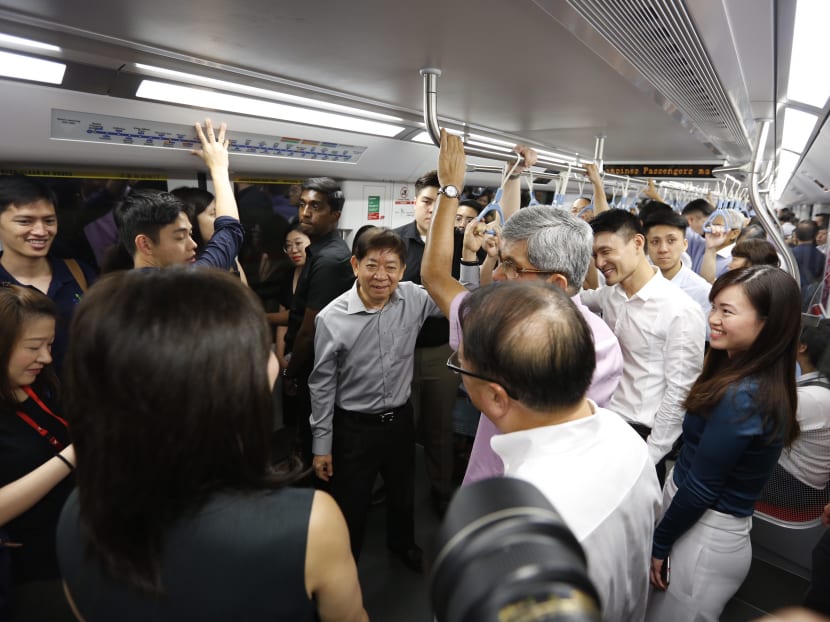
A review is underway to address additional fares incurred by commuters when they switch between MRT lines at different stations, Transport Minister Khaw Boon Wan said on Friday (Oct 20) at a ceremony marking the completion of the Downtown Line. Photo: Raj Nadarajan/TODAY

SINGAPORE — With the rail network getting denser, public transport fare rules will be reviewed to allow for transfers across MRT lines at different stations, said Transport Minister Khaw Boon Wan at the opening ceremony of the Downtown Line 3 (DTL3).
Some MRT stations on different lines are now close to one another and in some instances, commuters may save time by exiting one station and walking to another station to transfer to different line. The current fare structure does not provide for such transfers, except at Bukit Panjang, Newton and Tampines stations. Commuters will incur a second boarding charge at other stations.
For example, to travel from City Hall to Chinatown MRT Station, commuters could use the North South Line and transfer at Dhoby Ghaut to the North East Line. The 3km journey, by TODAY’s calculation, costs S$0.77.
An alternative route is to take the North South or East West Line to Raffles Place and exit the station for a five-minute walk to Telok Ayer station on the Downtown Line, one stop away from Chinatown. This 1.6km rail route costs S$1.54.
Mr Khaw said the Public Transport Council (PTC) will review distance-based fare transfer rules to ensure they continue to facilitate “fast, seamless” public transport journeys.
The review of distance-based fare rules on MRT lines is expected to be completed in the first quarter of next year. It is a separate exercise from the PTC’s annual fare review, which will be completed by the final quarter of this year.
Additional fares associated with bus-MRT or bus-bus transfers were removed in 2010 to make transfers more seamless.
Then-Transport Minister Raymond Lim told Parliament that the removal of the “transfer penalty” would create a fairer transport system, as all commuters would pay the same fare for the same distance travelled. “This way, commuters can choose the best way to reach their destination without having to worry about paying extra fare if they make a transfer,” he said then.
To have fairer fares for commuters exiting one MRT station and walking to a nearby station to change lines, analysts suggested factoring in time taken to travel and the distance between stations.
Singapore University of Social Sciences (SUSS) economist Walter Theseira suggested the authorities could consider commuters transiting between two stations in close proximity as making a transfer trip, instead of two separate trips.
Commuters should be given a reasonable amount of time to make the transfer by foot or bicycle.
“The reason to avoid double charging isn’t just for fairness. It’s also to ensure that commuters do not take inefficient routes where they add to crowding and congestion,” he said.
National University of Singapore transport researcher Lee Der-Horng proposed a transit window of 5 to 15 minutes to avoid abuse of the system. Senior citizens with a concession card could be given more time, said SUSS urban transport expert Park Byung Joon.
In his speech ahead of the Downtown Line’s start of operations on Saturday (Oct 21), Mr Khaw also said that the third phase of the Downtown Line will be a “game-changer” for residents in the East, as its second phase was for residents in the West. A Bedok Reservoir resident will be able to shave 25 minutes off an hour-long journey to Clarke Quay, for instance.
Mr Khaw said “many residents in Bukit Timah” switched to public transport with the opening of the DTL’s second phase – which consisted of 12 stations from Bukit Panjang to Rochor – in Dec 2015.
The construction of Downtown Line 3 – a 21km stretch from Fort Canning to Expo – was not without its difficulties. In fact, it was one of the biggest engineering challenges in Singapore, said Mr Khaw.
Land Transport Authority engineers had to use innovative diversion techniques to build a new rail line in a dense city. For instance, a new canal was constructed to divert the Singapore River to make space for the tunnels around Fort Canning Station, and stabilising material had to be placed in the river ahead of the tunneling works. The river was returned to its original position after the completion of these works.
Unlike older lines built to a depth of 15 to 20 metres, the Downtown Line was built deeper, at an average of 25 metres underground.
Noting upcoming rail projects such as the Thomson-East Cost Line and the Cross Island Line, Mr Khaw said the vision of a car-lite society would be “within our grasp” with the completion of these lines.
Over the past six years, the rail network had been expanded significantly, with new stations being added to the North-South Line and Circle Line, the opening of Tuas West Extension and the completion of the Downtown Line. The network grew by 30 per cent length-wise, with the addition of 41 new stations.
The total cost was a “very significant investment” of S$20.7 billion, said Mr Khaw.
Stay in the know. Anytime. Anywhere.

Subscribe to our newsletter for the top features, insights and must reads delivered straight to your inbox.
By clicking subscribe, I agree for my personal data to be used to send me TODAY newsletters, promotional offers and for research and analysis.