
Small pre-schools fight for survival in congested market
SINGAPORE — Faced with an expiring lease and soaring rentals, Gracefields Kindergarten principal Mrs Joyce Teo decided to move out of a Gilstead Road site her kindergarten had occupied for nine years, to a smaller centre in One Tree Hill last November, even though it meant having to cutting down her classes from 13 to four.
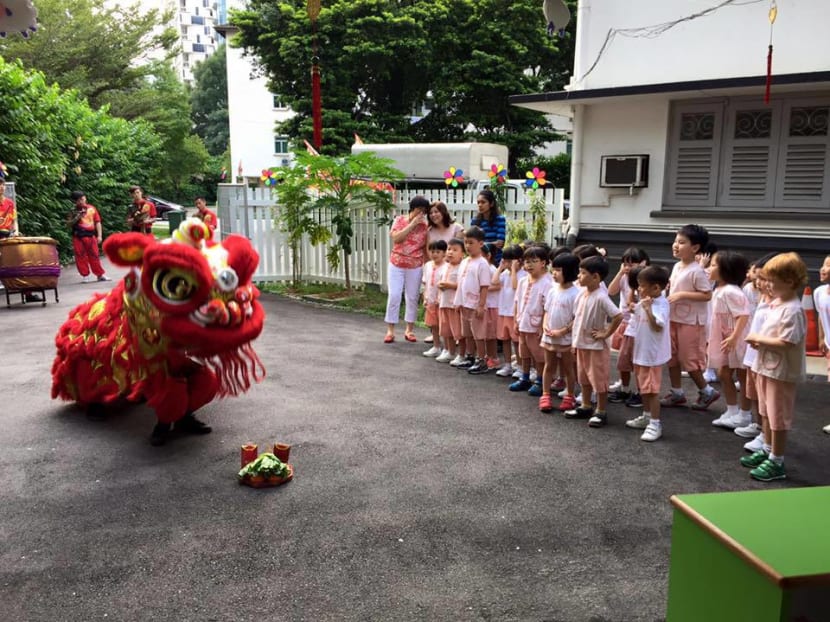
Children at Gracefields Kindergarten watching a Lion Dance show. Photo: Gracefields Kindergarten's Facebook page

SINGAPORE — Faced with an expiring lease and soaring rentals, Gracefields Kindergarten principal Mrs Joyce Teo decided to move out of a Gilstead Road site her kindergarten had occupied for nine years, to a smaller centre in One Tree Hill last November, even though it meant having to cutting down her classes from 13 to four.
Preferring a landed property with an outdoor space, she looked at 12 sites over a year before she managed to secure a new five year-lease for the school at One Tree Hill. Even then, Mrs Teo said the new lease is barely long enough to cover one complete four-year cycle from nursery to kindergarten.
“Children will have to keep on having to move … A lot of cost is involved – reinstating the place, then moving to another place and you’ve got do it again. It’s a lot of financial cost which is so unnecessary,” she said.
Gracefields is among the small private kindergarten operators that are fighting for their place in a market increasingly dominated by larger operators, some of which are funded by the Government under the Anchor Operator scheme (AOP) rolled out in 2009 and more recently, the Partner Operator scheme (POP) introduced last year.
Already facing long-running problems of controlling rising operating costs, some small players are worried that the addition of the POP scheme will further squeeze them out of the market — a pity when smaller players add to diversity with their niche programmes, said education experts.
Said Dr Christine Chen, president of the Association for Early Childhood Educators: “They are more able to differentiate learning and most importantly be able to provide a home away from home for the young children who still need the atmosphere of the home in the preschool,” she said.
Dr Theresa Lu, SIM University’s head of early childhood education programme, said: “Some of them focus on nature and outdoor learning, others on performing and visual arts, and some provide the niche environment to support inclusive programmes for children with special needs.”
One example is ArtsKidz Preschool, which has a strong arts element in its curriculum taught by teachers with specialised arts education. It started with 10 students from expatriate families in 2008, and now has two centres with about 180 to 200 children. Singaporeans now make up half the students enrolled and Ms Christina Koh, its managing director, attributed this to more local parents preferring holistic education beyond academics. She added: “The Government’s move to open mega preschools seems to counter their stance in supporting SMEs.”
Another example is Kits4Kids Kindergarten, which receives referrals for children with mild learning disabilities like dyslexia, language delays or behavioural issues. Principal Jessica Wang said teachers in pre-schools with larger classes may not be able to devote as much time to this group of children.
The AOP and POP schemes were launched in response to growing demand for quality, affordable childcare. They provide grants to large and mid-sized childcare operators, most of which also include kindergarten programmes, in exchange for keeping fees affordable.
The Early Childhood Development Agency (ECDA) works with the Housing and Development Board and Singapore Land Authority to set aside sites for preschool use, with some allocated to AOP operators. POP operators and private operators have to competitively bid for sites in a tender process, which was revised in 2013 to take into account quality and affordability of the programmes, aside from bid price.
Responding to queries on the concerns raised by the smaller kindergarten operators, an ECDA spokesperson said: “This change has reduced the rental paid by operators by about half, and provided parents greater assurance of affordable fees. Most of these sites can be used for up to nine years before they are re-tendered.”
But without subsidies or support, small private operators TODAY spoke to feel disadvantaged as they balance between offering affordable fees and meeting rising operating costs such as teachers’ salaries and higher rentals.
There is also the stress of constantly looking for future sites. When Lorna Whiston Preschool’s learned that its Raintree Cove centre in East Coast would have to make way for redevelopment next year, marketing and business development regional director Esther Wong said it took two years to find an alternative site in the east.
ArtsKidz’s Ms Koh also said she has to constantly keep an eye out for sites for potential expansion. “It’s because if I see a site that’s good and I don’t secure it now, I may not be able to secure a space some time down the road,” she said.
Dr Chen said that without government subsidies, pre-schools have to either to raise school fees to retain teachers with better remuneration packages, or lower school fees to increase enrolment.
Currently charging S$450 a month at Gracefields Kindergarten, Mrs Teo said she might have to raise fees to cover rising costs. “(Higher rentals) will tend translate into higher fees for sure, because the only type of income that kindergartens can get is school fees. (But) higher fees is not what early childhood should be charging,” she said. “I’m just happy to run a school, educate (children) and give them my best and … not go and fight with people (for land).”
Stay in the know. Anytime. Anywhere.

Subscribe to our newsletter for the top features, insights and must reads delivered straight to your inbox.
By clicking subscribe, I agree for my personal data to be used to send me TODAY newsletters, promotional offers and for research and analysis.






