
S’pore identity must go beyond material concerns: Chun Sing
SINGAPORE — Amid concerns over jobs in the current uncertain economic conditions, Minister in the Prime Minister’s Office Chan Chun Sing offered reassurances on the outlook while harking back to the spirit of the pioneer generation in urging Singaporeans to foster a national identity that goes beyond materialistic concerns.
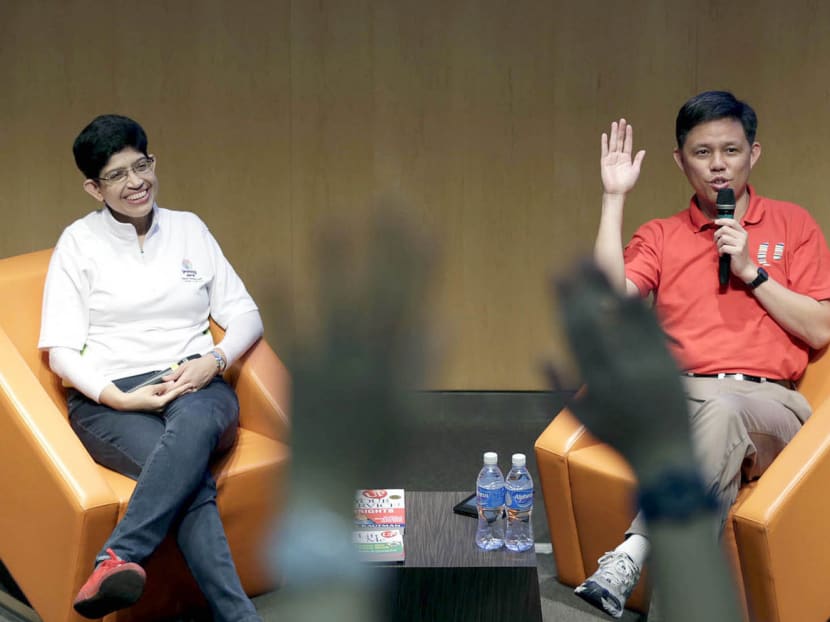
Minister Chan (right) and Assoc Prof Fatimah Lateef at the Lifelong Learning Institute, with the former reassuring participants that there is no lack of jobs here. Photo: Wee Teck Hian

SINGAPORE — Amid concerns over jobs in the current uncertain economic conditions, Minister in the Prime Minister’s Office Chan Chun Sing offered reassurances on the outlook while harking back to the spirit of the pioneer generation in urging Singaporeans to foster a national identity that goes beyond materialistic concerns.
Whether the Republic makes it to SG100 depends on Singaporeans’ reasons for staying put “even when the chips are down”, he added, addressing about 200 youth aged between 18 and 35 at a dialogue after a ministerial community visit to Geylang Serai.
“Is your staying in Singapore conditional on certain factors, particularly material or otherwise? Is it contingent — I will stay in Singapore if the following conditions are met; if the following conditions are not met, I won’t stay in Singapore,” he asked. “(What if) somebody else can give you better, cheaper, cost of living? ... If for the next 10 years, we have a serious recession and (it becomes) very difficult to find jobs, you cannot fulfil your aspirations, you cannot find the jobs that you like, will you still stay here?”
Noting that this form of national identity is one that is “transactional”, he compared it to the 1965 generation who had nothing but chose to make Singapore their home nonetheless. “That’s the difference between a real sense of national identity and one that is contingent on all these factors,” he added.
Mr Chan, who is also labour chief, also told the dialogue participants at the Lifelong Learning Institute that he has observed shorter taxi queues on Orchard Road, with those in line carrying fewer shopping bags. While these phenomena point to a changing economy, the minister reassured participants that there is no lack of jobs in Singapore. Rather, the issue at hand lies in matching available jobs with people’s aspirations.
The challenge is in retraining, said Mr Chan, who added that Singaporeans need to acquire skills to take on the jobs of tomorrow.
“But you shouldn’t be downcast because compared to the 1965 generation, you have much more resources at your disposal to overcome these challenges,” he stressed. “The question is not whether you can overcome these challenges — you should be confident — the question is how do we overcome these challenges together as a society.”
When participants raised the topic of welfare for the needy, Mr Chan said he agreed that more help should be given to those with less. But executing this properly could be tricky, he added, since it hinges on whether individuals think that they are entitled to get as much help as they can from the State, or if there is an understanding that some people get more because they really need it more.
Singapore’s cohesiveness depends on which mindset Singaporeans have, he said.
“If every one of us wants to take the maximum for ourselves, because we believe we are entitled to it, then we have a challenge. No matter how much resources we have, it will never be enough,” he added.
While many countries define their national identity through a “backward-looking concept”, such as by their history, race, language and religion, Mr Chan said the Singapore identity can be complemented with a “forward-looking sense of identity” as well.
This includes defining the Singapore identity through ideals such as meritocracy and multi-racialism that can unite people from diverse backgrounds to build a common future.
On how the Government can help youths better understand the rationale behind unpopular policies, Mr Chan said there are many platforms for the authorities to share the thinking behind policies. But the youths also need to be aware of events that are happening outside Singapore, be able to analyse and apply those situations and think about the available alternatives, he noted.
The dialogue capped off various stops he made in Geylang Serai, as part of the first ministerial community visit in this new term of Government. Mr Chan visited the Haig Road Food Centre, Paya Lebar MRT Station and had a closed-door discussion with some religious leaders at the Khadijah Mosque.
Stay in the know. Anytime. Anywhere.

Subscribe to our newsletter for the top features, insights and must reads delivered straight to your inbox.
By clicking subscribe, I agree for my personal data to be used to send me TODAY newsletters, promotional offers and for research and analysis.