
South China Sea tensions ‘have impacted investor confidence’: PM Lee
VIENTIANE — Tensions in the South China Sea have an intangible effect on the investment climate in the region, said Prime Minister Lee Hsien Loong on Thursday (Sept 8), as he called on all parties to work together and mitigate the risks of conflict.
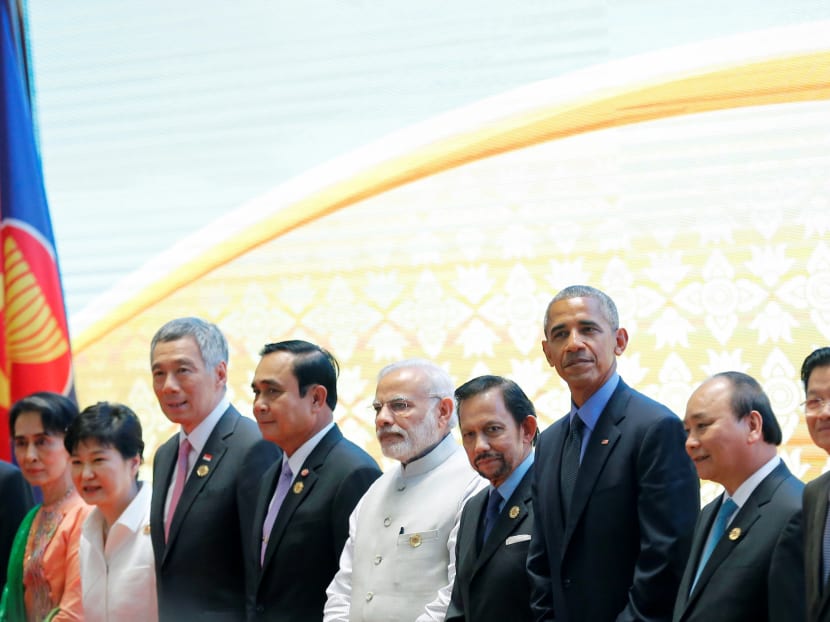
(L to R) Myanmar's State Counsellor Aung San Suu Kyi, South Korea's President Park Geun-hye, Singapore's Prime Minister Lee Hsien Loong, Thailand's Prime Minister General Prayut Chan-o-cha, Indian Prime Minister Narendra Modi, Brunei's Sultan Hassanal Bolkiah, U.S. President Barack Obama, Vietnam's Prime Minister Nguyen Xuan Phuc, Laos Prime Minister Thongloun Sisoulith and China's Premier Li Keqiang pose for photo before East Asia Summit in Vientiane, Laos September 8, 2016. Photo: Reuters

VIENTIANE — Tensions in the South China Sea have an intangible effect on the investment climate in the region, said Prime Minister Lee Hsien Loong on Thursday (Sept 8), as he called on all parties to work together and mitigate the risks of conflict.
Speaking to Singapore media in Vientiane as he wrapped up a three-day visit to attend the Association of South-east Asian Nations (Asean) Summits and related Summits, Mr Lee noted that the situation in the disputed waterway has affected the “atmosphere of peace and calm and confidence in the region”.
He added that the region has prospered because of peaceful cooperation among countries in deepening their inter-dependence on trade and investments. “Even Premier Li Keqiang said that China needs a peaceful and stable environment because China is a developing country,” said Mr Lee.
“I think when you have tensions in the South China Sea, there is an impact when people make decisions on investments” he added, noting that although investors will not say publicly that it is a decisive factor, it will be one of the things that affect their decisions.
This week, Asean and China agreed to several confidence-building measures, as they aimed to dial down tensions which some have blamed on Beijing’s assertive actions in the maritime domain.
Mr Lee cautioned that if the situation deteriorates and there are mishaps on the ground, temperatures would go up further and then “confidence will really be shaken and you would have a big problem”.
“So it’s one of those situations where you don’t feel that it (the situation) is good, but neither can you say I can count how many dollars it has cost me. It is a minus for me, I know it, and we really should mitigate that risk as much as we can.”
Mr Lee added that differences in perspectives on the South China Sea cannot be easily overcome, because they are fundamental to the strategic situations that the countries are in.
“These are realities of international relations, and we have to navigate and find our position, find our way through such an unpredictable world.”
China claims almost the entire South China Sea, through which more than US$5 trillion (S$6.7 trillion) in shipborne trade passes every year. Brunei, Malaysia, the Philippines, Taiwan and Vietnam also have claims in the sea, believed to be rich in energy deposits.
An arbitration court in The Hague ruled on July 12 that China had no historic title over the busy waterway and had breached the Philippines’ sovereign rights there. The decision infuriated Beijing, which dismissed the court’s authority to rule on the matter.
During the Asean-China Summit on Wednesday, both sides announced that they will set up a communications protocol for unplanned encounters in the South China Sea as well as a hotline among the foreign ministries to respond to maritime emergencies.
The Chinese government had also said earlier it would formulate a legally binding framework on the code of conduct in the South China Sea by the first half of next year.
During the summits this week, Mr Lee had said that while it is understandable for Asean members to have different positions on the issue, the grouping needs to stand united on several principles, including commitment to the maintenance of peace and stability, freedom of navigation, and resolving disputes peacefully in accordance with international law.
He also cautioned that the emergence of three new trends in terrorism — namely a rise in cases of self-radicalisation, growing links between terrorist groups and a spike in the number of attacks — mean that there is a greater need for the regional partners to work more closely to tackle the issue.
When asked by reporters on Thursday if new tools are required to counter new terrorist threats in the region, Mr Lee said that “there are no magic solutions”.
“The solutions all require hard work, and none of them are foolproof — you have to deal with it operationally, that means you find out who the potential terrorists are, intercept them and try and catch them before some damage is done.”
He added that the problems have to be dealt with at the ideological level by targeting terrorists’ “perverted ideology”.
“You have got to also do it at a broader social, community level to make sure within the community you have good mutual trust and understanding and there is no reason for people to feel marginalised, dispossessed, disenfranchised and therefore to be inclined towards crazy drastic solutions.”
The Prime Minister departed Laos for Singapore Thursday afternoon.
Stay in the know. Anytime. Anywhere.

Subscribe to our newsletter for the top features, insights and must reads delivered straight to your inbox.
By clicking subscribe, I agree for my personal data to be used to send me TODAY newsletters, promotional offers and for research and analysis.