
Terrorism threat has crystallised, said PM Lee before attack
SINGAPORE — The terrorism threat facing Singapore and the region is now more acute than ever because radicalised individuals are no longer operating under an amorphous idea, but have somewhere they can physically visit — Syria — to aid extremists’ cause, said Prime Minister Lee Hsien Loong, in an interview he gave to The Australian newspaper last Friday (Nov 13), before the Paris attacks.
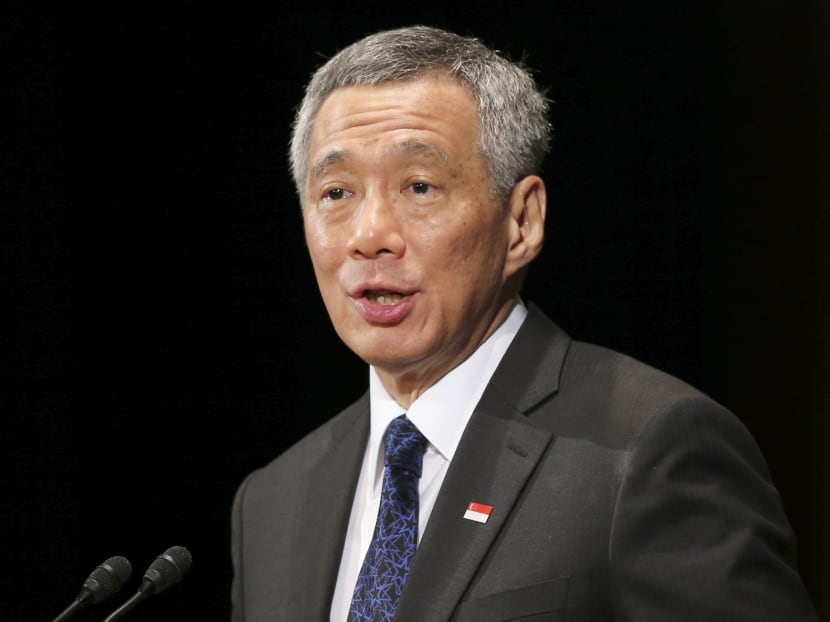
PM Lee Hsien Loong. AP photo

SINGAPORE — The terrorism threat facing Singapore and the region is now more acute than ever because radicalised individuals are no longer operating under an amorphous idea, but have somewhere they can physically visit — Syria — to aid extremists’ cause, said Prime Minister Lee Hsien Loong, in an interview he gave to The Australian newspaper last Friday (Nov 13), before the Paris attacks.
This is a “very serious” problem because the hundreds of people from South-east Asia, including Singapore and its neighbours, who try to go to Syria comprise not only random individuals, said Mr Lee, but also military personnel, in some cases.
“It is the latest incarnation of the (terrorism) problem. It has been there with us since before 9/11, but in this form, it has crystallised, it has got territory, it has got a place you can actually physically go to.
“It is not just an amorphous idea and people get seduced and led astray and actually go and do this,” Mr Lee said, during the interview by Mr Greg Sheridan at the Istana.
Singapore has seen the effects of this development, said the Prime Minister, who noted that a few from the Republic are in Syria while the local authorities have stopped close to a dozen others who tried to go there.
Mr Lee also revealed that at the start of this month, two persons en route to Turkey and Syria by sea from Indonesia had been sent back when they tried to enter Singapore.
But stopping people from going to Syria is not enough. Mr Lee noted that there are parts of Indonesia which are remote from centres of government, where Islamic State base camps can be set up and become “another focal point which can attract activists to go to as a kind of Mecca”.
Terrorists who have been put behind bars in Indonesia can also continue to pose problems, he added, because they can “do spectacular things such as hold press conferences and certain ceremonies to pledge allegiance to ISIS”.
Even when these terrorists are released from prison — and several hundred of them finish their terms this year and next year — it is “not at all clear that they are less dangerous now than they used to be”, said Mr Lee.
Asked about the challenges in heading off religious extremism, Mr Lee said the problem lies with the fact that the ideology is not purely religion and yet is not unrelated to “a certain warped view of religion”.
He said: “Some people genuinely persuade themselves that this is the way to Heaven and so they pursue this perverted path.
“Others know very little about religion or doctrine. Something has gone with their life and this is their way to hit out at the world or at their society.”
There are also young people who, after stumbling across such ideology, get misled deeper and deeper in until it becomes almost too late to turn them around. “We have picked up students who are like that.
“They are in school and they did not have a network. It is not that they had radical friends but somehow they became interested in this and it was lucky that we discovered them,” said Mr Lee.
Some of those who had bought into extremist ideology become “pretty hardcore”, he said.
Singapore has detained about 70 individuals since the Jemaah Islamiyah terror plot against several targets here in 2001 and about three-quarters have been released.
“Most of them have stayed clean, one has relapsed so far.
“There are a few, whom I do not know how we will ever release them, or how we will release them for a very long time because they are very hardcore,” he added.
Stay in the know. Anytime. Anywhere.

Subscribe to our newsletter for the top features, insights and must reads delivered straight to your inbox.
By clicking subscribe, I agree for my personal data to be used to send me TODAY newsletters, promotional offers and for research and analysis.






