
Thai teen’s appeal in lawsuit against SMRT, LTA dismissed
SINGAPORE — Her bid to claim S$3.4 million from train operator SMRT and the Land Transport Authority (LTA) was dismissed by the highest court of the land today (Oct 1), but Thai teenager Nitcharee Peneakchanasak, who lost both legs after falling onto train tracks over three years ago, remained stoic and expressed relief at closing the final chapter of the episode.
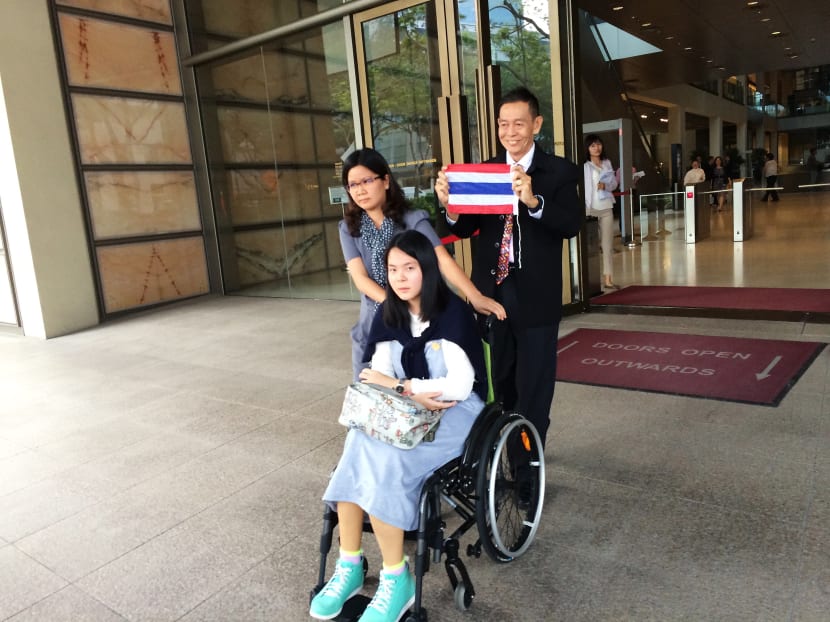
Ms Nitcharee, 18, with her father Kittanesh and an interpreter after her appeal. Photo: Neo Chai Chin

SINGAPORE — Her bid to claim S$3.4 million from train operator SMRT and the Land Transport Authority (LTA) was dismissed by the highest court of the land today (Oct 1), but Thai teenager Nitcharee Peneakchanasak, who lost both legs after falling onto train tracks over three years ago, remained stoic and expressed relief at closing the final chapter of the episode.
Speaking to reporters alongside her father Kittanesh after her appeal against a failed lawsuit against SMRT and the LTA, Ms Nitcharee, 18, said through an interpreter that she felt “a bit of relief” after long years of anxiety and worry. She said she would return home, study hard and learn more about the law.
Ms Nitcharee was hit by an oncoming train after she fell onto the train tracks at Ang Mo Kio MRT station on April 3, 2011, while on a visit here. One of her legs was severed and the other amputated. Train operator SMRT offered her father S$15,000 out of goodwill after the incident, and the family also received donations from the public inspired by her positive spirit.
In June 2011, her father sued SMRT for S$3.4 million to cover the cost of prosthetic legs she would need in her lifetime. The LTA was later added as a party in the lawsuit.
Today, SMRT and LTA’s lawyer K Anparasan said his clients will not be pursuing costs out of “compassion, sympathy and goodwill”. Acknowledging that it may be cold comfort to Ms Nitcharee and her parents, Mr Anparasan said this was the best his clients could do.
In dismissing Ms Nitcharee’s appeal, Chief Justice Sundaresh Menon — who heard the appeal with Judges of Appeal Chao Hick Tin and Andrew Phang — agreed with the ruling of trial judge Vinodh Coomaraswamy, that the failure to provide platform screen doors at Ang Mo Kio MRT station when the accident occurred was not a breach of standard of care. The installation of platform screen doors at above-ground stations was completed in March 2012.
The trial judge had found that SMRT and the LTA were not negligent as the safety features in place when Ms Nitcharee fell onto the tracks were sufficient to keep the MRT station reasonably safe.
Ms Nitcharee’s lawyer Peter Low had argued that SMRT and the LTA knew of the risk of people falling onto the train tracks, with 30 cases of track intrusions between 2004 and 2010 where a commuter is on the tracks the same time as an oncoming train. It did not matter if the falls were intentional or unintentional; the entities should have done more, he said.
But CJ Menon said there was a need to distinguish between the risk of unintentional and intentional track intrusions.
He noted that 87 per cent of track intrusions between 1998 and 2008 were intentional. Based on this statistic, it would make about three of the 30 cases cited by Mr Low unintentional track intrusions, he said. And of these, the risk of a wholly spontaneous collapse not involving crowds or pushing by others — as in the case of Ms Nitcharee — may be even more limited, although data was not available, CJ Menon added.
Her case was undoubtedly tragic but, as noted by Justice Coomaraswamy, the law of negligence awards compensation based on a defendant’s culpability and not simply because a plaintiff has suffered harm, he said.
Justice Phang also said that the approach taken by Mr Low was “too blanket” and un-nuanced. The law does not impose the elimination of risk, but a reasonable standard of care, he said.
Stay in the know. Anytime. Anywhere.

Subscribe to our newsletter for the top features, insights and must reads delivered straight to your inbox.
By clicking subscribe, I agree for my personal data to be used to send me TODAY newsletters, promotional offers and for research and analysis.






